Screens For The Poor, Human Connection For The Rich – Even In Healthcare?
Not so long ago, worries about the digital divide represented the anxiety that the rich will have access to more information and more possibilities in every area of life compared to those who cannot afford connected digital devices. Currently, trends show that human connection might become a luxury good for the rich, while poor families might not be able to afford living screen-free in the future. We asked how would that translate into healthcare and what could we do to ensure the treasure of human contact to everyone in the coming decades.

11 min | · Updated
|
THIS ARTICLE HAS NOT BEEN UPDATED SINCE 2019. THE INFORMATION SHARED IN THE ARTICLE WAS ACCURATE AT THE TIME OF ITS PUBLICATION, BUT IT MAY BE OUT OF DATE NOW. BROWSE OUR LATEST ARTICLES HERE |
Not so long ago, worries about the digital divide represented the anxiety that the rich will have access to more information and more possibilities in every area of life compared to those who cannot afford connected digital devices. Currently, trends show that human connection might become a luxury good for the rich, while poor families might not be able to afford to live screen-free in the future. We asked how would that translate into healthcare and what could we do to ensure the treasure of human contact to everyone in the coming decades.
Is digital detox becoming a luxury good?
Although the techno-dystopian sci-fi series’, Black Mirror’s season 5 did not meet fans’ high expectations, the Smithereens episode merits attention, especially because it contains a situation resembling too well the current attitude and position of the haves and have-nots towards technology. While the CEO of an imagined social media network, Smithereen, is on a 10-day-long retreat in the mountains without access to screens or technology, Chris, the main protagonist, a kind of Uber driver, kidnaps an intern of Smithereen out of unprocessed grief for her fiancée who was killed in a car accident. He feels guilty and feels responsible for what happened: he couldn’t take down his phone while driving and was checking a Smithereen notification on his phone when the incident took place.
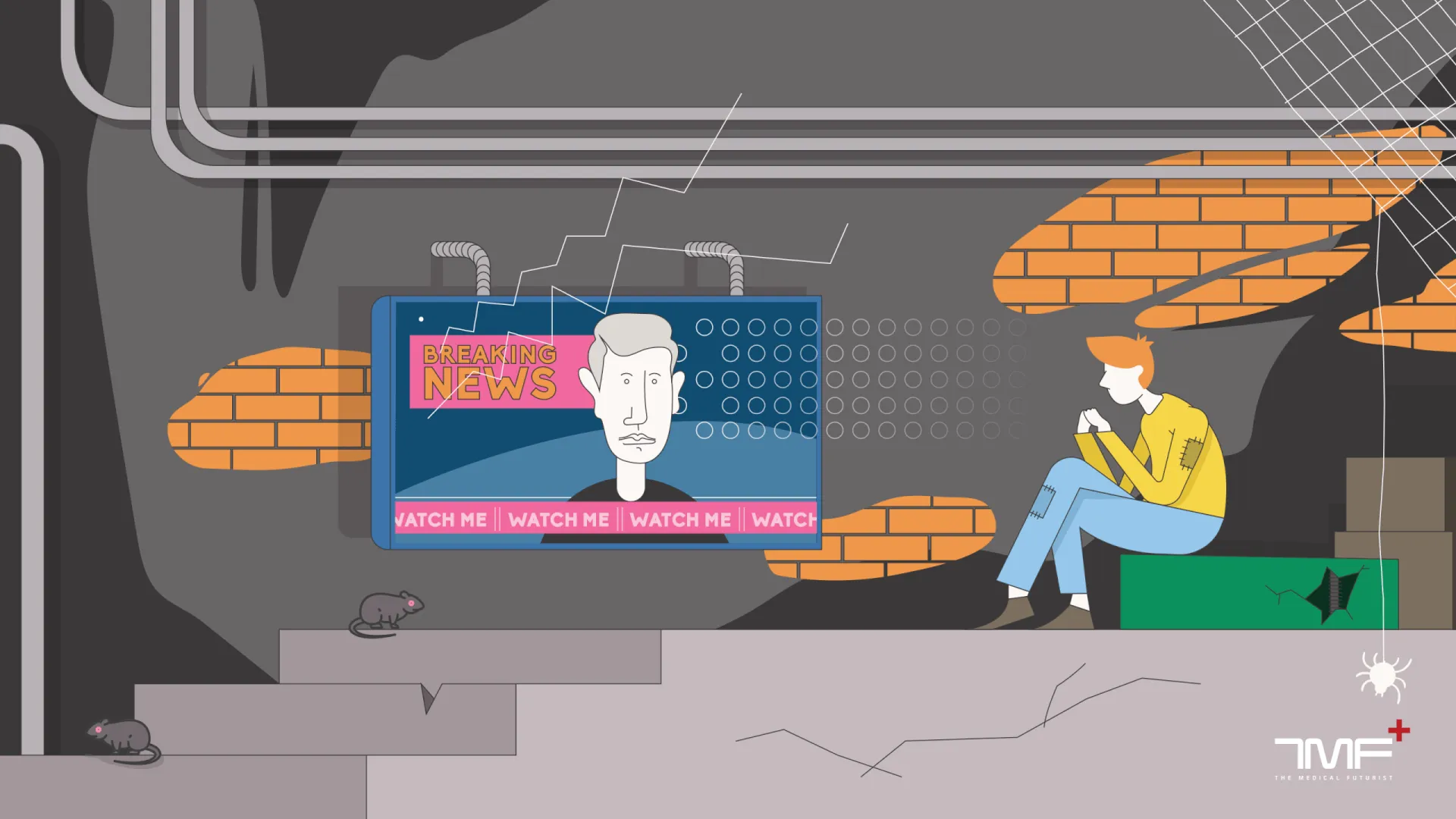
The contrast is becoming part of our everyday lives that the leader of a tech company has the means, the access, or the willingness to go on digital detox, while screens encircle average middle- or low-income people in the attention economy with little option to opt-out as the products are “free” or much cheaper than otherwise. Celebrities in Hollywood, such as Selena Gomez or Steven Spielberg, at some point not long ago, said that they would take a break from screens, and Ed Sheeran joined their club saying he wants to see the world through his own eyes, not screens. Techies in Silicon Valley are also joining their ranks by going to digital detox camps and advocating for less and less screen time.
Moreover, Bill Gates already implemented a cap on screen time for his daughter already back in 2007 – as he saw that the teenager was developing an unhealthy attachment to a video game. Thus, Silicon Valley elites and the haves are limiting their own screen time and that of their children, while average workers and students have more and more screens around them with fewer and fewer options to opt-out. How did we end up here and what could the future bring?
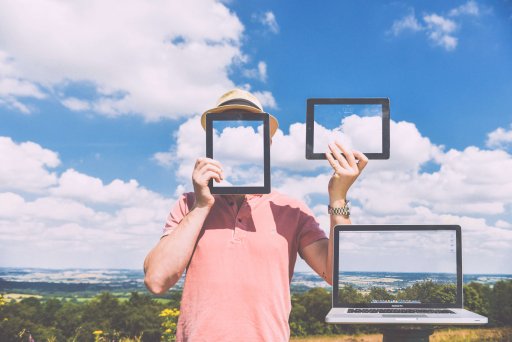
From paying line-standers for new smartphones to locking screens
Do you remember when the first iPhone came out? Well, neither do we. It was already more than a decade ago, but we do remember the news that after a while, people lined up in long lines, sometimes with tents, in front of the Apple stores just to get it – and the more affluent even paid people to stand in line for them. Having a smartphone alongside a high-tech laptop or personal computer at home has been considered for long as having a luxury good and having a higher social status. However, with the drop in the prices as well as the wide prevalence and the studies about the potentially harmful physiological and psychological effects of increased screen time, that status decreased significantly over the years. As The New York Times notes in its excellent article, the first Apple Mac shipped in 1984 and cost about 2,500 dollars (in today’s dollars, $6,000). Now the very best Chromebook laptop, according to Wirecutter, costs 470 dollars.
The drop in price also means that in more and more cases, it is cheaper or more convenient to have a screen for a task than an employee. And of course, screens started to take over very human duties, too. For example, on every single flight, the cabin crew had the task to show passengers what to do in emergency situations. Usually, no one pays attention to it, and it must not be a very well-received task on the part of the flight attendants either. Lately, more and more airline switched to screens to show the sequence of how to use the oxygen mask. Screens appeared in fast food restaurant chains to order food even faster than before, you run in front of screens in the gym, have them in the metro stations, and meet them even in schools or the doctor’s office.

The prevalence of screen-based education, especially in middle- and low-income communities in the U.S. started to take on a huge extent and the trend shows no slowing down. For example, Utah has been rolling out a state-funded online-only preschool, now serving around 10,000 children. Organizers announced that the screen-based preschool effort would expand in 2019 with a federal grant to Wyoming, North Dakota, South Dakota, Idaho, and Montana. At the same time, the leaders of Silicon Valley companies and the parents in affluent neighborhoods are going back to preschools with limited or no screen time, but wooden toys and playgroups.
Research by Common Sense Media, a nonprofit media watchdog already shows that lower-income teenagers spend an average of eight hours and seven minutes a day using screens for entertainment, while higher income peers spend five hours and 42 minutes. That trend shows that children of poorer and middle-class parents might be raised by screens in the future, while the children of Silicon Valley’s elite might be going back to the luxury of human interaction. That’s worrying because research shows that the brain of children who spend a lot of time in front of screens develops differently. In addition, some worry about increased depression rates, others link it to less developed social skills.
What about healthcare?
Due to the serious shortage in medical professionals worldwide, the high costs of healthcare services, as well as the physical and psychological burden of care professions on providers, digital technology and screens will be expected to have a much bigger role in healthcare in the future. But should we expect a similar gap to open between the haves and the have nots when it comes to medical issues?
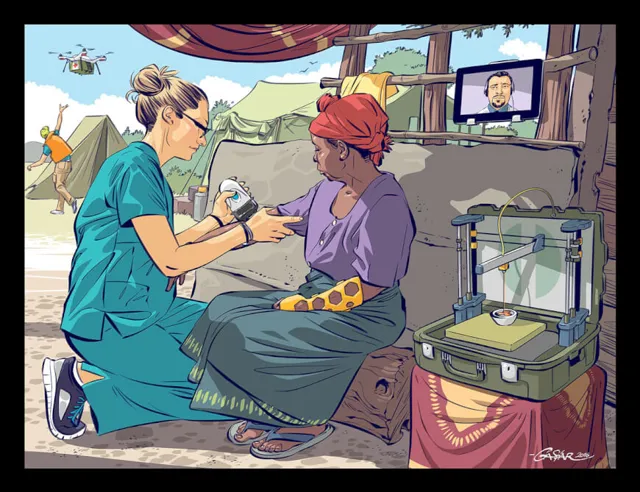
Unfortunately, the response in some cases is yes. Consider the development of health apps, symptom checkers, or chatbots. Based on artificial intelligence coupled with common medical knowledge, these tools could be of tremendous help to both medical professionals and patients. They could help self-diagnose in simple cases and thus, patients won’t need to spend time at the doctor’s office. With the help of connected devices, wearables, and sensors, patients have the chance to manage their conditions in a much easier and more efficient way. Telemedical services enable communities without appropriate specialists or in remote corners of the world to have medical advice and don’t need to travel long distances.
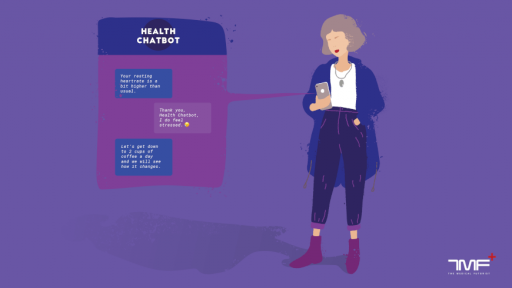
How does the widening gap in screen time translate into healthcare?
As a consequence, health chatbots, symptom checker apps, and other A.I.-based healthcare apps are expected to spread out more in the future and they have the reasonable promise to become the first line in primary care. Patients will most likely consult their symptom checkers and later on, their chatbots, about their symptoms first, and they will be referred to a human doctor only in case they have more serious issues. A medical visit might become more costly in the future, and those with lower incomes might not be able to afford this form of human contact.
Telemedicine and remote consultation could also be a more frequently used option for middle- and low-income patients than personal medical visits, especially in specialties such as psychology or psychiatry that don’t necessitate the patient to physically be at the place of the treatment. Coupled with mental health apps, the have nots might experience in the future that their psychological problems are taken care of by screens rather than humans.
In elderly care, the appearance of social companion robots, as well as virtual digital assistants, are also expected – so that inhabitants of care homes don’t feel alone. While it’s not the same as having a human around all day long, it is much much better than having the feeling of being left behind and not taken care of.
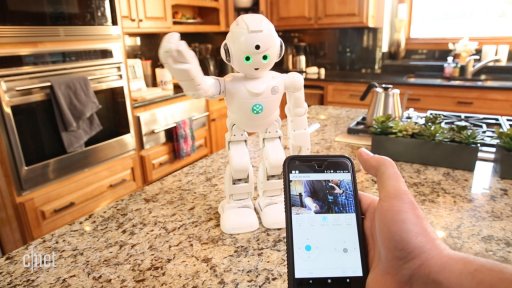
How could this trend appear globally?
A difference might also evolve between developing and developed countries when it comes to the divide between people who will have the luxury of a human doctor and the ones who will have to settle for screens and virtual aids. While in developed countries there might be a widening gap between the haves and have-nots when it comes to real or virtual healthcare services, in developing countries, the choice might be more straightforward: virtual healthcare services or no medical care at all.
As it is painfully visible, for example in the case of Africa, many corners of the continent lack the infrastructure to provide even basic health care to many of its people. There are hardly any doctors or nurses, only a handful of good hospitals and appropriate hospital beds; there is a lack of medical devices. One of the poorest countries in the world, Mozambique, has just 548 doctors for a population of more than 22 million. It is even more difficult to speak about specialists. The Nigerian Medical Association (NMA) estimates there are about 25 consultant oncologists to approximately 160 million Nigerians, while there is only one pathologist for every 700,000 patient in Sudan. In Uganda, the job is basically non-existent: statistics enumerate 1,555,000 patients per pathologist.
Under such circumstances coupled with the incredible speed of mobile penetration – by 2020, there will be more than 700m smartphone connections in Africa – the appearance of health apps, symptom checkers, telemedical services, seem to be inevitable and badly needed. Around 27,000 government health workers in Uganda use a mobile health system called mTRAC to report on medicine stocks across the country. Mobile healthcare solutions such as Kenya’s Miti Health and Ghana’s mPedigree are helping to improve the drug supply chain by validating prescriptions and over-the-counter drugs. UK-based Babylon Health established a feature phone-based health service in Rwanda, which they are expanding across the entire country.
What these developments mean is that some developing countries could become entirely “addicted” to screens and technology as they won’t get necessary services otherwise. That might not only happen in healthcare but also regarding education or public administration. So what would happen to African kids’ brains playing on tablets all day long in school and then going home to the shanty towns? Do Western technology developers who bring their high-tech digital screens to Africa have a response to this question? How should we proceed in the future to have the advantages of these technologies and mitigate their dark sides?
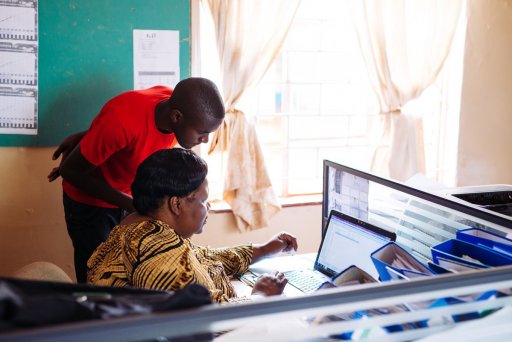
The future of healthcare will become largely screen-based in the future due to many factors, such as global doctor shortages, rising population numbers and civilizational diseases, the prevalence of digital technologies, and the rising costs of healthcare. Screens that connect us to the information superhighway are bridges that could lead to positive or negative outcomes – depending on the users, on us. Thus, our task is to start to deal with technologies more consciously and learn where the place of screens and technologies could be in our life. That’s incredibly difficult, especially because tech developers and other big players of the attention economy have contrasting interests. They want everyone to spend as much time in front of screens as possible, but we should go against those interests and strengthen the voices which advocate humane technology development.
We entirely support efforts to place back the real needs of humans in the center when it comes to screens and to figure out where we could find a healthy space for screens, while not widening the divide in society further but doing what social media platforms promise to do: connecting communities in meaningful ways.
|
At The Medical Futurist, we are building a community for making a bold vision about the future of healthcare reality today. If you’d like to support this mission, we invite you to join The Medical Futurist Patreon Community. A community of empowered patients, future-oriented healthcare professionals, concerned health policymakers, sensible health tech developers, and enthusiastic medical students. If there were ever a time to join us, it is now. Every contribution, however big or small, powers our research and sustains our future. Click here to support The Medical Futurist from as little as $3 – it only takes a minute. Thank you. |