Cognitive Behavioral Therapy For Better Sleep? – The Dreem 2 Headband Review
Sleep quality tracking and improvement through heart rate, brainwaves, and movement in bed: these are the features that the Dreem 2 sleep tracking headband promises to its users alongside with sleep lab quality data and measurements. As their pledge sounded tempting, we put on the headband and jumped into bed to test it. Here’s our verdict: the Dreem headband review.

10 min | · Updated

|
THIS ARTICLE HAS NOT BEEN UPDATED SINCE 2019. THE INFORMATION SHARED IN THE ARTICLE WAS ACCURATE AT THE TIME OF ITS PUBLICATION, BUT IT MAY BE OUT OF DATE NOW. BROWSE OUR LATEST ARTICLES HERE |
Sleep quality tracking and improvement through heart rate, cognitive behavioral therapy, and movement in bed: these are the features that the Dreem 2 sleep tracking headband promises to its users alongside with sleep lab quality data and measurements. As their pledge sounded tempting, we put on the headband and jumped into bed to test it. Here’s our verdict: the Dreem 2 headband review.
Sleep tracking headbands on the scene
The Medical Futurist team gets a kick out of sleep tracking, so we tested several apps and around 20 devices, such as the Viatom O2 Sleep Monitor or the Live by Earlysense. We have also written guidelines to help you kickstart a sleep tracker path or how to analyze your sleep quality. Thus, we are familiar with the fact that sleep sensors take various shapes: they can look like plates put under the mattress (Live by Earlysense, Beddit), wristbands – usually also used as fitness trackers (Fitbit Ionic, Misfit Shine), rings (Viatom O2 Sleep Monitor, SleepOn), and headbands.
However, we have mixed feelings about the latter, as our first experience with the SmartSleep headband from Philips, was not particularly convincing. It leaves the wearer to rest only on their back, it has a green blinking light (which eventually switches off), and a design that makes you never forget that you are wearing it. Moreover, the company left out the Holy Grail of sleep tracking – smart sleep alarm -, so when Paris-based company, Dreem, offered the team to test their sleep tracking and sleep-enhancing headband, we were skeptical. In the end, our curiosity outweighed our frustrations with headbands, but as we truly wanted to be impartial, we searched for a tester with sleep problems – someone who truly needs help – and someone who had never tried a headband.
After some weeks of searching, we found the perfect tester for it. He’s a 41-year-old data scientist with a stressful job who has been having sleeping problems for 6-7 years already. He is a regular smoker with irregular bedtimes; a habitual snorer, who usually falls asleep watching movies and wakes up easily even to soft noises like a honking car far away in the street or a flushing toilet in another room. Consequently, he regularly wakes up tired in the morning, thus being in that one-third of the global population that sleeps poorly. As the Dreem 2 headband promises that the user will need less time to fall asleep and less waking up during the night, we were eager to get to know how the device can help our sleep-troubled tester.

From pink noise to sweet dreams
Dreem was founded in 2014 when Hugo Mercier and Quentin Soulet de Brugière studying applied mathematics and computer science as a student at Paris’s Ecole Polytechnique. They were fascinated by the brain and soon began to collaborate with neuroscientists to see if auditory stimulation during deep sleep could enhance memory consolidation. Since then, they established a company with offices in Paris, New York, and investors such as Johnson & Johnson or BPI invested in the headband with great promises in sleep improvement.
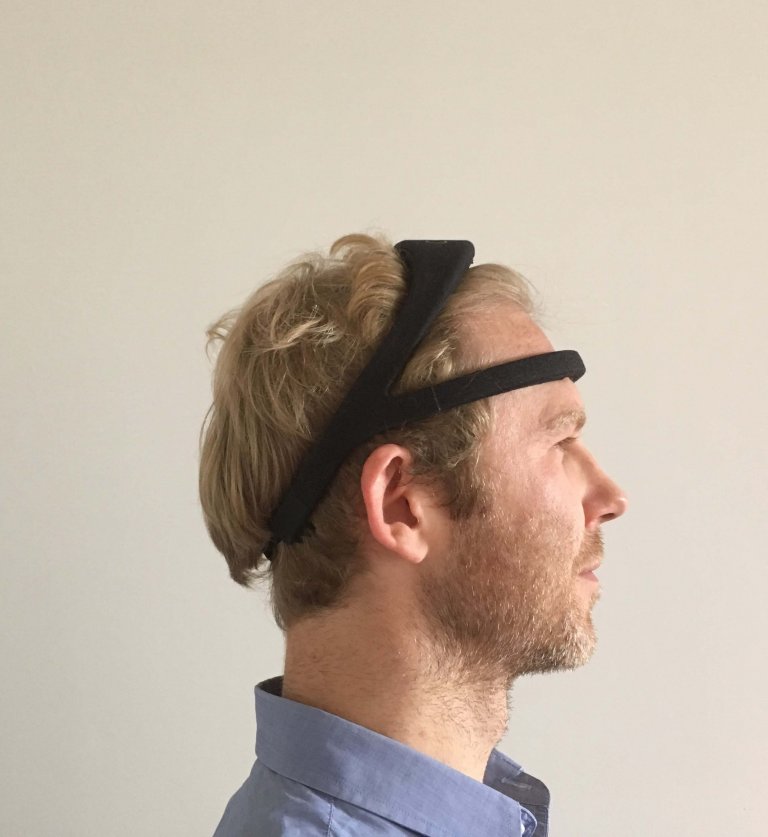
Working with an advisory board that includes sleep experts from Stanford and Oxford Universities, Dreem measures brain activity with dry polymer EEG electrodes, before analyzing this information on an internal CPU. Micro-vibrations transmit “pink noise” directly to the inner ear, improving slow-wave sleep, which could be translated into everyday language as deep sleep. Pink noise, as opposed to flat frequency white noise, is the noise of a density most often found in nature – like in whale songs. However, we have to note that due to its specific FDA-registration, the deep sleep stimulation feature doesn’t work in the U.S.
Moreover, the headband promises to get you to sleep earlier, to give an accurate overview of your sleep and to wake you up at the right moment with its smart alarm. Now, let’s see how well the Dreem 2 can deliver on these pledges.
Let’s get this party started: unboxing and design issues
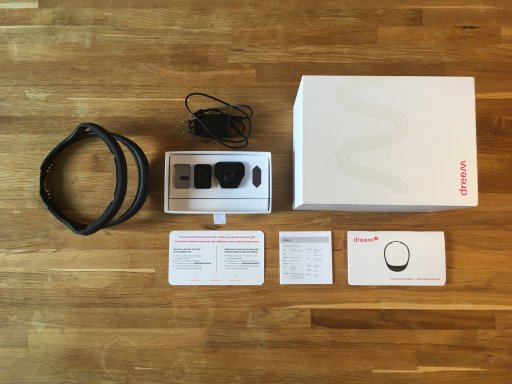
When the box arrived, it contained the Dreem 2 headband, 3 band size adjusters, various power supply adaptors, a USB charging cable, and quick start guides. The latter was easy to digest and thus starting up the headband did not require any skills in nuclear physics.
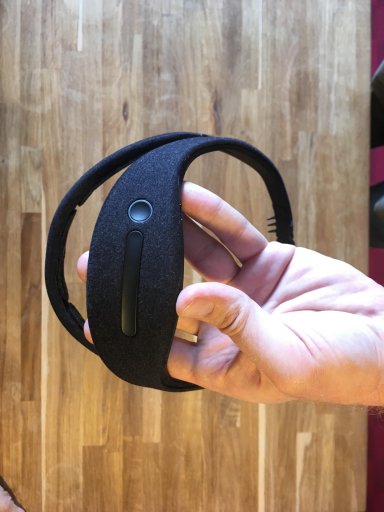
Our tester said that with the 3 band size adjusters, the headband itself is flexibly adjustable to any head size. In addition, the sensory board is coated with a textile-like, hypoallergenic material, and while the headband contains sensors on the front and the back, pulse oximeter, sonometer, and accelerometer, they don’t make it heavy. Moreover, the entire device is assembled in very high quality, and these all make it very comfortable to wear. The entire headband has a real good ergonomic shape, and it stays on throughout the whole night – no matter how much the user tosses and tumbles in bed. That’s important as one of the aims of the Dreem is to track sleep position.
When you charge the device, it can last for almost two nights – it’s Murphy’s law that the gadget goes dead exactly before the end of the second night, so our tester recommended charging it every day and suggested to the company that they should consider expanding the capacity of the batteries.

The Dreem app and Wi-Fi wonders
The headband can be activated with the help of the Dreem app that is very user-friendly and transparent. It transfers much more information than other sleep tracking systems, although, what we found problematic at first glance was that you could only see the level of the device batteries through the app. It would be nice to see that somehow on the headband itself.
For setting up the entire system, you need both Bluetooth and Wi-Fi connection. When you put the headband on, you can activate the sensors from the app, but the company claims that it also works without it – so you don’t need to have your phone next to you during the night. That’s also the reason why it doesn’t transmit sleep data continuously, but it sends it as one big chunk of data at the end of every night. However, our tester could not turn on and off the device with the button on the forehead, so in the end, he had to rely on his phone during the night.
Sleeping as a Dreemer
Now, we arrived at the sleep tracking experience. The company promises the user to measure brain activity, heart rate, and movement with the precision of a sleep lab. To achieve this level of accuracy, the headband learns about the sleeping habits of the user in the first week – you can see your sleep data in the app, but the program only generates a sleep report after this test week. In the meantime, our tester had to fill in questionnaires about his lifestyle and everyday habits: from drinking coffee to the frequency of stressing out during work. The app asks further questions also after the first week, but then, they basically inquire about the quality of your last night’s sleep and your overall well-being after awakening.
When you lie in bed and cannot go to sleep, you can try Dreem’s falling asleep techniques with meditative and calming sounds. Moreover, once you are in deep sleep, the headband measures EEG – that records electrical activity in the brain – and sends pink noise at specific intervals to strengthen deep sleep.
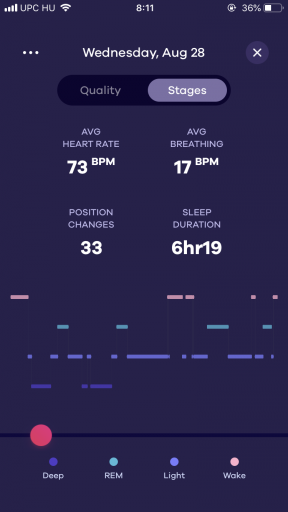
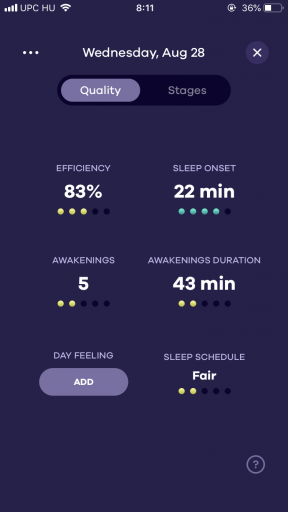
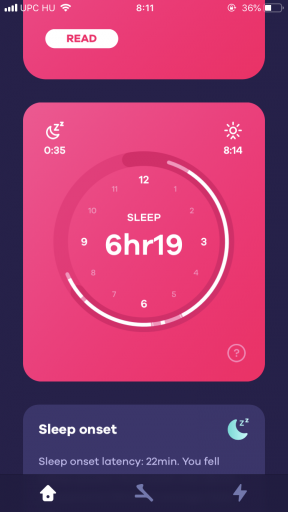
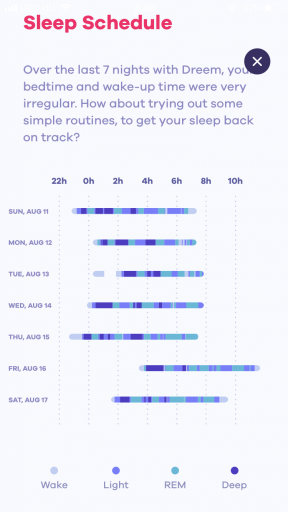
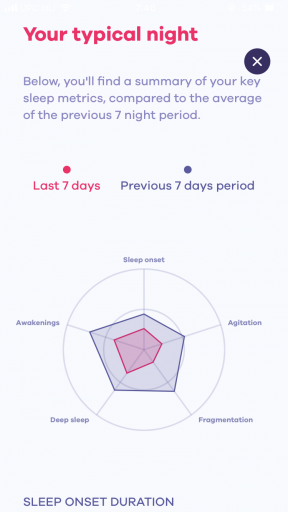
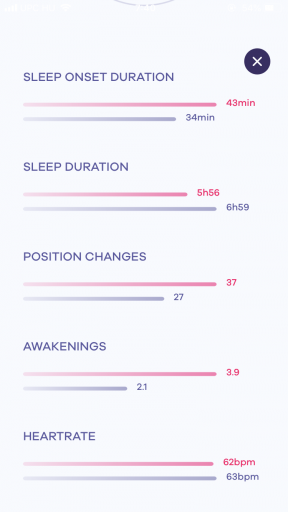
The sensors track three types of sleep: nap, sleep, and relax. It measures the various sleep phases: light sleep, deep sleep, REM, and wake periods. And the Sleep Schedule shows in a daily breakdown how the various sleep phases vary. You also have detailed information about your sleep duration, sleep onset duration, position changes, heart rate, and respiration. In addition, the app sends you notifications with useful tidbits of data: how ideal sleep looks like, how you can set the best conditions for sleeping, etc.
The perks of profound sleep analytics
Dreem sends the first detailed sleep report after using the headband for the first week. It summarizes all the above-mentioned data and introduces the sleep efficiency and insomnia severity index. In addition, sleep hygiene and habits reflect on the user’s habits before going to sleep. The document also shows how all this data varies in the specific gender and age group of the user, which proved to be very useful according to our tester.
On this basis, the app recommends specific, personalized programs to improve sleep. You can choose the option to meditate before shutting your eyes, to stimulate your deep sleep, or do cognitive behavioral therapy – or even do every single one of them after another. However, we must add that the latter demands a more serious engagement from the user – as this therapy can help in transforming sleep habits in the long run. You can also use the smart sleep alarm function with a sound of your choice. However, our tester said that the smart sleep alarm did not do its best as he did not feel the device could choose the best window to wake him up. Sometimes it managed to wake him up at an adequate time, but sometimes he woke up earlier than the alarm. Moreover, his data showed that at those times, his REM phase was often interrupted – well, he added that this happened usually when he woke up to certain noises.
Our tester said that in his case, the only measurement that wasn’t accurate was the sleep onset duration as he usually falls asleep watching a movie. In order not to interrupt the film, he puts on the headband before starting it, but this way the device records a longer falling asleep period. On the other hand, the app does tell the user to only use the Dreem before falling asleep – which was not comfortable for our tester, but he said he couldn’t find the best solution to his specific problem.
All-in-all, our tester said that the Dreem 2 offers a very thoughtful, complex system for helping insomniacs. It tracks a lot of data at the same time, it is comfortable, and it could offer a lot for people who find falling asleep a difficult ‘task’ to perform. On the other hand, our tester said that it couldn’t solve his problem of waking up at random time periods so far, but he’s undergoing the 2-6 week-long cognitive behavioral therapy, and we’ll update our review as soon as he has the results.
In general, we believe that sleep tracking is super useful – even with a not particularly exceptional device because we can learn a lot about ourselves and our habits. Dreem 2 tries to lift that experience to a whole new level as it gives you pieces of advice for improving your sleep. As that’s an enormous challenge, we can only hope that they will be successful.
|
At The Medical Futurist, we are building a community for making a bold vision about the future of healthcare reality today. If you’d like to support this mission, we invite you to join The Medical Futurist Patreon Community. A community of empowered patients, future-oriented healthcare professionals, concerned health policymakers, sensible health tech developers, and enthusiastic medical students. If there were ever a time to join us, it is now. Every contribution, however big or small, powers our research and sustains our future. Click here to support The Medical Futurist from as little as $3 – it only takes a minute. Thank you. |