Sweet Dreams In A Headband? – The Philips SmartSleep Review
If you’re a regular, you should have noticed by now that sleep tracking is my passion. I’ve tested several apps and devices like the Viatom O2 Sleep Monitor or the Live by Earlysense. I have also written guidelines to help you kickstart a sleep tracker path or how to analyze your sleep quality. As such, it should come at no surprise that I bring to you yet another sleep tracker review, this time the SmartSleep from Philips. While it’s absolutely a bummer on the design front, the “sleep enhancing” headband can be quite accurate and helpful, provided that you can get used to wearing it when going to bed.

9 min | · Updated
|
THIS ARTICLE HAS NOT BEEN UPDATED SINCE 2019. THE INFORMATION SHARED IN THE ARTICLE WAS ACCURATE AT THE TIME OF ITS PUBLICATION, BUT IT MAY BE OUT OF DATE NOW. BROWSE OUR LATEST ARTICLES HERE |
If you’re a regular, you should have noticed by now that sleep tracking is my passion. I’ve tested several apps, and devices like the Viatom O2 Sleep Monitor or the Live by Earlysense. I have also written guidelines to help you kickstart a sleep tracker path or how to analyze your sleep quality. As such, it should come as no surprise that I bring you yet another sleep tracker review, this time the SmartSleep from Philips. While it’s absolutely a bummer on the design front, the “sleep enhancing” headband can be quite accurate and helpful – if you can get used to wearing it when going to bed.
Shrek instead of Sleeping Beauty
The multinational technology company Philips needs no introduction, but its SmartSleep product line might. It includes upcoming apps to analyze sleep or devices like the SmartSleep
The latter intends to improve the quality of deep sleep for those individuals whose hectic lifestyle impedes their sleep quality, leaving them feeling not fully revitalized the next morning. The company also makes it clear that it is not intended for people with sleep disorders, people above their 50s or those with hearing impairment unable to hear 80 dBs. If you are eligible to operate this exclusive-sounding piece of tech, then you can consider investing in this $400 device.
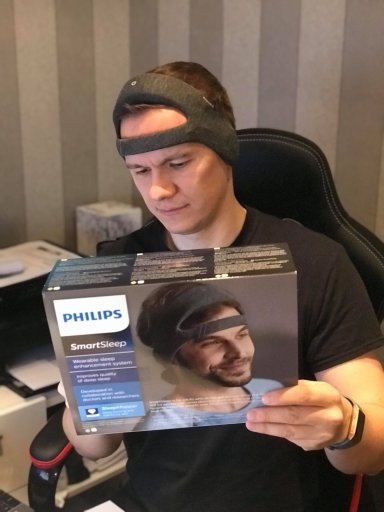
However, do bear in mind that it will not help you win any beauty contest while being worn, as my wife can surely attest. When I first wore it (and on any subsequent occasions for that matter), she just couldn’t help laughing, and while I felt somewhat embarrassed, I couldn’t blame her. From a design perspective, the SmartSleep headband is divisive at best; wrapping around your forehead with a blinking green light (which eventually switches off) might sound science-fiction-ish, but it’s just not my taste. Moreover, the prospect of wearing it the whole night to track your sleep is uninviting. Especially if you add that it only leaves you to rest on your back. That was quite unpleasant for me as I’m not Sheldon Cooper, so I practically never do that. But alas! As a reviewer, I had to take up the challenge.
Long-haired at a disadvantage
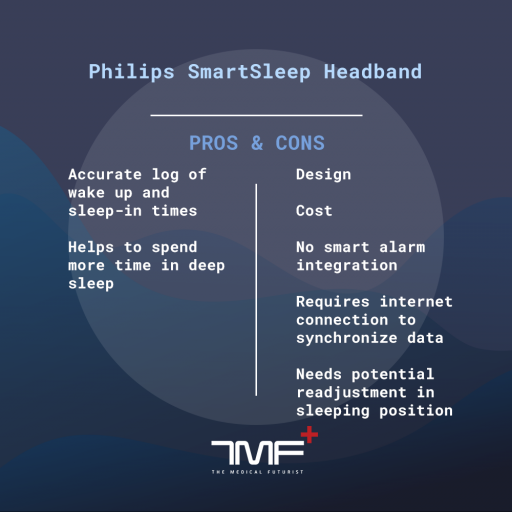
Getting started with the SmartSleep headband is fairly easy. As with most health trackers, it has to pair up via Bluetooth with its smartphone companion app for you to set up an account and analyze the data in the morning. Thankfully, it doesn’t require a constant connection during the whole night, and it’s only needed for the first-time pairing and subsequent sleep analysis once you wake up. However, to synchronize and output your data once you wake up, the app requires an internet connection, which I found to be unnecessary since other sleep trackers can give your sleep analysis result without an internet connection and synchronize with the cloud later. Philips can hopefully address this issue in the future with an app update.
Once you set up your account and paired the device, you can start tracking right away. It’s a strange process at the beginning, but you’ll get used to it after the first few uses. First, stick the replaceable sensor behind your right ear, then pull the headband over your forehead and connect the dangling SmartSleep connector to the sensor. For short-haired people like me, it shouldn’t be a problem, but for the longer-haired among you, it might be a hassle to get your hair out the way of the sensor and adjusting the headband.
Afterward, you should adjust the embedded speakers so that they are over your ear (more on their importance later). Finally, switch on the device by pressing the power button and confirm that the headband and sensors are connected with its beep (which eventually fades away after a few seconds). Now, you can go to sleep – or at least attempt to – with a device wrapped around your head.

Sleep on your back – required
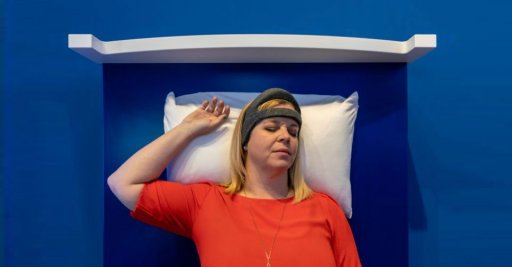
While the SmartSleep headband is not particularly heavy, you do feel its presence and being as unnatural as it gets, it requires a lot of practice to come to terms with sleeping with it. Furthermore, with its integrated speakers, which play a crucial part in its functioning, users might have to change their regular sleeping position. You see, if you are used to sleeping on your side (like me) or on your stomach, the headband’s speakers will be in the way, pressing on your ears. The best is to sleep on your back. However, if you are not used to sleeping in this position, then you will most likely have to adopt it when using this device. It is quite an understatement that my first time wearing it was challenging, and I can imagine that it will be the same for a lot of users.
When you wake up, you can finally detach the connector, free your head from the headband and reseal the sensor in its package (they can be reused up to 3 times). To end your sleep session, you will have to plug in the headband, which is another step I consider redundant. My smartwatch’s integrated sleep tracker can automatically detect when I wake up without any action from my part, and I would expect a dedicated sleep-tracking device to at least be able to do that. Nevertheless, I did find the sleep tracking time to be very accurate, especially when compared to that of my smartwatch. But let’s go on to how it actually works.
Don’t judge a book by its cover… or should you?
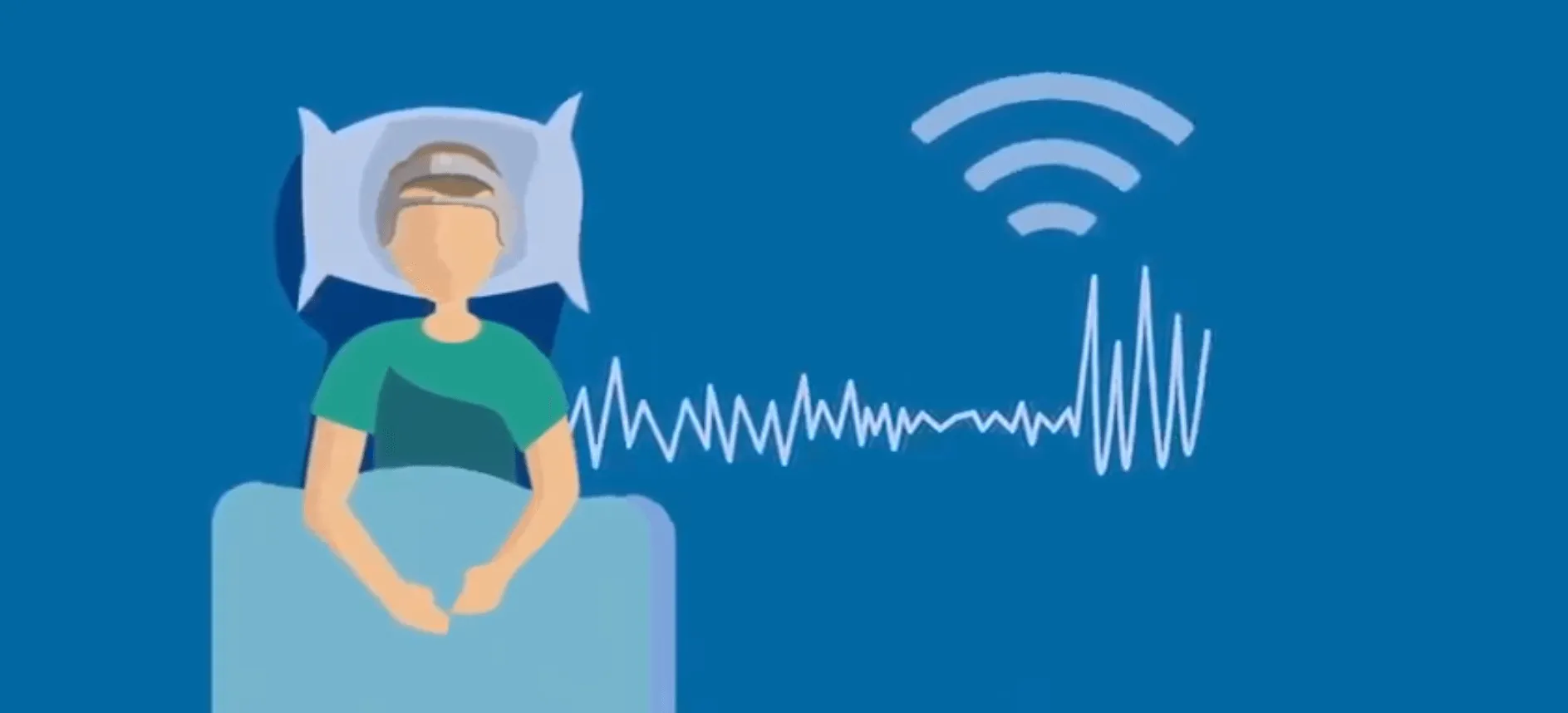
The way that the SmartSleep headband helps its users to improve their sleep quality is actually quite interesting. With its smart sleep sensors, it detects when the user enters in slow-wave sleep and then begins to emit quiet audio tones that are not loud enough to wake you up but enhance those slow waves which then support a longer deep sleep period and help you feel more energized the next morning. The embedded algorithm further customizes the timing and volume of tones according to the user’s sleep pattern every night.
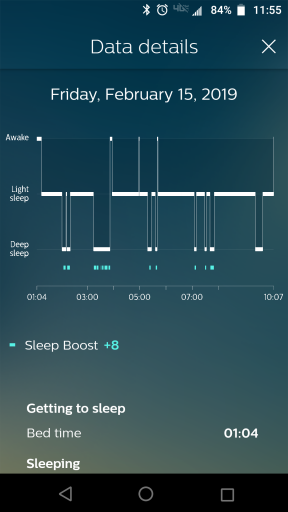
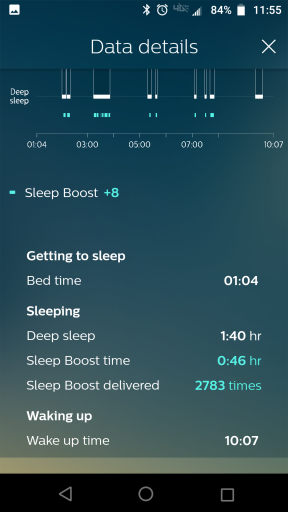
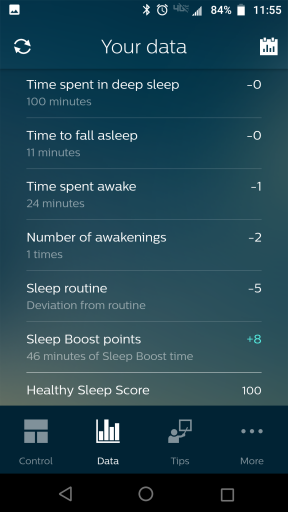
Once synched, the SleepMapper companion app gives quite a detailed analysis of the user’s last night’s sleep. It accurately tells at what time you fell asleep, woke up, the number of awakenings you’ve had, how long you’ve slept in deep sleep and if you’ve had any deviations from your sleep routine like the time of going to bed. More importantly, it shows you how much “Sleep Boost Time” you’ve gained, which is the amount of extra deep sleep time you’ve profited thanks to the device. I could see that I progressively increased my time due to Sleep Boosts.
Interestingly, the SleeMapper app adds a gamifying aspect to its sleep analysis by giving you extra points for the amount of sleep boosts you got and subtracting points if you’ve deviated from your sleep routine or spent more time awake. This feature can push you to aim for a better score and improve your sleep quality by identifying where you are losing points and try to fix that, for example by trying to be more consistent with the time you tuck yourself in bed.
An investment worth the cost?
At a suggested retail price of $400, the Philips SmartSleep sensor is quite a considerable investment. While the decision to purchase it ultimately depends on your budget and your needs to improve your deep sleep, there are some aspects to consider. For one, the app is solely used to analyze the data recorded on the headband. There is no smart alarm integrated which could wake you up at the ideal time when paired with the SmartSleep’s accurate sleep tracking technology. Understandably, that would require a constant Bluetooth connection, but there are much cheaper options like pairing an old Pebble Time smartwatch with the Sleep As Android app, which I extensively tested and found to be very effective. And for a $400 device, I would have expected to at least have this option.
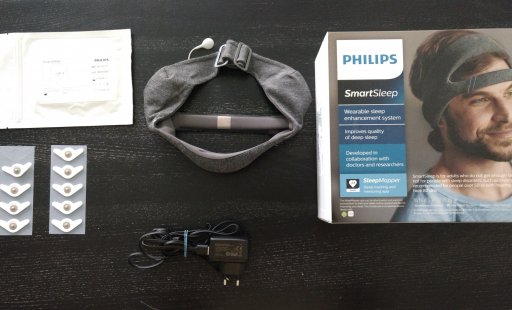
Additionally, the box comes with 30 reusable sensors, which, as mentioned before, can be used up to 3 times. Once your store of 30 sensors has been depleted after 90 days, you will need to invest in more. These are priced at $30 for 30 replacement sensors, and while they are affordable, you will need to regularly stock up on these, and they can add up to be quite the investment in the long run.
A little bit nitpicky but there is no carry case included with the purchase. If you are a frequent traveler, then you most likely know the importance of good sleep and might want to bring with you a device you’ve invested in for that purpose. But Philips does not include a handy carry bag for travelers or just for storage along with the charger and the dozens of smart sensors it needs.
However, Philips is not the only company foraging in such types of “sleep-enhancing” devices. There is the Dreem Band from the San Francisco Bay Area-based company Dreem, which looks conspicuously very much like the SmartSleep and has similar features. If there is healthy competition for such kinds of peripherals on the market, I can expect the companies to improve them to make them more inviting and more affordable to use.
|
At The Medical Futurist, we are building a community for making a bold vision about the future of healthcare reality today. If you’d like to support this mission, we invite you to join The Medical Futurist Patreon Community. A community of empowered patients, future-oriented healthcare professionals, concerned health policymakers, sensible health tech developers, and enthusiastic medical students. If there were ever a time to join us, it is now. Every contribution, however big or small, powers our research and sustains our future. Click here to support The Medical Futurist from as little as $3 – it only takes a minute. Thank you. |