Synchronising Your Mind: The NeoRhythm Review
In the movie The Matrix, the protagonist, Neo, is able to learn decades worth of kung fu techniques without any prior knowledge of martial arts, […]

Pranavsingh Dhunnoo
20 August 2020

In the movie The Matrix, the protagonist, Neo, is able to learn decades worth of kung fu techniques without any prior knowledge of martial arts, simply by plugging his brain into a computer. Within minutes, he utters the famous line: “I know kung fu”.
It’s just a hunch, but the device under review today, the NeoRhythm headband, feels a bit like it was intended to be a real-world version of what Neo experienced. (Notice how they both have Neo in their names? Again, just a hunch). Wear the NeoRhythm and it will help you achieve more through neurostimulation, claims Omnipemf, the company behind the device.
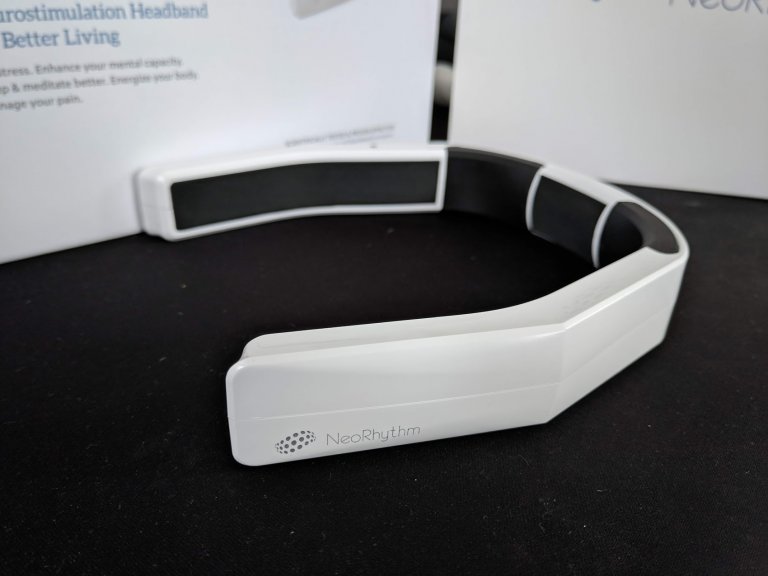
Although you might not learn kung fu as swiftly as Neo did in The Matrix, it could help you achieve the focus needed to perform better. In fact, the NeoRhythm aims to help you achieve more than enhancing your focus but also improving your sleep, helping in pain control and even helping with meditation.
On its website, Omnipemf writes that their device is “scientifically designed to help reach and improve a specific state of mind”. How does it achieve that, and more importantly, does it achieve that? Neurostimulation is a thin ice field with not strong enough scientific evidence behind it for consumer use. After testing over 100 digital health gadgets, we are always cautious when a company claims too much about their tech. So, read on as we put the NeoRhythm to the test and gauge its effectiveness.
Neo tech
At The Medical Futurist, we’ve reviewed quite a few headbands destined for different purposes, yet sharing a similar form factor. For example, the Muse headband helps improve meditation through real-time biofeedback via its EEG sensors. On the other hand, the Philips SmartSleep and Dreem 2 headband help users track their sleep so that they can analyse their sleep pattern and improve their shuteye time. As such, we were quite excited to test the NeoRhythm as it is yet another headband with a completely different purpose than what we had previously tested.
Rather than offering the user biofeedback, where sensors provide biological information about the user, the NeoRhythm is a neurostimulation device. It uses pulsed electromagnetic field (PEMF) technology to emit frequencies to which the brain synchronises. Such magnetic field therapy has also been employed to relieve symptoms of chronic pain, depression and even tested by NASA. The idea is that our bodies have their own electromagnetic fields, which can get “out of balance” with certain ailments. An external magnetic field might influence our bodies’ own one and help in treatment. Some clinical trials have shown its potential as a treatment for back pain. Given that it is a relatively understudied field, conclusive evidence is yet to be found.
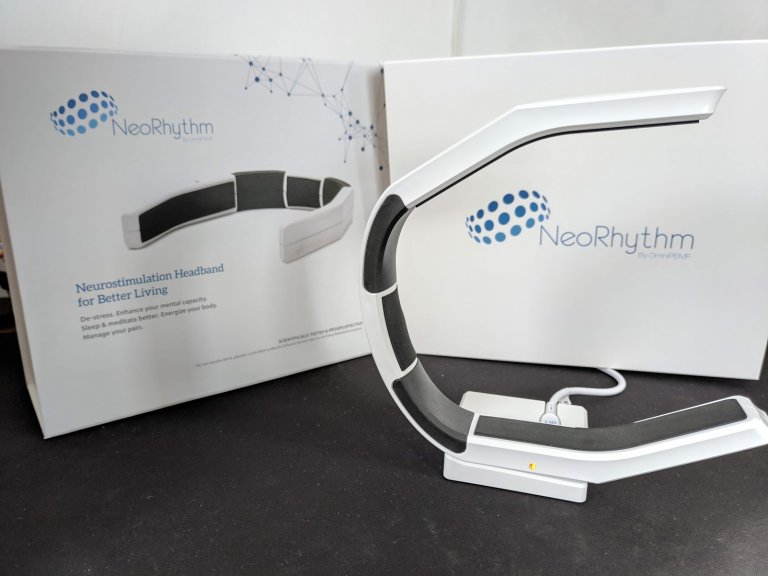
The NeoRhythm’s concept applies this model to our brain; more specifically, our brainwaves. It bases its principle on the fact that our state of mind (tired, focused, relaxed) is reflected in our brainwaves; and it can get in sync with an external rhythm that mimics a desired state of mind. The device’s built-in coils generate this external PEMF rhythm when activated.
The actual device’s effectiveness, rather than the technology in general, was proven by 2 double-blind, placebo-controlled studies. Now that it’s out of the lab and into the consumer market, let’s see what comes in the consumer kit; and how it performs, or how it makes us perform in this case.
Neo look
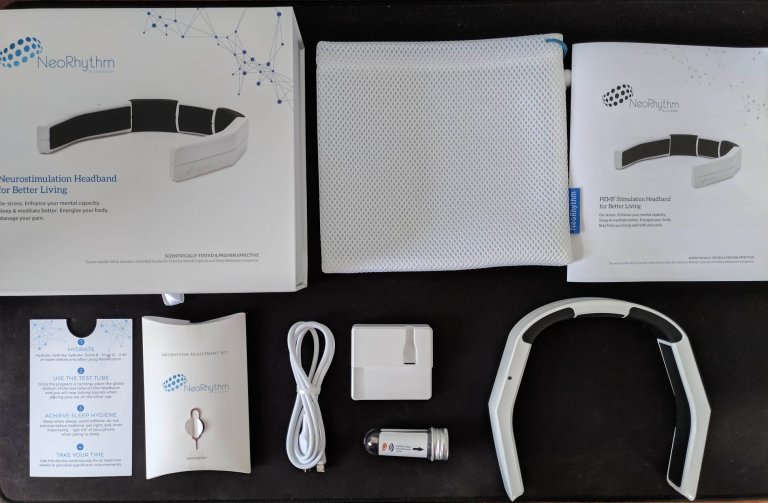
Before diving into the performance of the device, let’s see what first meets the eye when unboxing the NeoRhythm. Out of the white box comes the headband itself, an adjustment kit, instruction manuals, a soft pouch, a charging cable and a dock that gives the NeoRhythm quite the look when charging.
There’s also a peculiar test tube labelled “Magnetic Field And Frequency Tester”. It contains a cube-shaped magnet which reacts to the magnetic field generated by the headband. The magnet thus vibrates and helps you hear the pulses, which will otherwise go undetected and also proves that the headband is functioning.
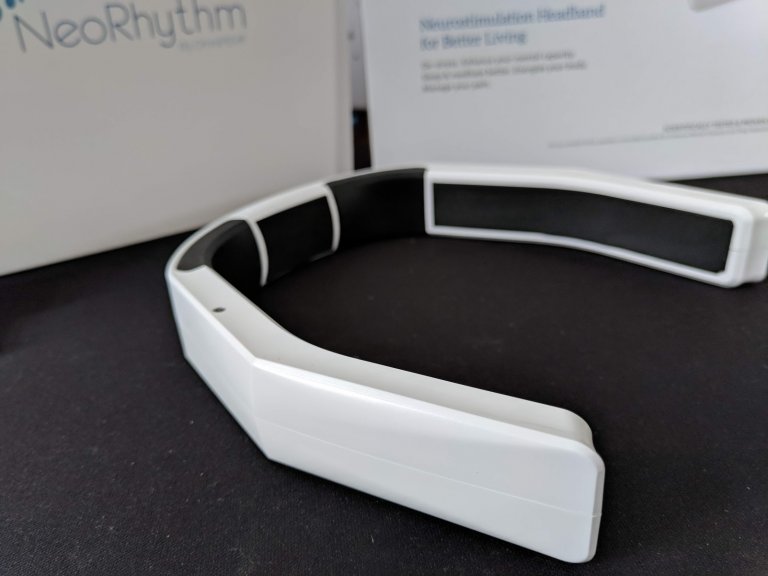
Once unboxed, it’s time to charge the device, following which we must download the companion app (available for both Android and iOS) and pair the device via Bluetooth. It’s very easy to use and set up, with starting a session only a few taps away. The headband is also tap-friendly as it features no hardware buttons but a touch-sensitive area around its indicator light. It’s a welcome aspect that gives the NeoRhythm a sleek look without any protruding hardware. With its polygonal design, it wouldn’t surprise us to see it used in futuristic catwalks or as a fashion accessory in a sci-fi flick.
While we have yet to see actors and models put on the NeoRhythm, we went ahead and wore it. It’s quite easy to put on; just slide it on top of the head, and you’re ready to go. There are no straps to worry about and it’s also glass-friendly, without any inconvenience to bespectacled users. It’s also very light at 105g and comfortable to wear. At first, we found it a bit loose and it had a tendency to slide off our heads. Thankfully, Omnipemf included extra rubber pads to easily help adjust the NeoRhythm comfortably.
Magnetic field, activate and… help me learn kung fu?
On the app, you can select one of the 7 programs to help you reach your desired mental state. Maybe you want to meditate better? Or Neo inspired you to learn kung fu and you wish to increase your focus? There’s also the option to improve your sleep by wearing it for 20 minutes before your bedtime. Or you can slip it under your pillow through the night (quite uncomfortable though). Once selected, you will see a brief description of the program, which position to place the headband and the frequencies that the NeoRhythm’s built-in coils emit for that program. A more detailed explanation of each program is also available on the official website.
To start the session, double tap on the device next to the light indicator and it will vibrate, signalling that you can wear the device. At this point, you can use the test tube to check that the device is indeed functioning. By bringing your ear close to the tube, you will hear a faint buzzing.
Once the session ends, the NeoRhythm will vibrate again. This way, you don’t even need it to be paired to your phone constantly to keep track of your sessions. You just need to pair it to choose the program and the headband will store up to 10 sessions offline. The ability to swap between programs directly from the headband would also be a welcome feature here, but its offline support is commendable already. Additionally, we have been using it for around a week and with moderate use, we only charged it once upon receiving and the battery is still at an impressive 60%.
Of note, even if the PEMF it uses is a safe and non-invasive method, NeoRhythm is contraindicated for people with electronic implants such as pacemakers, cochlear implants or mechanical heart valves. This is due to the pulsed electromagnetic field that it generates, which can interfere with such implants.
Yes or Neo?
Saying definitively whether or not the NeoRhythm helps with its neurostimulation claims is a tricky issue. Firstly, we’ve had it for around a week and it’s hard to gauge from personal experience if it’s effective. But the company says that the effects are more noticeable with continuous use. Additionally, the double-blind studies seem to confirm NeoRhythm’s efficacy, but still more research with this particular device is needed for more conclusive evidence.
Secondly, the app is very basic. It functions without any issues, allows you to choose a program, see a countdown timer for your session, and gives you a rundown of the programs you completed everyday in its calendar. However, since it has no sensors that can provide biofeedback, it’s hard to quantify any changes in brain activity. They could have included EEG sensors to detect brainwave activity, which could help you better visualise your progress.
Additionally, the app could include some guided training, especially for the meditation and deep relaxation programs. These are not always intuitive tasks, even with a headband that nudges you towards those states of mind. Coupled with an EEG feedback, these audio guides would go a long way to make the experience with the NeoRhythm more interactive and compelling. The price tag of around 375€ would have also been more justified with those additional features.
Hopefully, some of these will be remedied with software updates, but the biofeedback sensors should also be included with the device. Nevertheless, as a proven and easy-to-use technology, our experience was pleasant. The benefits might themselves be subjective and might not help you learn kung fu in minutes, but could be considered as supplementary tech to help you reach a desired state of mind.