What Empowered Patients Need: Empathy, Time, And Attention
Empathy, time, and attention are what opinion leader e-patients need most from their physicians, and that’s the most important outcome they get from an equal-level patient-doctor relationship. Cooperation between technology and healthcare is not enough on its own: the most decisive factor is the return of the human touch and reciprocal communication. That’s the main finding of the latest study of The Medical Futurist Institute, entitled Opinion leader empowered patients about the era of digital health: a qualitative study, published in the British Medical Journal.

6 min | · Updated
|
THIS ARTICLE HAS NOT BEEN UPDATED SINCE 2019. THE INFORMATION SHARED IN THE ARTICLE WAS ACCURATE AT THE TIME OF ITS PUBLICATION, BUT IT MAY BE OUT OF DATE NOW. BROWSE OUR LATEST ARTICLES HERE |
Empathy, time, and attention are what opinion leader e-patients need most from their physicians, and that’s the most important outcome they get from an equal-level patient-doctor relationship. Cooperation between technology and healthcare is not enough on its own: the most decisive factor is the return of the human touch and reciprocal communication. That’s the main finding of the latest study of The Medical Futurist Institute, entitled Opinion leader empowered patients about the era of digital health: a qualitative study, published in the British Medical Journal.
The case for e-patients
In the last decade, rapid technological advancement has resulted in a shift towards digital health in medicine. This shift is theorized as a cultural transformation of how disruptive technologies providing digital and objective data accessible to both caregivers and patients lead to an equal level physician-patient relationship with shared decision-making and the democratization of care. Has this change already started? Where does it stand at the moment if it already has? What does a doctor-patient partnership look like? What do physicians and patients need to do differently in the digital age? What are their greatest challenges?
The Medical Futurist Institute (TMFI) had plenty of questions regarding the assumed shift in the behavior of patients and doctors due to easily available health technologies. For questions concerning the patient’s side, TMFI conducted a qualitative study by asking 11 e-patients who are considered opinion leaders worldwide about their experiences and expectations. They represent some of the most empowered, most technologically-savvy population, early adopters both in technology and cultural change, thus future trends for patients might be extrapolated from their attitude and behavior.
How are empowered patients different?
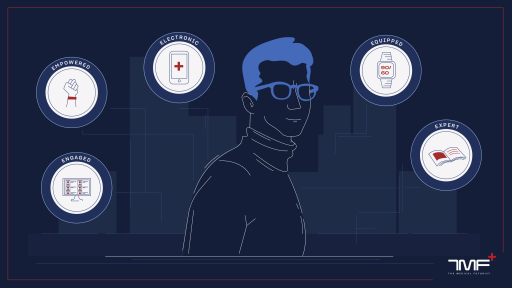
What does it mean to be an e-patient and how is it different from any other patient? Although there’s no strict definition yet, the ‘e’ can stand for ‘electronic’, ‘equipped’, ‘enabled’, ‘empowered’, ‘engaged’ or ‘expert’.
Empowered patients often have access to information, medical knowledge, and their own health data. It is important for them to be in contact with other patients and become highly active, engaged, equipped and educated in this process. Sharing medical stories, pieces of advice, providing support to other patients, and looking for new opportunities in treatment options are all characteristics of an empowered patient. They can find the questions they need to ask and have the confidence to ask those questions. They think that each patient can strive to be the expert of their own condition because of social media and technology in general.
Anyone can become an e-patient, who is proactive, has the desire and the courage to ask questions, and uses technologies. The latter doesn’t even have to mean particularly unique technologies. One of the key findings was that e-patients use communication tools and technologies such as search engines, Skype or Fitbit sensors, but they did not mention anything beyond the reach of an average consumer; therefore, being technology-savvy is a helpful but not principal requirement for empowerment.
What do e-patients expect from their physicians?
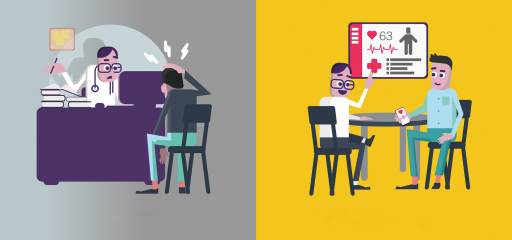
E-patients require a different kind of physician-patient relationship than the traditional paternalistic one, as they need a partnership based on proper communication online and offline. This partnership already signifies a cultural change or paradigm shift: the previously rather asymmetrical conversation with a semi-god-like doctor becomes reciprocal. Partnership also means that physicians and patients listen to each other, express their needs and desires clearly, and have a common goal. According to one of the e-patients, this also means that ‘patients have to empathize with doctors as well, like ‘I understand you have seen fifty other patients before me today.’
In this process, it is essential that patients are curious, while doctors need bravery and a willingness to make changes. Based on the interviews, ‘medical professionals need to change their perception of medical support because now there’s a sort of feeling that ‘I don’t need a machine, I know myself,’ although there is so much information that it’s physically and mentally impossible for somebody to know everything. This is why participants think physicians need to recognize the values of technology and dare use it.
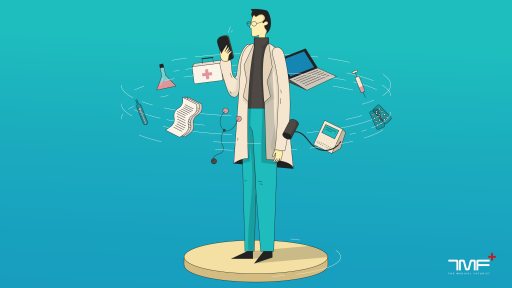
What to expect in the future?
The interviewed e-patients are optimistic that some years from now the doctor-patient relationship is going to be a real partnership in which conversation is in the focus. Physicians will tell patients it is not just socially appropriate to ask questions but it is also an important aspect of proactivity. Patients will prepare more for the visits, and discussions and technologies will be part of everyday care. These will simplify but not replace contact between patients and caregivers.
‘Ten years from now every patient will be asked ‘Do you want to come in? Do you want a video consultation? Do you want your information on your mobile phone? What is the right thing for you?’ That is the hope of one of the e-patients we asked. Another commented this: ‘And instead of doctors saying do not Google your symptoms because you will feel sicker, they will actually support their patients and teach them how to Google and how to assess credibility and correctness on what they find. So that’s what I hope, and I think that’s what will happen.’
It’s an important point of the entire study, which we at The Medical Futurist also want to happen. That’s why we have launched the Ask Me About Digital campaign with badges and pins indicating that patients can have a conversation about “Dr. Google”, and that’s why we have published our Guide as a resource for doctors for answering patients’ questions about digital technologies. Feel free to comment on it and come back to us if you have any queries.
|
At The Medical Futurist, we are building a community for making a bold vision about the future of healthcare reality today. If you’d like to support this mission, we invite you to join The Medical Futurist Patreon Community. A community of empowered patients, future-oriented healthcare professionals, concerned health policymakers, sensible health tech developers, and enthusiastic medical students. If there were ever a time to join us, it is now. Every contribution, however big or small, powers our research and sustains our future. Click here to support The Medical Futurist from as little as $3 – it only takes a minute. Thank you. |