With Quantification Towards Pregnancy: The Mira Fertility Tracker Review
Mira is one of the increasing numbers of digital technologies that promise to reduce the role of luck and go against the trends of declining fertility rates by providing quantified information about ovulation and hormone levels. We received the device and found the perfect tester for it. Let’s see the comprehensive Mira fertility tracker review below.

8 min | · Updated
|
THIS ARTICLE HAS NOT BEEN UPDATED SINCE 2019. THE INFORMATION SHARED IN THE ARTICLE WAS ACCURATE AT THE TIME OF ITS PUBLICATION, BUT IT MAY BE OUT OF DATE NOW. BROWSE OUR LATEST ARTICLES HERE |
Mira is one of the increasing numbers of digital technologies that promise to reduce the role of luck and go against the trends of declining fertility rates by providing quantified information about ovulation and hormone levels. We received the device and found the perfect tester for it. Let’s see the comprehensive Mira fertility tracker review below.
Fertility tracking is off the charts
Due to the declining fertility rate worldwide and the ever-increasing age of first-time pregnancy, there’s a growing interest in female reproductive health – also from a technological point of view. In the past three years, an estimated $1 billion has been poured into women’s health technology and the “femtech” market is expected to be worth more than $50 billion by 2025. A Fertility Test Market report predicted that the market is expected to reach $772.9 million by 2027. Ovulation predictor kits, urine or saliva-based fertility monitors, smartphone accessories and applications, sleep sensors and mail-order tests offer answers for when and how to try to conceive a baby.
For example, a small Croatian start-up, a mom and dad trying to have their first child, developed a smartphone camera attachment called me.mum able to detect mold-like particles in saliva that signals when a woman is at her most fertile. Another company called Modern Fertility offers fertility testing on-demand. Women can order their at-home testing kit online, collect a finger-prick of blood at home, and mail it back to a lab, where it will be analyzed for nine hormones related to ovarian reserve and reproductive health. Opionato, established in 2016, offers a digital platform with fertility advice. Subscribers can pay for phone calls to experts, information about egg freezing, or advice about getting pregnant. The Zürich-based company, Ava Women developed the Ava bracelet to observe menstruation or ovulation cycles. We tested it here and had an overall positive experience. It was not easy to incorporate the device into the daily going-to-bed routine, but after the learning period, the wearable worked as promised.
In the past weeks, we got the chance to test another gadget in the field, the Mira Fertility Tracker. As no one in The Medical Futurist team is trying to get pregnant at the moment, we searched for a tester – and found the perfect one for it. She’s a 34-year-old woman with a background in finance, who decided to have a baby with her partner.
“Honestly, I have zero knowledge on how to think about fertility schedule, what are the hormonal processes in my body to be monitored, and when will we have the biggest chance for a successful conception. We just want to avoid waiting and trying to conceive for months. So, I wanted to have some ‘extra help’ to think about the whole process and provide me with all the necessary information.” That’s exactly what the Mira Fertility Tracker promises so we were glad to provide her with a testing kit and excited to share her results here.

Going after a puzzle with many pieces
Before going deeper into the review, we have to pin down that no single factor can define whether or not a woman can conceive. Although many digital health companies offer their solutions for the issue, none can claim 100 percent accuracy in predicting fertility. If a woman has trouble getting pregnant, she can be tested for a panel of hormones related to reproductive health. The gold standard, sometimes called the “egg timer test,” measures the anti-müllerian hormone, closely correlated to the number of eggs left in the ovaries. That, and other tests, can help paint the picture of someone’s reproductive health and her options for getting pregnant, but that view will always have some grey areas.
Anyhow, the San Francisco Bay Area-based Mira Fertility introduced its ovulation tracker in 2018, for almost $200. The palm-sized device pairs with a smartphone and uses disposable wands to measure levels of Luteinizing hormone (LH) in morning pee. The rise of LH triggers ovulation, thus it’s an appropriate indicator of the fertile window. The app stores this information and uses a proprietary algorithm to predict ovulation over time. Yazan Amro, Chief Marketing Officer at Mira emphasized that the device is the only FDA and CE certified tracker to date on the market that provides that type of quantitative hormone data and offers personalized cycle prediction. In the future, the company promises options for tracking other fertility hormones, allergies, and influenza, too. But for now, let’s see how Mira fairs in practice as a fertility tracker.
Starting up with the Mira Fertility Tracker
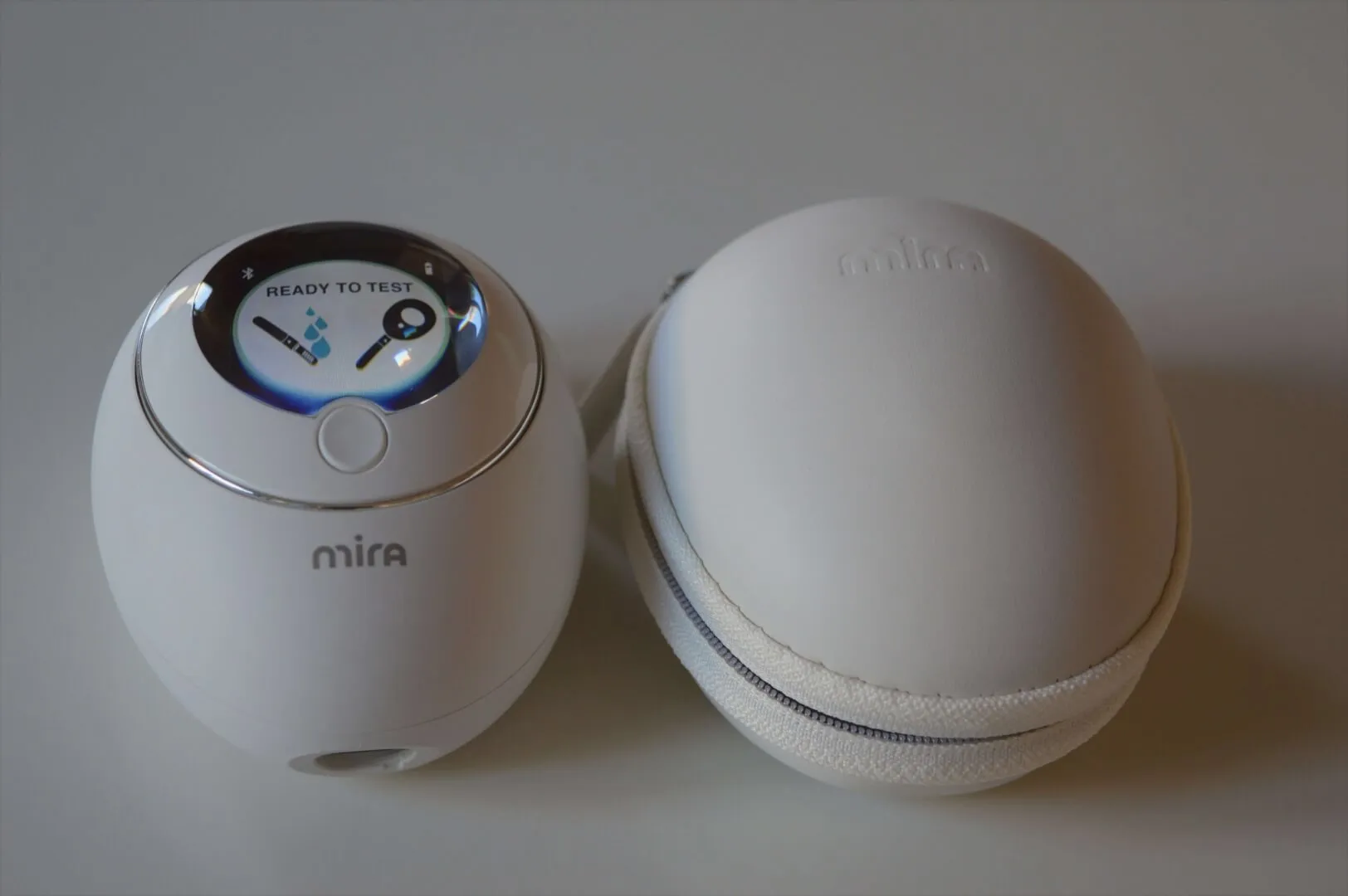
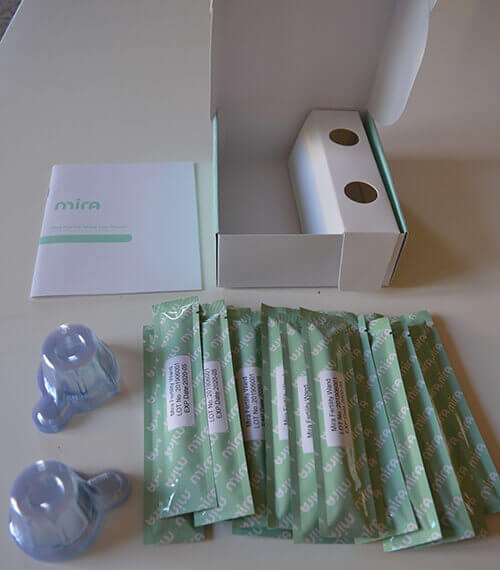
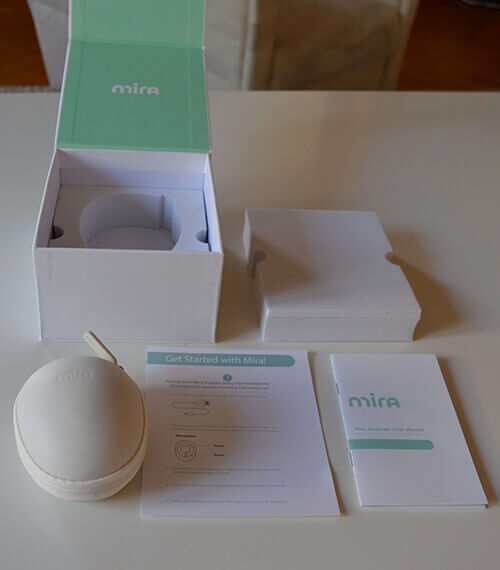
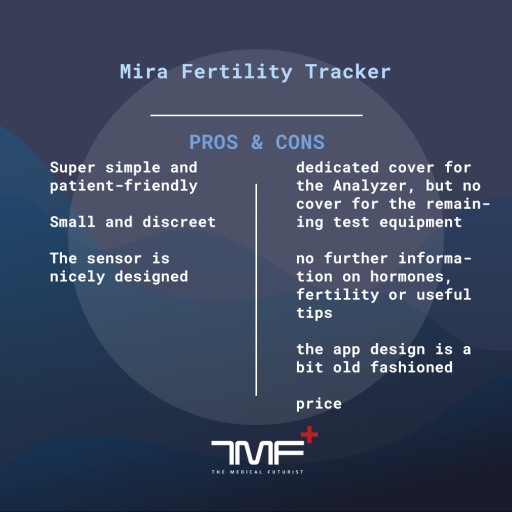
The Mira Fertility Starter Kit comes with two boxes, one for the Mira Analyzer and another one for the Mira Fertility Wand with 20 wands and a urine container. The actual sensor, the Mira Analyzer is small, compact, and nicely designed. It’s very discreet and fits into the palm of the user. The gadget comes with a cover for protection, although our tester told us that it would make more sense to have a cover for both the sensor and the remaining test equipment, e.g. the wands – as it would make it a better fit for busy women on the go.
The boxes contain long descriptions about the device and the other accessories, but fortunately, there is a one-pager sheet with major instructions for those who don’t want to read the whole instruction manual. Our tester found that very helpful.
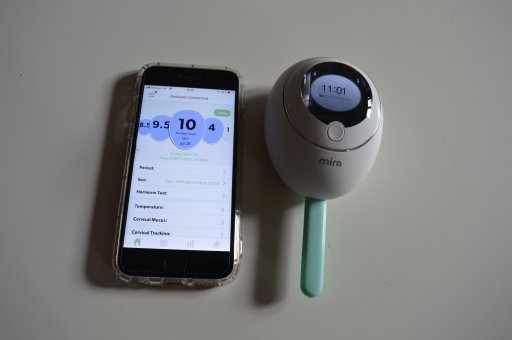
After familiarizing with the fertility tracker, the first step in the testing procedure is to download the Mira app and create an account. Once created, you can connect it with the Mira Analyzer via Bluetooth. While the process to connect the device is short and straightforward, our tester had some connection issues first. Although there’s an option to contact the team via embedded chat in the app and she sent her problem to the team, she never got an answer.
Almost like a pregnancy test: super easy, but needs more time
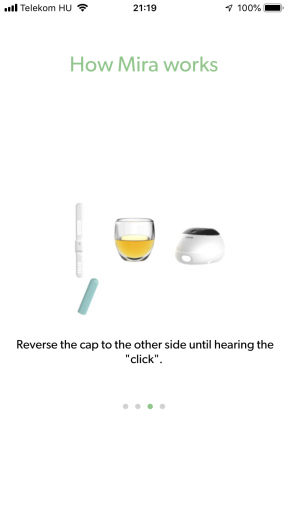
After restarting the app and the Mira Analyzer for a couple of times, the two finally connected with each other. There was a short and very straightforward intro with visual illustrations on how to use the analyzer.
Our enthusiastic tester did the first test in the following morning, as the guide recommended using the sensor on the morning pee. The wand looks exactly like a pregnancy test with a test stripe on one end and a chip on the other. First, you need to unwrap one of the wands. There is a cap on the end of the wand where the chip is placed. After collecting the urine sample in the container, you can switch the cap end, put it on the side with the test stripe (to keep the wand hygienic and clean). Then you can place the wand into the analyzer. It takes approximately 15 minutes to evaluate the hormone levels, and the company placed a timer on the analyzer in order to help not to lose track of time. Finally, the results are shown in the app with some simple assessment of ovulation.
“Using the test is super easy. The instructions are short and clear; the process is easy to follow. Although having a wand that looks very similar to a pregnancy test was a bit misleading, as I was waiting for the control line to show up when I realized after a few seconds that I shouldn’t have one here”, explained our tester.
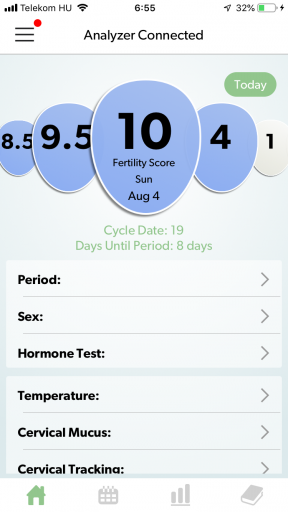
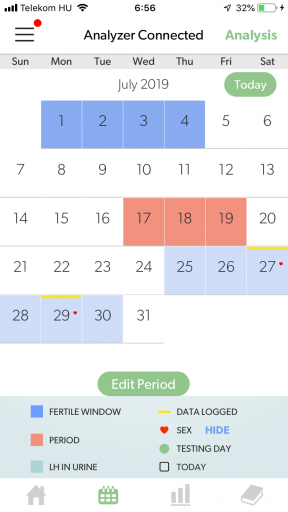
Overall, Mira is very patient-friendly and easy to use. Not just the setup and the testing process, but also the visualization and information sharing via the app are super easy to follow and understand. Besides, it’s nicely designed, small and discreet. On the other hand, simplicity kind of sacrifices the information content. It would be great if the app contained some further information on hormones, fertility or useful tips for this period. Moreover, the app design could be further improved with something more intuitive as it currently fairs as a bit old-fashioned (especially when it comes to the calendar on the home page). After publishing the review, the Mira team told us that they would release their new app in September – we’re looking forward to it!
All-in-all, our tester said that she appreciated the knowledge about her hormone levels, but as other app-based services are also able to give similar information, she would most probably think twice before buying the device for its current price. Although sensor-based solutions are usually a lot more accurate than smartphone apps, they might be more helpful in specific situations when hormone levels need to be monitored more closely.
|
At The Medical Futurist, we are building a community for making a bold vision about the future of healthcare reality today. If you’d like to support this mission, we invite you to join The Medical Futurist Patreon Community. A community of empowered patients, future-oriented healthcare professionals, concerned health policymakers, sensible health tech developers, and enthusiastic medical students. If there were ever a time to join us, it is now. Every contribution, however big or small, powers our research and sustains our future. Click here to support The Medical Futurist from as little as $3 – it only takes a minute. Thank you. |