How To Predict The Future Of Healthcare: Method #2 – Futures Wheel
The Futures Wheel helps us understand the cascading consequences and opportunities. This is the easiest way to start thinking about the future in a productive manner.

5 min | · Updated

Key Takeaways
The Futures Wheel is a simple yet powerful tool for visualizing the cascading consequences of an event, trend, or milestone in healthcare.
This method is flexible and can be used to analyze the impacts of technological advancements, policy changes, and other significant developments.
It empowers individuals and teams to shape preferred outcomes.
Welcome back to our series on “How to Predict the Future of Healthcare.” In our first installment, we discussed forecasting as a fundamental futures method. Today, we’re shifting gears to explore a tool designed to map out the ripple effects of change: the Futures Wheel. If forecasting helps us answer “what” might happen, the Futures Wheel helps us understand “so what?” – the cascading consequences and opportunities that a single event or trend can set in motion.
While Futures Wheel may sound like a fairground attraction, it is perhaps the simplest method to engage people in thinking about the future in a way that generates a useful, ideally, actionable output.
Why would you need a Futures Wheel?
The method’s strength lies in its flexibility. Look at these diverse examples:
- introduction of 5G technology in healthcare
- mass production of lab-grown organs
- deployment of AI chatbots for mental health support
- the impact of universal basic income on healthcare
While seemingly disparate, each can be the starting point for a Futures Wheel. Whether it’s a technological breakthrough, a policy change, or the discovery of a new health-related technology, any trend, event, or milestone can start the process.
This method is great for analyzing the impact of technological advancements, understanding the consequences of policy shifts, or future implications of a financial or cultural change for a healthcare company. From subtle shifts to major trends, the Futures Wheel is a uniquely flexible tool for having a better understanding of the future.
How to build a Futures Wheel
The Futures Wheel process begins by establishing a well-defined central point, which can be an event, trend, or milestone—practically anything significant in your area of study. The purpose of the Futures Wheel is to understand the cascading effects of this central point.
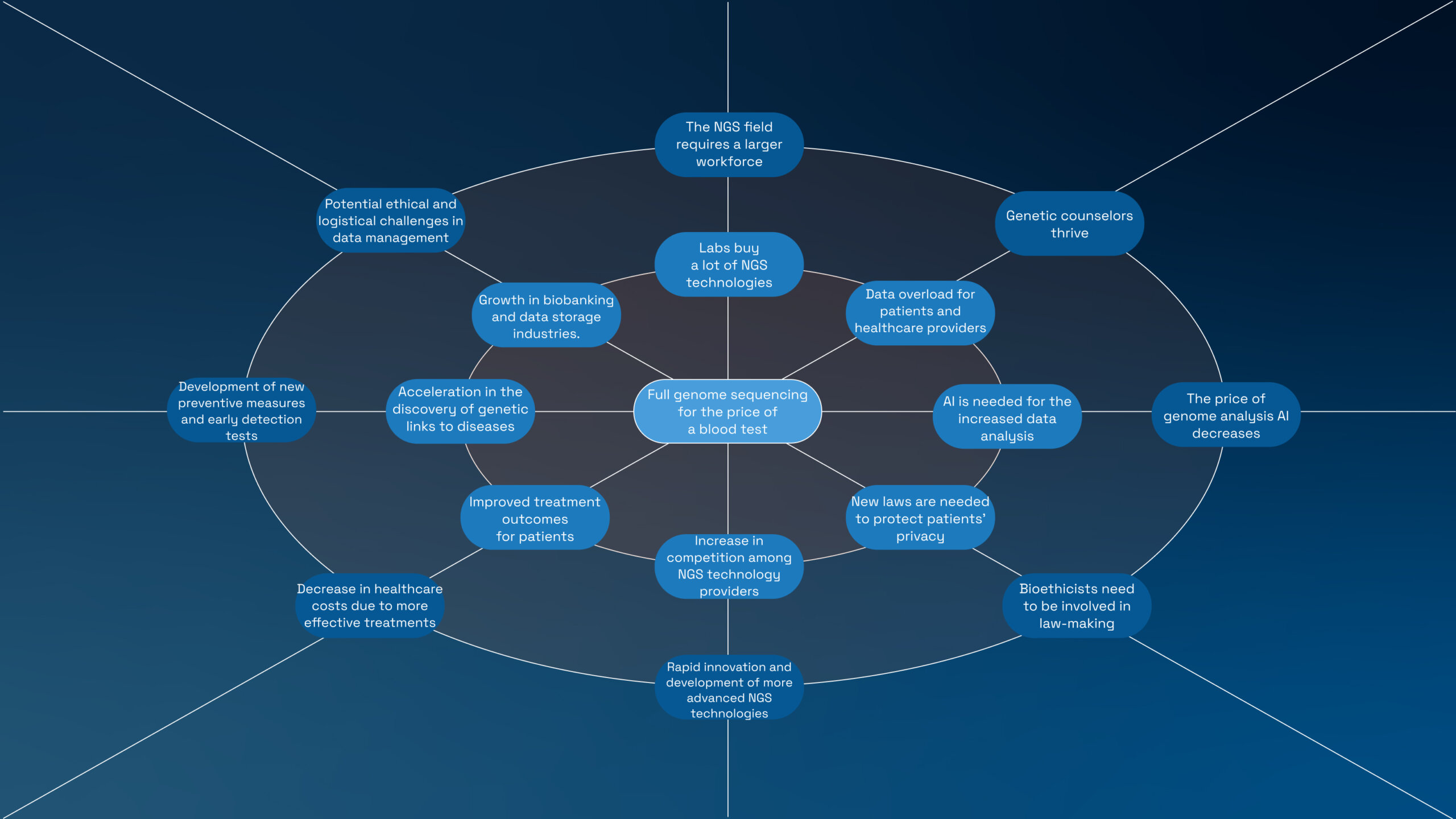
For example, let’s start thinking about “Full genome sequencing for the price of a blood test” – as our starting point.
- Once we have our well-defined starting question, we start the work by identifying the primary consequences – the direct, immediate outcomes that are most likely to occur. These form the first ring around the central point. As you see on our chart, there are many effects, but we pick one here as an example:
- New laws are needed to protect patients’ privacy
- Once the primary consequences are established, we move outward to the secondary consequences. These are the outcomes that result from the primary consequences, creating a second ring around the wheel. If we think further from our primary, “new laws are needed” example, we find a next-level effect:
- Bioethicists need to be involved in law-making
- In some cases, it’s beneficial to go even further and explore tertiary consequences, the outcomes stemming from the secondary consequences. However, even a Futures Wheel with primary and secondary consequences can provide valuable insights. Sticking to our example, a potential tertiary effect can be
- Increased need to train bioethicists at universities
Break it up into smaller chunks!
As it’s generally easier to think about specific questions like ‘What are the immediate technological consequences of X?’ rather than considering ‘What are the primary consequences of X?’ – it is a good practice to initially divide the future effects into sections, like legal, professional, policy-related, or technological. This helps in guiding the discussion and makes the end product more visually compelling.
This specificity helps in focusing the discussion and making the thought process more manageable.
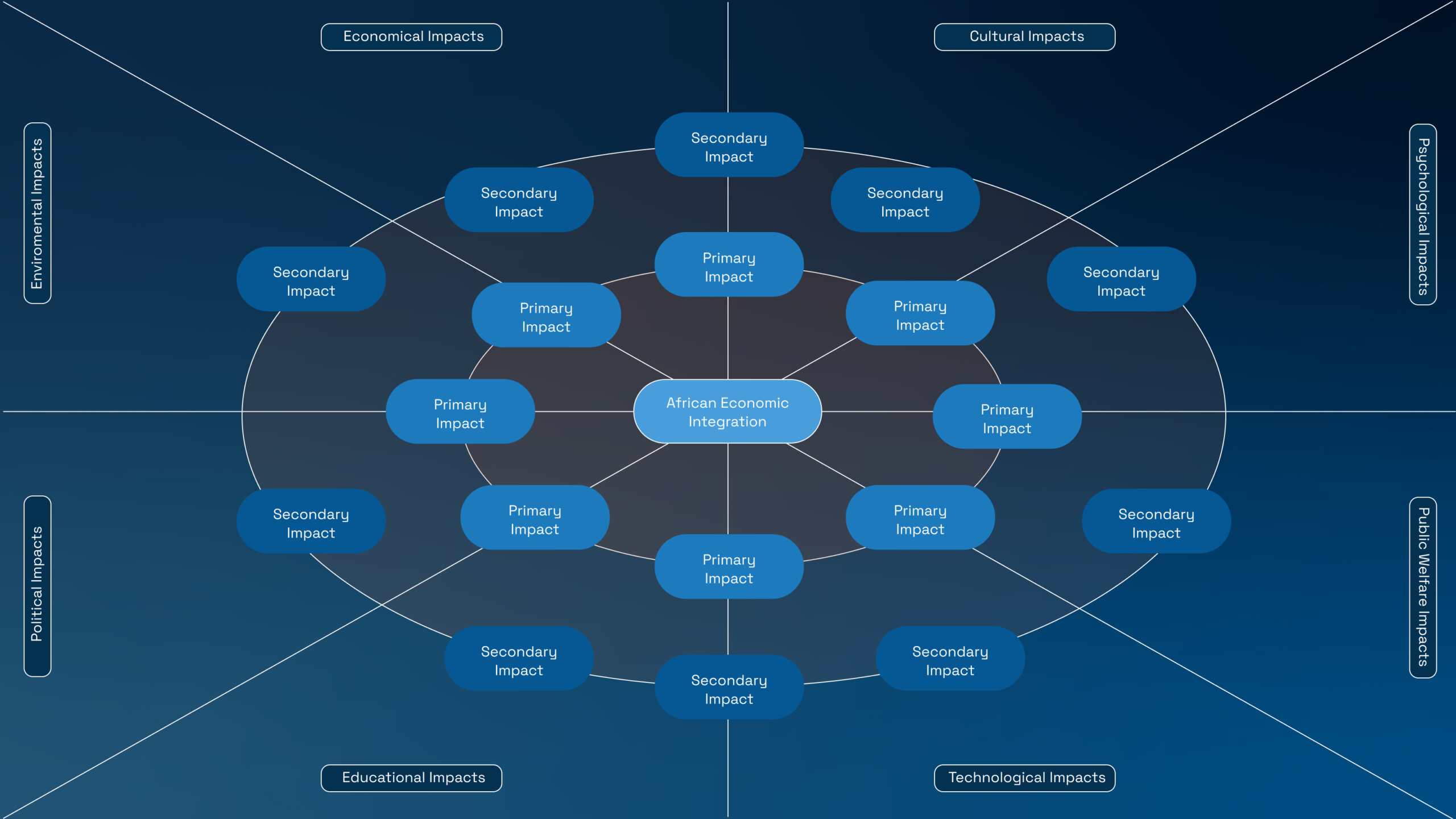
Another application of the Futures Wheel method is creating wheels for both the past and the future. For the past, a Futures Wheel helps us trace back and understand how specific events, trends, or decisions led to the present state, identifying patterns and lessons from past experiences.
For the “Future Futures Wheel”, it allows us to map out possible outcomes and their impacts, aiding in proactive planning and decision-making. While this is obviously an advanced-level use of the method, it shows how many possibilities there are in drawing circles about our present situation.
We have multiple futures and can work on the best one
We hope this overview made the Futures Wheel method accessible to everyone. We love this technique, as it requires no prior training; anyone can begin using it at any time, and it will benefit individuals or teams by fostering structured thinking.
Our graphic designer created editable Futures wheel templates on Google Slides, you can start working with it. You can freely resize the boxes, remove them, or add new ones to suit your needs. Feel free to create your own wheels!
Remember, the future is not set in stone. We are not merely waiting for a predetermined future to just happen to us. Instead, we face multiple possible futures, shaped by our choices and actions. By defining a preferred outcome, we work on our ability to reverse-engineer the process leading there, enabling us to make decisions today that steer toward our “best” future.