Diabetes as the Trojan Horse of Digital Health
Originally, a Trojan horse referred to the wooden horse used to cunningly penetrate and conquer the city of Troy by the Greeks. In our era, the term has been adapted to describe disguised malwares that attack unsuspecting users’ computers and wreak havoc once inside. Judging by the title of this article, how then can a condition as serious as diabetes help move the digital health agenda forward?

5 min |

Originally, a Trojan horse referred to the wooden horse used to cunningly penetrate and conquer the city of Troy by the Greeks. In our era, the term has been adapted to describe disguised malwares that attack unsuspecting users’ computers and wreak havoc once inside. Judging by the title of this article, how then can a condition as serious as diabetes help move the digital health agenda forward?

Once upon a time, empowered patients started a revolution…
It all begins with a crippling speed of bureaucracy and empowered patients who have had enough. One of the most awaited devices to help in diabetes care was, for a painfully long time, the artificial pancreas. The latter would replace patients’ malfunctioning pancreas with an advanced technology that creates a closed-loop-system constantly measuring the glucose level while communicating with an insulin pump to administer insulin and glucagon in the right amount at the right time automatically.
This would prevent serious complications like the dead-in-bed syndrome, where patients die in their sleep due to low blood glucose level while asleep and their inability to correct it in time. Alas, with regulation lagging behind, medtech companies failed to deliver such a device.
This blatant failure of medical hardware companies and regulatory bodies forced diabetic patients to take matters into their own hands. After all, theirs is a daily struggle where the stakes are life and death. The diabetic community went on to create the “#wearenotwaiting” movement, signifying that diabetics are fed up with fake promises of medtech companies to deliver new products to better attend to diabetes care and won’t wait anymore.
This led to initiatives like open-sourced DIY artificial pancreas, discussion platforms like DiabetesMine and cloud-based solutions like Tidepool, which makes diabetes data more accessible and actionable.

Moreover, such solutions don’t necessarily have to come from disruptive ideas but can build up on simpler ones. “I went from building a system to better wake me up at night to building an artificial pancreas system that allows me to sleep without having to wake up and take action for diabetes,” Dana Lewis, inventor of the DIY artificial pancreas, told The Medical Futurist.
Her simple idea and tinkering led to the creation of an insulin pump and glucose monitor hybrid device, one that big medical device companies couldn’t deliver for years. Dana open-sourced her findings and setup which are currently being used by more than (n=1)*1,569+ individuals around the world!
The fall of the ivory tower…
True, these endeavours are outside of the usual, tightly controlled world of medicine. But those very endeavours created a revolution that shook up the healthcare landscape. Diabetic patients forced medical companies and regulators to realize the vital input of patients for designing their very therapy. In 2016, the first FDA-approved artificial pancreas finally hit the market, nearly two years after Dana Lewis made hers publicly available.
The FDA now has a patient engagement advisory board. Earlier this year, we compiled a list of companies currently on the way to build the artificial pancreas or offering solutions to turn diabetes into an invisible condition, showing that things are moving in the direction that diabetics want it to move.
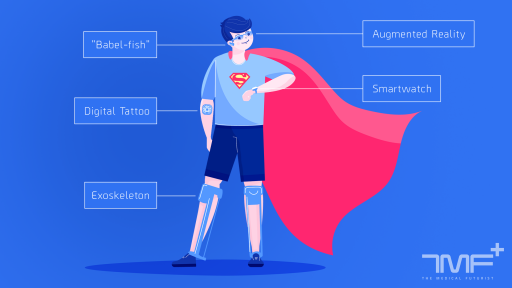
The ivory tower held by medtech companies and key policymakers is the Troy in our analogy, while diabetes is its Trojan horse hiding its proactive patients ready to reshape the diabetes care landscape. Thanks to a strong-willed community sharing information and knowledge online while forcing regulators to follow them, the actions taken by those affected by diabetes can serve as a template to advance digital health in favour of patients.
Treading the same path
Similar incentives empowering patients have been seen beyond diabetes as well. Dave deBronkart, also known as e-Patient Dave, was diagnosed with stage 4 kidney cancer in 2007. As an avid internet user, Dave logged on to Association of Cancer Online Resources (ACOR) website to learn more about treatment possibilities for his case from the cancer patients community.
That’s where he learnt about an experimental treatment he wouldn’t have heard of elsewhere and it was this treatment that eventually saved him. Since then, he has dedicated his life to advocate how much patients can help designing their own care.
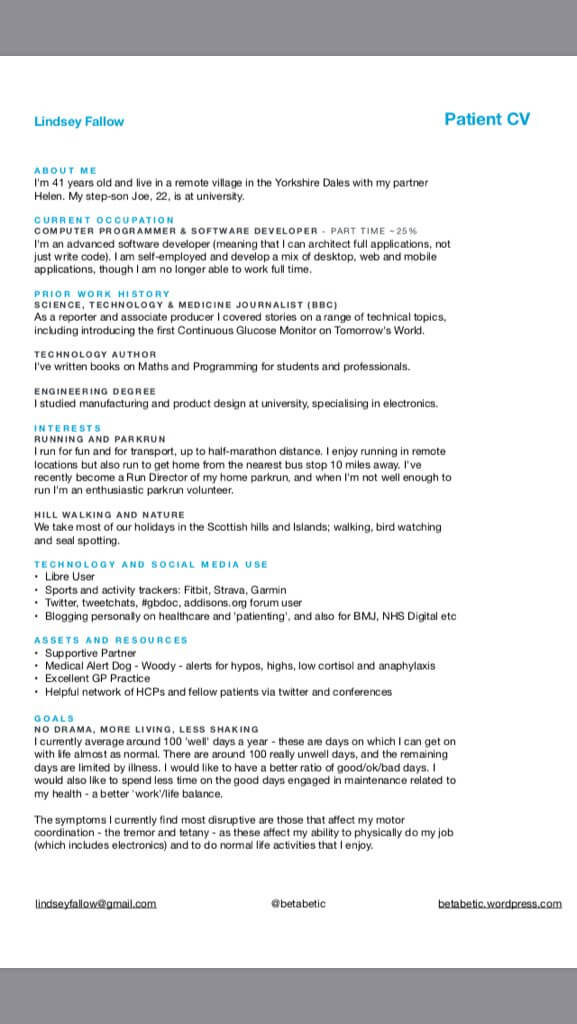
Another brilliant example is that of Lindsay Fallow, who copes with multiple endocrine problems including adrenal insufficiency and a type-1 variant diabetes, plus severe asthma and gastric issues on a daily basis. Given her complex medical history and the associated management required, Fallow came up with the idea of a Patient CV to present to her doctors.
Similar to a regular CV, this one-pager includes information about her personal and professional life but also about the fitness trackers she is using and all the resources and assets that help her manage her condition. “Who you are, defines how you deal with anything life throws at you… yet our medical records do not store that,” Fallow told The Medical Futurist.
Thanks to the #PatientCV movement she helped create, the clear and concise information listed in such a document can help doctors better understand patients’ conditions and give them the appropriate treatment. What’s more is that this CV can be stored on a phone or tablet, updated with time, and shown to every new doctor or clinic a patient visits.
At The Medical Futurist, we applaud such initiatives empowering patients through the use of technology and thereby helping in the design of their treatment. Afterall, it’s the patients who manage their treatments.
As such, we urge every major stakeholders from governments to health organizations to health insurance companies to appoint a patient advisory board in order to embrace patient design. As seen by the above examples, patients are not waiting and want to get involved in reshaping policies and regulations around healthcare for the better. Troy has already been captured and it’s getting reshaped by its new inhabitants.