Merck, GlaxoSmithKline, AbbVie, Sanofi & Bristol Myers Squibb: Big Pharma’s Extending Digital Health Reaches
A few weeks ago, we kickstarted a new series of articles contemplating the moves of pharmaceutical heavyweights in the digital health arena. The first batch […]

6 min |

A few weeks ago, we kickstarted a new series of articles contemplating the moves of pharmaceutical heavyweights in the digital health arena. The first batch of companies, Johnson & Johnson, Pfizer, Bayer and Novartis, seem to have some interest in remote healthcare solutions and DTx.
In this second article, we will explore which trends pharma giants Merck, GlaxoSmithKline, AbbVie, Sanofi and Bristol Myers Squibb are eyeing.
Merck: big tech-friendly
A big pharma company itself, Germany’s Merck hasn’t shied from teaming up with big tech companies in recent years as it aims to make a lasting footprint in the digital health sector. In 2019, Merck teamed up with China’s Tencent on digital healthcare services in the country. Their initial focus was on boosting disease awareness and the accessibility of health services through digital means.
More recently in 2021, the pharma company announced that it would work with tech giant Philips on digital tools for personalised fertility treatment. They aim to increase the chances of conception with tools like A.I.-enabled ultrasound and advanced informatics.
Merck not only collaborated with tech giants but also with companies working on digital health solutions of their own. Last November, it announced a new project with healthcare technology company Holmusk to support the treatment pathway of prediabetes and diabetes patients.
With Holmusk’s GlycoLeap platform, they aim to improve patients’ blood glucose control and weight loss goals. Merck announced another similar collaboration in June with health data analytics company Evidation Health. Through smartphone and wearable data, the pair aims to investigate the ability to diagnose Alzheimer’s disease early.

GlaxoSmithKline: exploring advanced tech
British multinational pharma company GlaxoSmithKline (GSK) is also no stranger to forging ahead collaborations in the digital health sphere. Back in 2018, it invested $300 million in direct-to-consumer genetic testing company 23andMe so as to leverage the startup’s seizable DNA database, but not without raising privacy concerns. Its more recent partnerships have been less controversial though and more geared towards healthcare A.I. endeavours.
In June, GSK and diagnostic and digital technologies developer Progentec announced that they would collaborate on researching new management tools for systemic lupus erythematosus; potentially with the integration of wearables, A.I. software and lupus-specific lab tests. Its other partnership formed in September with King’s College London to leverage A.I. to gain genetic insights into cancer treatment response.
Another interesting project in the pipeline for GSK was announced in June. Along with Siemens and IT firm Atos, GSK initiated a digital twin project on the manufacturing process of one of GSK’s vaccine adjuvant particles. With a digital twin, the team can receive valuable simulated insights that can be used to improve the real-world process.

AbbVie: wearables and long term projects
When it comes to digital health, back in 2019, U.S.-based AbbVie initiated promising pilot projects involving wearables to monitor patients with conditions like atopic dermatitis and Parkinson’s. In the same year, it teamed up with MC10 for clinical trials involving the use of the latter’s wearable health sensors with multiple sclerosis patients.
However, well before such projects, more specifically since 2014, AbbVie has been in close collaboration with Google-backed Calico, which itself works on longevity and combating diseases of aging. Their partnership advanced three neurodegeneration and cancer targets into the clinic; as well as led to the development of over 20 early-stage programs. In mid-2021, the two companies announced that they would be extending this collaboration to “discover, develop and bring to market new therapies for patients with age-related diseases, including neurodegeneration and cancer”.

Sanofi: expanding its reach
Akin to its competitors, French pharma multinational Sanofi strategically partnered with several companies for its own digital health endeavours. In March 2020, it teamed up with symptom checker developer Babylon to assist patients with digestive health conditions.
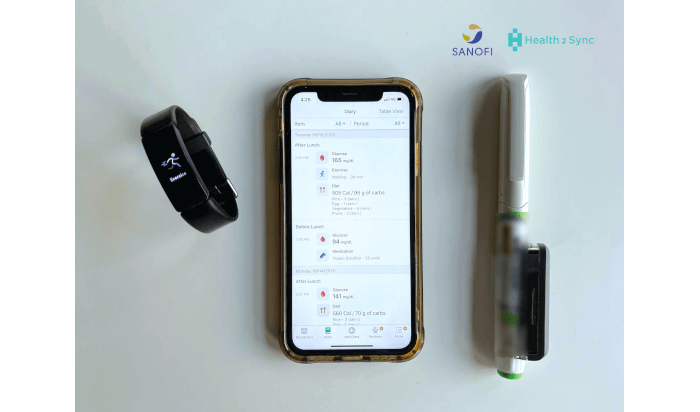
In September 2020, Sanofi entered another partnership with Taiwan-based digital health startup Health2Sync. The latter’s patient management software would be deployed in 300 Sanofi-contracted medical facilities for digitised diabetes management.
Sanofi further expanded its digital health partnerships in China by pledging to co-develop related projects during its second Innovation Summit. “Sanofi will further seize the opportunity to make a closer integration with external Internet ecosystems, promote our digital innovation and drive digital transformation to build an innovative healthcare ecosystem,” said Pius Hornstein, Sanofi China country lead.
Bristol Myers Squibb: siding with patients
Like AbbVie, pharma giant Bristol Myers Squibb (BMS) eyed the potential of wearables recently. In late 2019, it started working with Pfizer and Fitbit on educational content to help Fitbit users identify their risk of atrial fibrillation.
Some months later, in March 2020, BMS initiated a new digital health partnership with Voluntis, a Paris-based digital therapeutics developer. They aim to develop a smartphone app for cancer patients for remote monitoring and management of symptoms. The app’s algorithm will also supplement personalised recommendations for managing symptoms.
BMS also took some promising steps to promote patient advocacy in 2020. In June of that year, the pharma company paired with digital health firm GRYT Health for the ‘Advocacy Exchange’ virtual platform. The latter’s goal is to promote collaboration among patient advocacy organisations, policymakers and healthcare practitioners to support patients during the COVID-19 pandemic.
This second batch of big pharma companies that we looked at seem keen to extend their footprints in the digital health scene through multiple collaborations. This is not surprising given the financial incentives that the field promises. But it is also encouraging to see some like BMS take steps towards promoting patient advocacy, which is itself a major component of the cultural transformation for effective digital health strategies.
In the next installment to this series of articles, we will explore the digital health developments coming from our final list of pharma companies. Be sure to keep an eye out for it!
Written by Dr. Bertalan Meskó & Dr. Pranavsingh Dhunnoo
|
At The Medical Futurist, we are building a community for making a bold vision about the future of healthcare reality today. If you’d like to support this mission, we invite you to join The Medical Futurist Patreon Community. A community of empowered patients, future-oriented healthcare professionals, concerned health policymakers, sensible health tech developers, and enthusiastic medical students. If there were ever a time to join us, it is now. Every contribution, however big or small, powers our research and sustains our future. Click here to support The Medical Futurist from as little as $3 – it only takes a minute. Thank you. |