7 Promising Examples AI Could Do In Healthcare In The Future
Here, we share 7 examples of what these next milestones for AI in healthcare might look like. As these mostly represent ideal scenarios and aspirations, there are no current examples but hints of what we can expect.

6 min | · Updated
Key Takeaways
As we progress across levels of automation, AI technology will be able to handle more complex tasks with less human input, even in the healthcare sector.
In this article, we share 7 examples of the next milestones that AI could bring to healthcare.
In our recent series of artificial intelligence (AI) in healthcare, we looked at what the technology can already do and at what we can expect it to do in the near future. With technological development, there will be further potential for AI in this field beyond the ones we shared before.
In particular, as we progress across levels of automation, AI technology will be able to handle more complex tasks with fewer human input. They might take longer to materialise due to regulatory and computational hurdles but we can expect them to be the next big things in healthcare over time.
Here, we share 7 examples of what these next milestones for AI in healthcare might look like. As these mostly represent ideal scenarios and aspirations, there are no current examples but hints of what we can expect.
1. Personalized AI doctors and health companions
We are used to conversing with AI assistants for specific health services such as Woebot for mental health assistance. In the future, AI systems will be able to offer more health services, akin to a health navigator “living” with patients. They will be able to offer end-to-end consultations, diagnostics, and treatment recommendations tailored to individual genetics and lifestyle.
OpenAI and Thrive AI Health have partnered to build an AI health coach for personalised health and lifestyle advice which might give us a glimpse of that future.

Before such AI systems are deployed, the accuracy of their output will have to be virtually infallible. Moreover, they will have to abide by regulatory safeguards and, importantly, be met with minimal social friction.
2. Fully autonomous robotic surgeries
Robotic assistance in the operating room is a rising trend. With tools such as the da Vinci surgical system, surgeons across the world are able to perform more precise operations. Over time, robotic systems using advanced AI will become more agile and precise. They will be able to perform surgeries independently with precision beyond human capability.
While we are not at that level yet, researchers have provided us with a glimpse of such a future. Johns Hopkins University academics have designed an automated robot to independently perform laparoscopic surgery on the soft tissue of four pigs. It was also able to reconnect two ends of their intestines producing significantly better results than humans performing the same, extremely challenging surgical procedure.
3. AI-generated virtual twins for disease simulation
In healthcare, digital twins refer to virtual representations of the human body and its organs. Digital twins have been used to study some human organs. For example, the Blue Brain Project from École Polytechnique Fédérale de Lausanne in Switzerland is building digital reconstructions of the brain, while Siemens Healthineers is working on a digital twin of the liver.
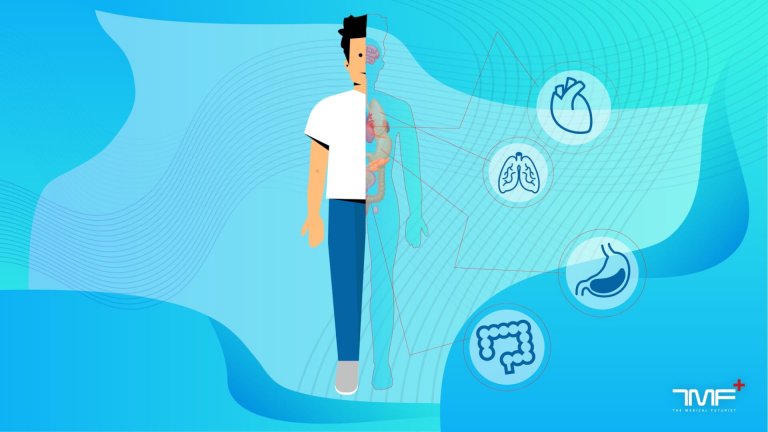
We are still far from a completely digitized version of a full patient but developing digital twins of organs will lead to digital human bodies. With such personalized digital replicas of patients, physicians can simulate treatment outcomes before trying them in real life. AI could help in the development of such models and they could even help digital twins converse with healthcare professionals during simulations.
4. Predicting global health crises
We’ve all lived through a pandemic and don’t want to go through such an experience again. AI technology has been shown to be of assistance during such health crises. During the COVID-19 pandemic, an AI company and its team of epidemiologists used an algorithm to issue the first warnings of the virus’ spread, even before the WHO and the CDC did so.
In the future, advanced AI systems will be able to detect outbreaks well in advance. They will be able to help mode the disease’s spread and suggest containment strategies in real-time. Such approaches will help prevent uncontrolled propagation and minimise consequences to the public.
5. Detecting unusual biomarkers
Biomarkers generally refer to biological signs that provide insights into one’s health status. Classic examples of biomarkers include the likes of heart rate and blood chemistries. With the rise of personal health sensors, we now have a new set of biomarkers, the so-called “digital biomarkers”. These refer to fitness and wellness data collected through digital health technologies.

The wealth of data that they collect can provide personalised insights with the assessment of AI tools. The technology could be used to identify subtle cues in unconventional ways. For example, it could analyse voice patterns from audio recordings to assess neurological disorders or musculoskeletal issues by analysing gait in videos. Research has been undertaken to use vocal biomarkers to identify COVID-19 from cough recordings and to assess for Parkinson’s disease; and in the future, AI tools could be able to assist in such diagnoses via simple apps.
6. Revolutionising the medical research process from findings to publication
AI has increasingly been the subject of medical research and assisting in medical studies. For example, Google DeepMind’s AlphaFold AI has assisted in the prediction of protein structures which can help in drug discovery and improving treatment for diseases. The developers of the tool have even been awarded the 2024 Chemistry Nobel Prize for this scientific breakthrough.
However, in the future, AI will not only assist in such processes but it will be actively involved in them. In the case of AlphaFold, the next steps could include drug discovery based on simulated molecular interactions developed by the AI itself. The tool would not only make the discoveries but also write the relevant academic papers. As the technology edges closer to artificial general intelligence (AGI) or gains “human-level cognition”, AI might even develop medical breakthroughs that are worthy of a Nobel Prize.
7. Restoring abilities with brain-computer interfaces
Brain-computer interface (BCI) technology has been a longstanding neurological research field where brain signals are used to interact with a piece of technology. Traditionally, BCI has been used in patients with severe motor or communication challenges to provide them with simple controls for routine activities such as moving a computer mouse to communicate.
Recently, companies like Neurable, Synchron and Neuralink have been increasing awareness of BCI implants to re-enable communication for patients with paralysis or neurodegenerative diseases. Neurable’s BCI further uses AI to provide predictive analytics to provide preventative and personalized health options.
With more advanced AI technology, AI-powered BCIs could even replicate speech and control exoskeletons to restore motion in patients. In fact, a BCI developed at UC Davis Health has been able to translate brain signals into speech with up to 97% accuracy. In France, researchers have developed a brain-controlled exoskeleton that can help tetraplegics walk again.
This brings us to the end of our collection of the possible next big things that AI could bring in healthcare. As these are long-term potentials, we are not likely to see them in practice soon. But we hope that this article has provided you with a glimpse of a promising, AI-powered future of healthcare.
Written by Dr. Bertalan Meskó & Dr. Pranavsingh Dhunnoo