What Would It Take For AI To Prescribe Medications Without Human Supervision?
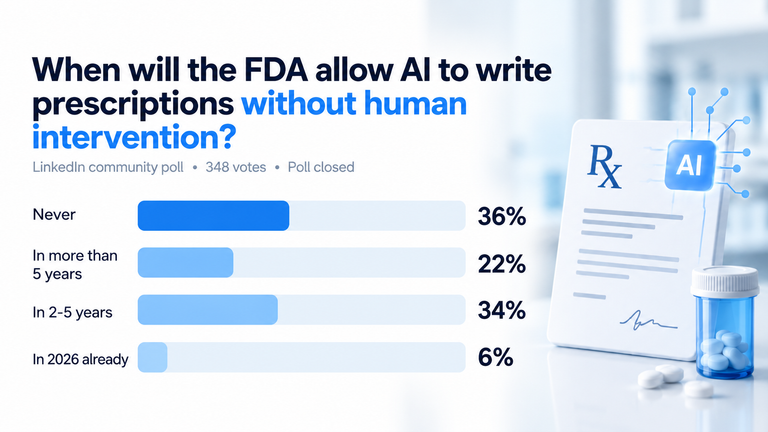
I recently asked my LinkedIn community when they think the FDA might allow AI to prescribe medications without human intervention. Of the 348 respondents, 36% […]

4 min |

I recently asked my LinkedIn community when they think the FDA might allow AI to prescribe medications without human intervention. Of the 348 respondents, 36% said never, while 34% expected it within 2–5 years. I find this divide fascinating because the first experiments are already happening.
In Utah, a regulatory sandbox allows companies to test AI prescribing under specific conditions. One pilot focuses on acne treatments, while another explores renewing existing prescriptions. These are limited experiments with clinical oversight, but they represent a significant step towards autonomous AI in medicine.
Meanwhile, a recent JAMA viewpoint argued that autonomous clinical AI could eventually make medical decisions independently, provided that a new regulatory framework defines its responsibilities.
I think the most interesting question is what would have to happen before we could safely allow AI to prescribe medications without human supervision. I see four major requirements.
1. AI would need a clearly defined scope of practice
We already know this concept from human medicine. Healthcare professionals have defined responsibilities based on their qualifications, specialties and legal authority. AI would need similar boundaries.
An AI system might be allowed to renew prescriptions for patients with stable chronic conditions or select from a limited number of topical treatments for uncomplicated skin conditions. Prescribing complex medications for patients with multiple diseases would require a very different level of evidence and safeguards.
This is exactly why the Utah experiments are so interesting. The acne pilot, for example, uses a predefined list of topical treatments and excludes oral medications.
I expect autonomous AI to enter prescribing through these narrow applications first, gradually expanding its responsibilities as evidence accumulates.
2. It would need convincing clinical evidence
We have become accustomed to seeing AI systems achieve impressive results on medical examinations, clinical benchmarks and diagnostic tasks. These demonstrate technological progress, but they tell us little about how safely an autonomous system would prescribe medications in everyday clinical practice.
We would need prospective clinical studies demonstrating that AI prescribing can achieve outcomes comparable to, or better than, established clinical practice.
The evaluation should include prescribing errors, drug interactions, contraindications, adverse events and outcomes across different patient populations. These systems would also need continuous monitoring after deployment, especially when their underlying models are updated.
The evidence should determine how much autonomy we give AI. This step alone will definitely take years.
3. AI would need to recognize when human intervention is necessary
One of the most important capabilities of an autonomous clinical AI system would be recognizing the limits of its own competence.
Imagine an AI renewing medication for a patient whose condition has been stable for years. That might be a relatively straightforward decision. But what if the patient’s kidney function has recently deteriorated, another medication has been added, or the patient reports an unexpected symptom?
A reliable system should recognize these situations and refer the case to a qualified healthcare professional.
This is already part of the Utah pilots. Nolla Health’s system refers uncertain cases to physicians, while August AI’s prescription renewal pilot is designed to detect circumstances requiring human intervention.
This ability to recognize uncertainty and escalate complex cases will be one of the defining requirements of safe autonomous AI in medicine. This will help medical professionals gain trust in the system.
4. Liability would have to become painfully clear
This is perhaps the most difficult requirement. If an AI prescribes the wrong medication, misses a contraindication or causes harm, who is responsible?
The company developing the system? The healthcare institution deploying it? The physician who was never involved in the decision? We cannot build a healthcare system in which autonomous decisions have consequences for patients while responsibility remains unclear.
Before widespread autonomous prescribing becomes possible, regulators and healthcare organizations will have to establish clear legal accountability, insurance arrangements and mechanisms for investigating harmful decisions.
These questions are difficult even when a human physician makes a mistake. Autonomous AI introduces additional complexity because the system may operate without anyone reviewing individual decisions.
How far are we from autonomous AI prescribing?
We will see more narrowly defined autonomous prescribing applications in the coming years. Medication renewals and selected low-risk treatments offer opportunities to test the concept under controlled conditions.
Broad autonomous prescribing across multiple diseases and medication categories is a much more distant prospect. Maybe a decade in the making.
And I would not expect a single moment when regulators suddenly announce that AI can prescribe anything. We will probably see a gradual expansion of permissions, with different systems earning different levels of autonomy.
The goal should be to give AI as much autonomy as the evidence and safeguards justify.
That is how I would like to see autonomous prescribing become part of the future of medicine.