We Went To A NATO Military Medical Exercise. Here’s What We Learned
In Afghanistan, when we went out for a mission, the thought always calmed me down that no matter what happens the medical team has our back, says Lieutenant Colonel Dirk Mathes, currently Desk Officer at NATO’s Headquarters to The Medical Futurist in the middle of a field somewhere close to Craiova, Romania. We’re sipping coffee from white plastic cups, while some military vehicles fire at imaginary enemies in the distance. A live firing exercise is underway on the first day of the NATO Vigorous Warrior Multinational Joint Medical Exercise. How did we end up there? Sometimes our Editor-in-Chief was asking herself the same question. Here’s her account on a military field trip.

10 min | · Updated
|
THIS ARTICLE HAS NOT BEEN UPDATED SINCE 2019. THE INFORMATION SHARED IN THE ARTICLE WAS ACCURATE AT THE TIME OF ITS PUBLICATION, BUT IT MAY BE OUT OF DATE NOW. BROWSE OUR LATEST ARTICLES HERE |
In Afghanistan, when we went out for a mission, the thought always calmed me down that no matter what happens the medical team has our back, says Lieutenant Colonel Dirk Mathes, currently Desk Officer at NATO’s Headquarters to The Medical Futurist in the middle of a field somewhere close to Craiova, Romania. We’re sipping coffee from white plastic cups, while some military vehicles fire at imaginary enemies in the distance. A live firing exercise is underway on the first day of the NATO Vigorous Warrior Multinational Joint Medical Exercise. How did we end up there? Sometimes our Editor-in-Chief was asking herself the same question. Here’s her account of a military field trip.
Dashing warriors in vigorous weather
Uniforms, soldiers, tanks, helicopters, weapons, and commands uttered in staccato. The scene was as far away from me as a termite from driving a Tesla. Thus, I hesitated for weeks whether to accept the NATO invitation to visit Craiova, Sibiu, and Cincu between 9-12 April. At first, the invite landed in Dr. Meskó’s inbox, but he couldn’t participate due to his schedule being full and that’s how I came into the picture. On the plus side, the press release promised the largest medical exercise in the history of the Alliance with 38 participating nations, as well as civilians from 10 different organizations, including air, land and naval components, chemical, biological, nuclear centers, a virtual reality center, a biolab, and many other “gourmandises”. Finally, my curiosity triumphed (it usually does), so I packed my most military-ish looking boots, least civilian jacket, and the next thing I knew was asking First Lieutenant Dogaro, Staff Officer in the 26 Infantry Battalion, next to a combat vehicle somewhere in a sunny field near Craiova what we have just experienced.
Day One. Lieutenant Dogaro told me how the Romanian and the Polish military contingent conducted attack and defense operations, how the troops simulated an ambush with numerous casualties which required the intervention of the medical crew and how difficult it is to secure the zone where the injured soldiers are waiting to be evacuated while being under attack. Heavy smoke was wreathing over the trees as I jumped into one of the combat vehicles under the gaze of soldiers and hiding behind the lens of my iPhone to ride off to Sibiu to finish the day. Never before had I been taken to my fish and chips dinner in a tank, but that was just the beginning.
High-intensity conflict situations, building collapses, or epidemiological outbreak
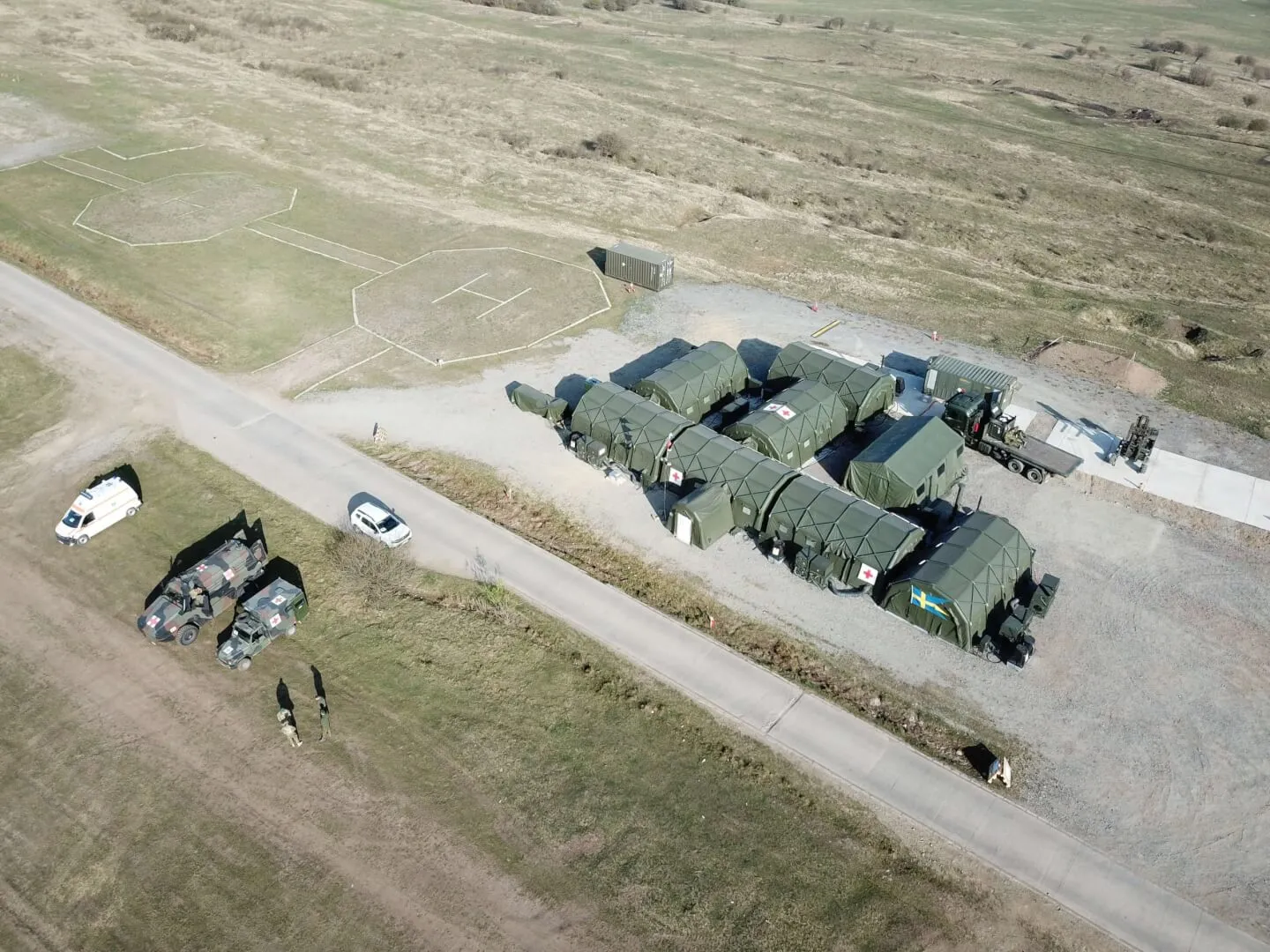
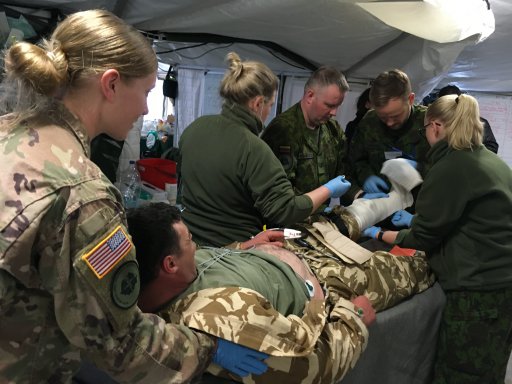
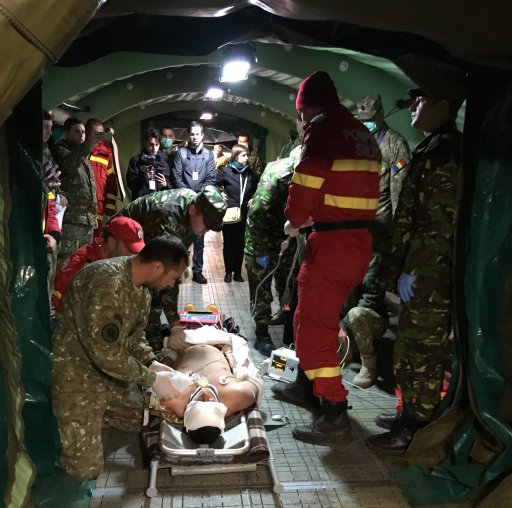
Day Two. After a bus trip to Cincu and fully prepared to get heavy rain, in a short morning briefing Captain Máté Tóth, International Relations Officer at the NATO Center of Excellence for Military Medicine, introduced the military medical exercise. He sketched how the setting simulates a NATO Article 5 scenario – an attack against a member state is an attack against all allies – with around 200 casualties entering the system each day going from triage to treatment. The cases vary from incidents like small arms fire, rocket attack, to building collapse, an epidemiological outbreak or intoxication, while patients are played by both soldiers and enterprising civilians. The field hospitals accommodate fully equipped ER, OR, and ICU units, the staff even set up a veterinary unit to treat stray dogs and deal with public health issues.
Colonel Dr. Laszlo Fazekas, Director of the NATO Center of Excellence for Military Medicine, leader of the military medical exercise, after jokingly hinting at my weather-inappropriate non-military clothing as a “nice try”, told me that in the war in Afghanistan, NATO forces could ensure the care of the injured in 97 percent of the cases in low-intensity conflict situations. In such settings, after controlling bleeding and doing inevitable damage control on the battlefield, NATO forces can ensure that the injured gets to a hospital by plane within one hour. On the other hand, the present exercise simulated what happens in high-intensity conflict situations if the patient cannot be brought to a medical facility via plane. The question was how NATO could increase survival rate under such circumstances.
Painting wounds and satisfying case managers
The entire simulation seemed to work like a clockwork, where everyone knows their role and plays by the rules. Civilians or soldiers simulating an injury grunted in pain, while medical staff offered words of empathy in the midst of exams or treatment.
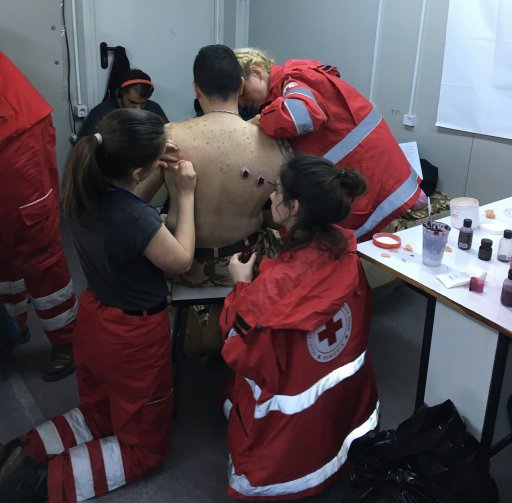
The key to the realism of large-scale medical exercises lies in the introduction of case managers, explained Dr. Melinda Gál, Chief Emergency Medical Officer at Targu Mures, Romania, who coordinated civilian case managers during Vigorous Warrior. This concept is brand new: Dr. Gál told me that it has only been a year since they first applied it, but the number of case managers working on NATO medical exercises has risen to 80 people.
They include nurses or physicians, for example, anesthesiologists, surgeons or emergency specialists, who tell the roleplayers what injuries they have, how they should behave, and what vital signs they exhibit. Then the roleplayer “gets” the injury: wounds are painted on shoulders, blood is displayed on chests – moulage is everywhere. Then, the case manager follows each patient: as the military medical staff treats the roleplayer, so do their parameters and their condition change.
How to hold your ground?
While I was a curious outsider walking around medical personnel doing blood work, lab tests, medical imaging, damage control, transferring patients to the OR, and being trained in laparoscopic simulations, I could feel the stakes were high. Captain Máté Tóth told me that through such simulations, they are testing medical procedures that had never been deployed in combat situations. They are aiming for mimicking reality in the most possible way while preserving the health of their personnel. At the present military medical exercise, they experimented, for example, with the scenario of how different surgical teams from different countries react if they are placed in entirely new technological settings. In their experience, one of the biggest challenges for medical staff in the field is not transporting technology but having an expert who can actually operate a given medical device – as they are different in almost every hospital, not to speak about the variety of instruments in various countries.
Captain Máté Tóth explained how important it is for a highly skilled medical team to hold their ground in an entirely unknown OR or other completely foreign situations. But he also mentioned that medical equipment also has to be shaped to persist no matter what. Ultrasounds, X-rays, other medical devices have to be robust: they are constantly moved, placed in tents where dust, water, or other materials constantly impact them or are sterilized several times a day with strong chemicals. These are the factors military medical equipment developers have to keep in mind when designing a new solution for the army.
What could the future of military medicine hold?
I was running around asking everyone I could get a hold of to answer this question until I found myself in the virtual reality center, where I found the response how military medical exercise in the future might look. Paramedics were sitting in front of screens simulating building collapses, mass casualties, and environmental disasters, such as earthquakes, gas leakage, or radiation. The task was to coordinate their moves to see how they communicate with various units, soldiers, firefighters, first responders in difficult situations and how they make decisions.
Diana Vikas, an emergency resident from Targu Mures told me they introduced VR simulations in 2013, and she expects these to partly replace military exercises in the future as you don’t need roleplayers, vehicles or other equipment, while you can still easily create situations with multiple victims in various settings. However, you cannot simulate the treatment of patients in VR, so military medical exercises will likely stay for a long time.
The future of military medical technology
Colonel Dr. Laszlo Fazekas noted that everything here is about time. How to keep the injured alive until the medical crew arrives on a scene. From experts to soldiers, first responders to technology, everything is dedicated to this one objective – and future digital technologies should undertake the exact same task.
Captain Máté Tóth mentioned how he believes the next big thing on both the civilian and military scene will be the constant presence of sensors and wearables. It would be of tremendous help for commanders to get real-time feedback about the state of their soldiers – how tired they are, whether they have any medical issues or mental health troubles.
Military medicine already applies remote monitoring, telemedicine, and big data-based analytics in epidemiological predictions, but these will likely be even more crucial in the future. Captain Máté Tóth mentioned how the Munich-based department for the prevention of transmissible diseases of the NATO Center of Excellence already uses data from the military systems coupled with background information to try to predict potential outbreaks. Regarding telemedicine, he mentioned the example of the hospital in Mazar-i-Sharif, Afghanistan. The medical team records a radiological image there and sends it back to a German military hospital, where another team of specialists evaluates the case. It is a convenient solution as they can utilize the experience of the best experts even in the field of battle.
Regarding the question of technology taking over tasks in military medicine or conducting exercises, Captain Máté Tóth said that until humans fight wars, we are likely to have people who heal them, and we will have to do exercises to practice. He explained how strong the bond between soldiers and the medical crew is, how trust overrides everything else. “The soldier knows that there will be someone who comes for them in the moment of need, there will be someone who provides care for them, and that has an enormous impact on morale”, he added.
|
At The Medical Futurist, we are building a community for making a bold vision about the future of healthcare reality today. If you’d like to support this mission, we invite you to join The Medical Futurist Patreon Community. A community of empowered patients, future-oriented healthcare professionals, concerned health policymakers, sensible health tech developers, and enthusiastic medical students. If there were ever a time to join us, it is now. Every contribution, however big or small, powers our research and sustains our future. Click here to support The Medical Futurist from as little as $3 – it only takes a minute. Thank you. |