The Top Examples of Gamification in Healthcare
If you measure your daily step count or raise a virtual plant to drink more water a day, you already fell victim of the charms of gamification. Is it bad news? On the contrary! Gamified apps, devices, and therapies will gradually appear in every field of healthcare making behavior change easier and more fun. Here are the greatest examples of gamification!

Dr. Bertalan Mesko, PhD
28 October 2024
Key Takeaways
Gamification is the process of adding games or gamelike elements to a task or a process to encourage participation.
Gamified apps, devices, and therapies will gradually appear in every field of healthcare making behavior change easier and more fun. Here are the greatest examples of gamification!
If you measure your daily step count or raise a virtual plant to drink more water a day, you already fell victim of the charms of gamification. Is it bad news? On the contrary! Gamified apps, devices, and therapies will gradually appear in every field of healthcare making behavior change easier and more fun. Here are the greatest examples of gamification!
Why is it so hard to change?
Sequin dresses, champagne and smiling faces counting down to the new year. Some kisses here and some resolutions there. This time, Samantha thought everything will be different. She made a resolution every year to change her lifestyle into something fitter but she could not make a lasting change in the long run. But this time, she was absolutely determined. In the first weeks of January, she bought new shoes and active wear, she started to spinning class twice a week and promised herself a biking weekend as a reward in the spring.
But then in February, Jim’s birthday celebration collided with her work out session, so she missed it out. Afterward, her mom needed to be brought to the hospital due to chest pains, while another time her fridge broke and needed to wait for the technician. March was already upon her when she realized – she does not go to the gym anymore.
Her story is one of ours, no matter whether it’s about sports, eating, reading more or working less. I spoke to Jurriaan van Rijswijk, Chairman of the Games for Health Europe Foundation, about why it is so hard to adopt new habits. The gamification expert said that motivation is one factor in changing behavior, but loyalty towards the subject of change is something people usually don’t consider. The money versus time issue is often why desired long–term behavioral change fails. So instead of trying to buy your way into change with sport clothing items or pricey devices, at first, you should start spending time exercising with limited resources and technology. Then gradually the new behavior becomes valuable, and you will spend more and more of your valuable time doing it.

Technology can be your coach supporting lasting change
The key to success is time commitment or loyalty to the subject. Both are really hard to reach, but there are factors making it easier. Some people are motivated by the feeling of community and socializing, others by getting rewards for certain achievements, competing against others, looking at data and measurements about small successes or making the whole process fun.
Technology can combine many of these factors and could become a resource liberating tool helping us spend more time on the desired goal. I have been measuring my health parameters and vital signs for years. I know that sometimes I run for another ten minutes just to beat my score from yesterday. However, there are many people for whom it is not enough motivation if you show their raw data, they need challenges, rewards or some community. Gamification can do the trick for them.
A new buzzword: Gamification in healthcare
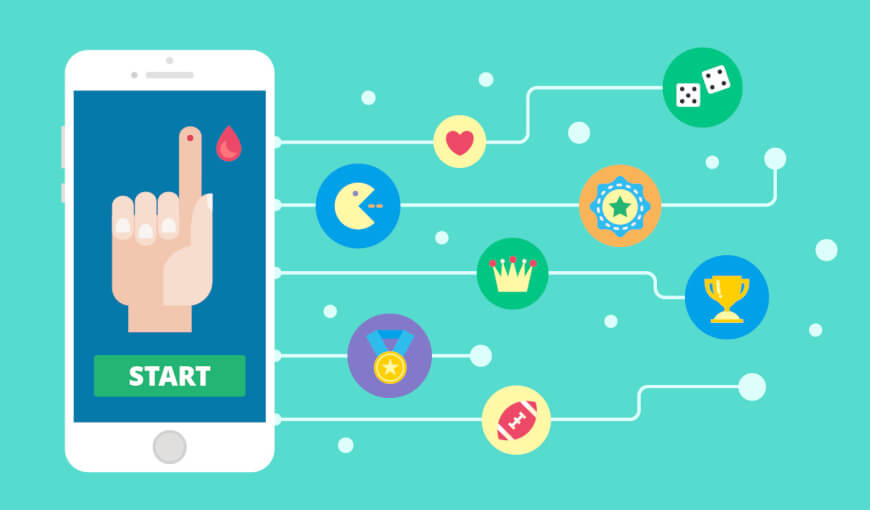
Game play focuses and controls our attention, taps into our innate strengths, thrills us utterly, and compels us to greater resilience in the attainment of more powerful and effective skills. That’s why many believe it is perfect for behavior change in healthcare. A game is more than the automatic collector of vital signs and notifications. Gamified services engage us, keep us motivated and helps us down the bumpy road of change. It’s the combination of a great buddy and a considerate parent. That’s why I believe gamified solutions will spread like epidemics in healthcare as well.
But it is really difficult to find the right balance for digital tools to act as sources of motivation not turning into burdensome constraints or “digital whips”. Years ago, Fitbit announced that it was partnering with employers, corporations to track employees and mine that data in order to monitor employee health habits. Fitbit was introduced way before in several companies as “the corporate fitness tracker” creating common challenges and competitions for employees – which is fun and motivating.
In an interview, Adam Pellegrini, VP of Digital Health for Fitbit told me that Houston Methodist implemented a month-long step challenge where employees went head to head with their departmental CEOs. Average daily step count to beat was 16,000! Now that’s what I call a challenge!
But imagine that your boss knows about your fitness goals, sees your data – and has the capacity to forward it to the health insurance company deciding about your premiums! Imagine that you are making a lot of effort to lose weight but still your employer considers that it is not enough… Where are the boundaries of a motivating tool? How far could employers, moreover health insurance companies go when it comes down to the health or fitness issues of their employers or users? Complex and difficult questions which need to be answered soon!
Great game design is difficult
As you could already discern from the above, game design is a very difficult area. You need something which pulls you in but does not make you toxically addicted, which is fun but also informative, which creates achievable but not that easy challenges. Not to speak about the most problematic part of a gamified device or app: its ability to achieve lasting change.
There was a study which examined the effects of Pokémon Go. Shortly after the release of the little monster hunting adventure, there was a lot of enthusiasm that it would be a healthy addiction by getting users more active. Pokémon Go players’ steps went up from an average of 4256 steps per day to 5123 steps in the first week of playing the game. After that, though, there was a gradual decline back to where they started by the sixth week. That pattern was consistent across various subgroups based on neighborhood walkability, income level, age, and more.
However, there are good examples of apps and services that provide motivation, rewards and reinforce commitment. If we respect the fact that it will only work when participation is voluntary and self-motivated, they could really help in achieving great things. Here, I collected some of the most widely known game-based digital technologies in healthcare.
1) Physical fitness
I already mentioned Fitbit & Co: how common challenges can be set up through the Fitbit community interfaces and how competition could motivate better gym performances and step counts. EveryMove also counts on your competitiveness. It collects data from trackers and apps we already use to allow friends to compare one another’s progress. Social motivation, such as seeing that my friends went for a run today but I haven’t yet, is a strong one.
Blue Shield California, a not–for–profit health insurer, attempts to make wellness fun via social media. Participants earn points, badges, status, and see their progress. Blue Shield claims that 80 per cent of its employees have participated, and had a 50 per cent drop in smoking prevalence.
2) Medication and chronic condition management
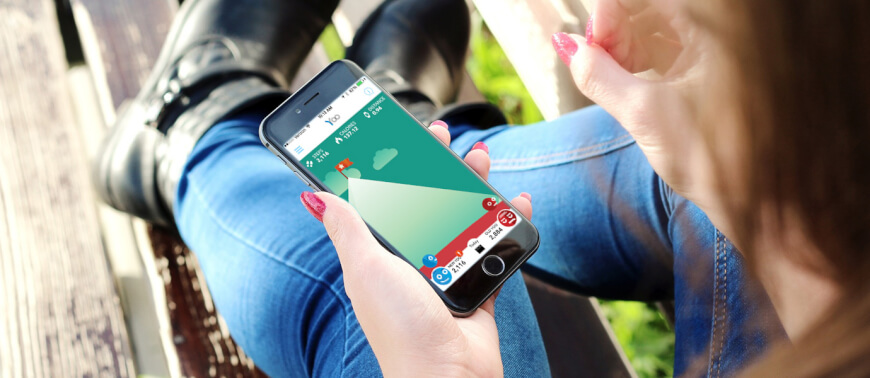
Bayer’s Didget blood glucose meter, which connects to a Nintendo DS gaming platform, is intended for kids between 4 to 14. It helps manage their diabetes by rewarding them for consistent blood glucose testing. As points accumulate, new game levels and options unlock. There are leader boards with kids who collected the most points, web games and an online community as well.
The Austrian startup, mySugr also offers its gamified solutions for diabetes management in a fun way both for children (mySugr Junior app) and adults. As the creator of the cute diabetes monster, mySugr has already over a million registered users, is available in 52 countries and in 13 different languages. It was later acquired by the global pharmaceutical company, Roche.
3) Gamification for kids
It is especially important to apply gamification for medical solutions aimed at children as they usually do not understand the importance of therapies or drugs for their health, in the long run, they just consider the short-term miseries. They do not want to swallow bitter pills or eat vegetables, do not want to go to therapy or stay in the hospital. Gamification can help forget kids that they are undergoing therapy or medical treatment. If they believe they are swallowing the secret of a long-gone civilization with the pill and only their enteric bacteria could decipher that code, they would gladly take any drug.
For example, the American Red Cross developed an app called Monster Guard focused on helping prepare children for emergencies. It teaches kids through “Monster Guard Academy” how to prepare and stay safe during home fires, hurricanes, floods or other disasters, and they get points and medals for completing tasks.
Raising a health-focused and fit child is also easier through gamification. Smartwatches made for them encourage kids to stay on the move. Kids can gather points and other rewards while staying physically active.
4) Physical therapy and rehabilitation
After a serious injury or a stroke, it is difficult and time-consuming to reach even an agreeable level of independence regarding movement or other activity. If you have trouble imagining what it’s like to tackle everyday challenges after waking up from an accident, try the SCI Hard gaming app developed by the University of Michigan. Gamified therapies could help in making rehabilitation more fun, stretching abilities playfully and divert attention from pain. Reflexion Health uses a video feedback system to correct the movements of patients practice physical therapy based exercises. The system works in patients’ homes. Movements are modeled by animated figures. Motion guided technology compares patients’ movements with those of the models and gives guidance and correction suggestions.
A Canadian company, GestureTek Health develops applications specific to health, disability, and rehabilitation. Its VR exercise programs enable patients to have fun while stretching their physical and cognitive capabilities. MindMaze created devices, which use virtual reality, brain imaging and gaming technologies to retrain the brain in stroke victims. It also works on solutions for spinal cord injury and amputee patients.
In the medical world, compliance is the word that is used to describe to what extent patients abide themselves by the therapy. Yet, as patients are more and more empowered, the expression becomes more and more offending as it assumes that patients are blindly following the doctor’s commands and do not follow recommendations voluntarily. Instead, they want to actively take part in their health, they want the patient-doctor relationship to be on an equal level. Instead of compliance, they want to be motivated on the long-run.
With digital health powered healthcare in the future, gamification will be the help already motivated patients need in order to stick to therapies without burdening efforts.
|
At The Medical Futurist, we are building a community for making a bold vision about the future of healthcare reality today. If you’d like to support this mission, we invite you to join The Medical Futurist Patreon Community. A community of empowered patients, future-oriented healthcare professionals, concerned health policymakers, sensible health tech developers, and enthusiastic medical students. If there were ever a time to join us, it is now. Every contribution, however big or small, powers our research and sustains our future. Click here to support The Medical Futurist from as little as $3 – it only takes a minute. Thank you. |