Health Tech And Smart Habitats For People With Special Needs
No matter whether it’s about the problems of ageing, vision, hearing, disabilities or other permanent conditions, modern urban environments or residential places often disregard people […]

6 min | · Updated

No matter whether it’s about the problems of ageing, vision, hearing, disabilities or other permanent conditions, modern urban environments or residential places often disregard people with special needs. Luckily, technology and smart design might offer solutions on how to make cities more accessible, more inclusive and entirely suited for everyone in the future.
Smart cities helping people with disabilities
According to the United Nations, by 2050 70% of the global population will live in cities, of which at least 15% will be people with disabilities. Moreover, 360 million people worldwide have moderate to profound hearing loss, 285 million people are visually impaired (39 million of whom are blind) and 75 million people need a wheelchair (of which, only 5-15% actually have access to one). Inclusive, accessible, sustainable and viable cities are needed.
What does an ideal smart habitat look like? It is a place that incorporates technology to make city life more accessible and efficient, without feeling like technology is present. Imagine shopping malls and retail stores, schools, corporate offices, medical buildings and more being all fully accessible through mobile applications, voice commands, and mandatory automatic doors.
Walking to the bright side
Toronto is slated to be the first smart city in Canada thanks to Google’s parent company, Alphabet’s Sidewalk Labs. The project’s mission is to “blend people-centered urban design with cutting-edge technology to achieve new standards of sustainability, affordability, mobility, and economic opportunity.” In an interview, Willa Ng, Associate Director responsible for Mobility and Streets at Sidewalk Labs said that they strive for solutions such as smart street lights, which would notice elderly people and halt the traffic as long as they crossed the street.
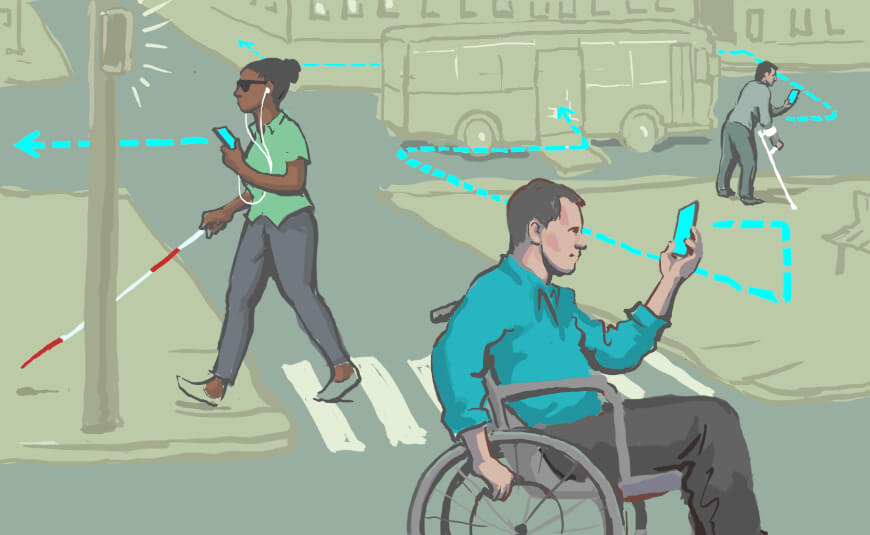
The Dutch application called Crosswalk offers something similar. A sensor in the lights constantly scans the pavement on either side of the junction, and if it “sees” a person with the app waiting after pressing the button, it adjusts the green-light time. The app comes pre-installed with one of the four-time settings, depending on the user’s level of mobility, to minimise delays to other traffic. It basically allows anyone to “hack” the traffic lights. The Carnegie Mellon University’s Robotics Institute had similar experiments in Pittsburgh, and Hongkong also introduced a technological solution to help its elderly cross the street.

Making accessibility information available
Finding your way around the city isn’t easy even when you can use all of your five senses and all of your limbs. Imagine how difficult it might be if you couldn’t. Luckily, startups and tech companies have started to take note and provide accessibility information. Google added wheelchair accessibility navigation to its Google Maps app so you can find a route that accommodates wheelchairs. In Seattle, the University of Washington’s Taskar Center for Accessible Technology created AccessMap, a map-based app allowing pedestrians with limited mobility to plan accessible routes.
The German Wheelmap, wants to ease finding and rating wheelchair-accessible places. People from all over the world can spot and add locations to the map, which has been available since 2010. It’s an excellent tool for wheelchair users and people with mobility impairments to plan their day more effectively.
In Melbourne, Australia, BlindSquare helps create a navigation system for the visually impaired. Users receive audio cues via their smartphones, providing directions or real-time information about issues such as escalator outages. Outside, the app offers real-time directional information; inside, where GPS is unreliable, 20 wireless Bluetooth beacons ensure users still receive information.
Autism-friendly accommodation
Digital technologies could not only make public locations more accessible to people living with disabilities or permanent conditions but also private spaces to live long and prosper. For example, people with autism can be hypersensitive to sound, light, and movement, and become overwhelmed by noisy, cluttered or crowded spaces. That’s what Sweetwater Spectrum, a supported housing project in Sonoma, California, aims to address.
The site, which opened its doors in 2013, includes four 4-bed homes for 16 young adults, a community center, therapy pools and an organic farm – all designed according to autism-specific principles recommended by Arizona State University to promote a sense of calm.
Dementia Villages
The Hogeweyk in The Netherlands is a specially designed small residential area with houses for dementia-suffering seniors (read more about Alzheimer’s and dementia in this article). The elderly all need nursing home facilities and live in houses differentiated by lifestyle. The residents manage their own households together with a permanent team of staff members.
In June 2020, the first Alzheimer’s Village opened in France, welcoming 120 inhabitants with Alzheimer’s disease or related. Such villages, designed to increase the freedom and reduce the anxiety of their residents, help them remain active and retain their independence. The inhabitants are confined to the village for their own safety but are allowed to move around freely inside and are watched over by plain-clothed medical staff.
These facilities allow much more freedom to residents than traditional nursing homes, and they could decrease the phenomenon of dementia patients roaming around aimlessly on the streets or losing their way home – but they could still walk and live a less narrowed life.
Applications, technological solutions or design tricks making spaces autism-friendly don’t solve every problem around the issue. But they represent a new approach towards people with special needs: the attitude of paying attention. It starts with small things such as halting traffic lights for as long as necessary, but after a while, these little tools will take on a global measure.
|
At The Medical Futurist, we are building a community for making a bold vision about the future of healthcare reality today. If you’d like to support this mission, we invite you to join The Medical Futurist Patreon Community. A community of empowered patients, future-oriented healthcare professionals, concerned health policymakers, sensible health tech developers, and enthusiastic medical students. If there were ever a time to join us, it is now. Every contribution, however big or small, powers our research and sustains our future. Click here to support The Medical Futurist from as little as $3 – it only takes a minute. Thank you. |