The Current State Of Over 1600 FDA-Approved, AI-Based Medical Devices
Given that healthcare is an industry where decisions can literally be a matter of life and death, the importance of effective regulation can’t be overstated. Now this is one hell of a challenge even for the most seasoned professionals.

5 min | · Updated

Key Takeaways
The FDA, a global leader in healthcare regulation, is adapting its framework to include AI-based medical devices, with 1600 approvals and clearances to date, indicating an acknowledgment of AI’s expanding role in healthcare.
The rise of AI in healthcare is revolutionizing medical practice, presenting unique regulatory challenges given AI’s evolving nature, which necessitates effective oversight to manage potential risks.
Radiology leads in AI device approvals reflecting deep learning’s applicability in image-based diagnostics, while the 510(k) submission pathway is predominant due to its streamlined process for devices similar to existing ones.
The rise of Artificial Intelligence (AI) and Machine Learning (ML) in healthcare has reshaped the industry. And due to the recent march of ChatGPT, and similar tools, various AI algorithms have entered the lives of the general population as well. These technologies will undoubtedly change the way medicine is practiced. Given that healthcare is an industry where decisions can literally be a matter of life and death, the importance of effective regulation can’t be overstated. Now this is one hell of a challenge even for the most seasoned professionals.
AI and ML present novel regulatory challenges. Unlike traditional medical devices, these technologies are capable of evolving and learning over time. This means that they could perform differently in the real world than they did during their pre-market testing. While this could mean improved patient outcomes, it also could introduce new risks that need to be managed. Which is no easy task with a constantly changing algorithm.

Historically, the FDA has been a global pioneer in regulating novel technologies in healthcare. From pharmaceuticals to medical devices, the FDA was traditionally setting standards, no wonder, all eyes seem to be on the American regulatory body these days.
Traditionally, FDA updates its AI-enabled database once a year, always in the fall months, so it was time to take a look at what we can learn from the latest available statistics.
Now the FDA database has a total of 1614 devices (up from 1451 last year). As of September, 2026, no device has been authorized that uses generative AI or is powered by large language models.
From zero to hero
A few years ago, the regulatory landscape for AI and ML technologies was almost non-existent. Medical device approvals didn’t explicitly indicate if a technology was AI-based. This made it difficult for healthcare professionals, patients, and other stakeholders to understand the extent to which AI was being integrated into healthcare solutions. Inventors and developers are also seriously hindered as they see no clear path to market approval of new technologies. It’s crucial to distinguish these AI-based technologies because they carry unique considerations and implications for users and patients.
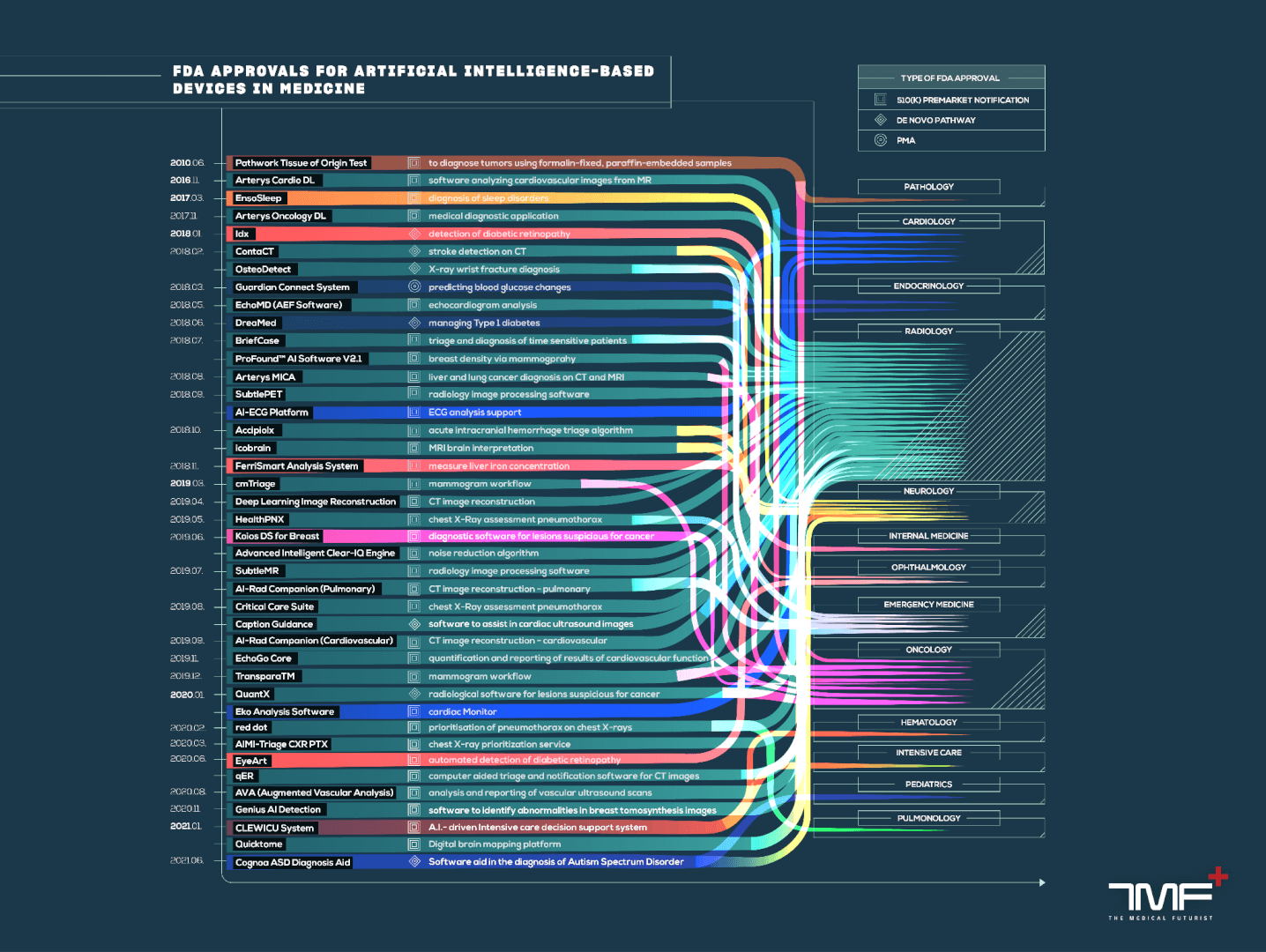
The FDA has been approving AI-based devices for years but didn’t initially distinguish them as a unique category. A few years back, we at The Medical Futurist Institute took it upon ourselves to sift through all these approvals and identify the ones that were AI-based. From our work, we created an open-access database, which we shared with the FDA so they could build on our groundwork. To our gratification, a year later, the FDA published its own database and cited us as a source.
The exponential growth we witness now
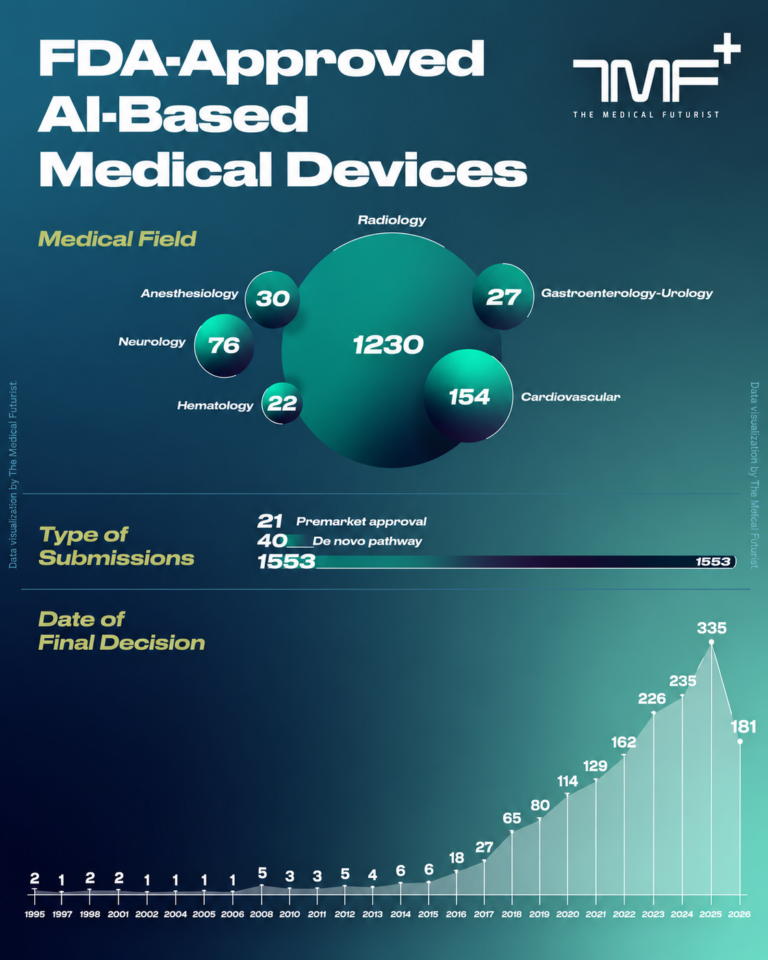
Look how sharply this number has been rising:
- 1995: 2
- 1997: 1
- 1998: 2
- 2001: 2
- 2002: 1
- 2004: 1
- 2005: 1
- 2006: 1
- 2008: 5
- 2010: 3
- 2011: 3
- 2012: 5
- 2013: 4
- 2014: 6
- 2015: 6
- 2016: 18
- 2017: 27
- 2018: 65
- 2019: 80
- 2020: 114
- 2021: 130
- 2022: 163
- 2023: 225
- 2024: 235
- 2025: 335
- 2026: 181
Which specialties are most affected?
According to our latest data analysis, radiology stands out as the most AI-invested medical specialty, boasting a whopping 1230 approved devices. A distant second is cardiology or cardiovascular (as a category), with 154 devices.
Beyond that, other specialties (neurology, hematology, gastroenterology-urology and ophthalmology among others) see a handful of devices. What propelled imaging to such heights? Well, deep learning found a fertile ground in radiology, which is largely data-driven.
Here is the full list:
- Radiology 1230
- Cardiovascular 154
- Neurology 76
- Anesthesiology 30
- Gastroenterology-Urology 27
- Hematology 22
The FDA submission types
The FDA recognises three distinct submission types: the 510(k), pre-market approval, and the De Novo pathway. By a long shot,
- the 510(k) is the most popular with 1553 (+157 since last year) approvals so far,
- leaving De Novo 40 (+3)
- and pre-market 21 (+3) far behind.
No wonder 510(k) is so popular, simply put, it’s the easiest route, as it is the pathway used for devices that are substantially equivalent to another legally marketed device. No new clinical trials are needed, although companies need to prove that their device is as safe and as effective as the already approved one.
Meanwhile, pre-market approval is the most stringent type of device marketing application process. It is for high-risk devices, and it requires the manufacturer to provide clinical evidence demonstrating the safety and effectiveness of the device. This often involves clinical trials, which in turn makes it expensive.

The De Novo pathway is a regulatory pathway for low- to moderate-risk devices that are novel and for which there are no legally marketed predicate devices. It is suitable for Class I or II (lower-risk classifications) medical devices.
We will continue to monitor this field, given that the FDA’s approach can set a valuable precedent for regulatory bodies in other countries. So, buckle up and stay tuned – there will be a lot to learn in the coming few years.