Putting Wear OS By Google To The Test: The TicWatch Pro 2020 Review
Recently, The Medical Futurist himself had a negative experience with Fitbit. Even after being among the first to order the new Fitbit Sense in August, […]

8 min |
Recently, The Medical Futurist himself had a negative experience with Fitbit. Even after being among the first to order the new Fitbit Sense in August, the delivery never happened even after 2 months. Customer support was not very much helpful either. Dr. Meskó has owned around 10 Fitbit trackers since 2009; and doesn’t miss to highlight how the company was the first to integrate in its fitness tracker a smart sleep alarm or the Holy Grail of health tracking. But this recent experience was one of the worst he had; and as a result, Fitbit lost one of their most faithful customers.
So to help him find a replacement smartwatch, The Medical Futurist team went hunting for such devices and stumbled on the TicWatch Pro 2020. Developed by Mobvoi, this is actually the first device to run Wear OS by Google that we test. Since Google’s acquisition of Fitbit in 2019 for a whopping $2.1 billion, it would be interesting to see how the search giant’s own dedicated fitness operating system (OS) fares with this merger.
The only way to find out is to strap the device on our wrist and put it to the test. Here’s how that went.
Getting Google-fit
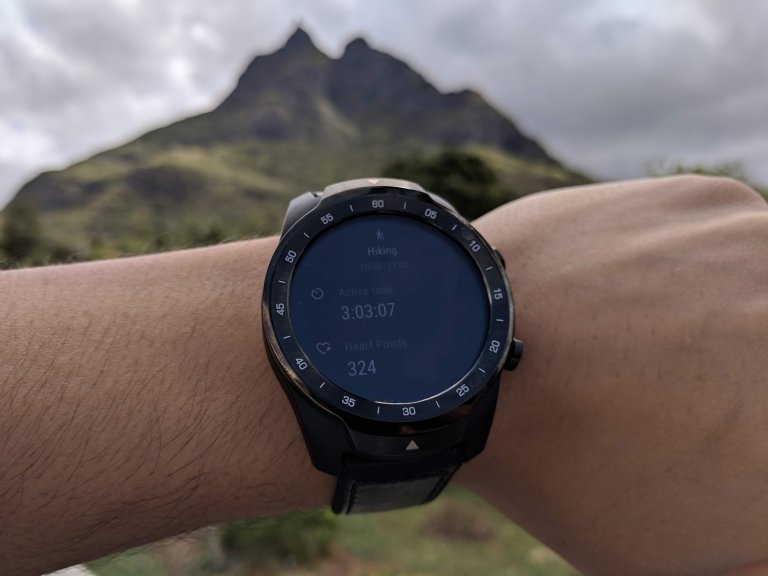
The great thing about Wear OS is that it integrates neatly with Google Fit. All workouts, step counts and heart rate measurements from the smartwatch sync up with the Google Fit platform; no need to individually pair the measurements, it’s done natively. For fitness tracking – which is one of the main reasons you would look into such a device – Wear OS offers a range of options to choose from. A few taps from the device and it’s ready to track whatever you feel like to do; whether it’s volleyball, crossfit or even floss dancing! Once selected, the on-screen information will display real-time data; such as calories burnt, steps taken, heart rate and pace (where applicable).
After a workout, you can then review the data on the watch itself or view it on your phone’s Google Fit app. This is particularly handy after a run or hike as the smartwatch’s GPS-tracking feature lets you visualise the path you took on a map in the app. The phone app also provides additional details such as elevation, detailed variations in heart rate and changes in pace. It would however be welcome if you could visualise all this from the watch itself.
One tracking hiccup was with strength training as the experience is rather mixed. Once launched, the software automatically records your exercises and repetitions, but it’s rather a hit-or-miss affair. When it works, it can be impressive, detecting exactly the exercise performed; but it often misses rep counts that have to be adjusted. At other times, it misses an exercise altogether from the set, with no means to add it.
Moreover, the focus is rather on working out. There is a handy “Fit Breathe” app that helps you relax via guided deep breathing sessions and a hand wash timer; but the crucial smart sleep alarm is sorely missing. Somehow Google failed to integrate Fitbit’s iconic software in its own fitness-focused OS; which was a let down at The Medical Futurist.
Not just stuck to Google
Thankfully, Wear OS does not keep you confined to Google’s fitness ecosystem; meaning you can also find Wear OS versions of some of your favourite mobile apps be it for messaging, music playback and yes, wellness. You’ll find Wear OS versions of Strava, Nike Run Club and Sleep As Android. The TicWatch Pro 2020’s parent company, Mobvoi, also has dedicated Wear OS fitness apps; and these seem more optimised for the device and really help get the most out of it by providing features Google omitted.
For instance, the TicHealth app sends hourly reminders about taking steps to reach your daily goals. This is particularly helpful if you are working from a desk; where you can easily forget to stretch your legs as time flows by. Another app, TicPulse, regularly monitors your heart rate without any prompt (compared to the need to manually measure it with Google Fit) and even sends warnings when it’s abnormally high or low while at rest or sustained during exercise. This is a great digital health feature that Google itself could have integrated natively.
Mobvoi also remedied the lack of a smart sleep alarm with its TicSleep app that lets you monitor your sleep and wakes you up at the optimal time by only wearing your watch. In comparison, Sleep As Android will need the watch to be connected to your phone via Bluetooth overnight, which is not ideal.
Ultimately, if you dig around, Wear OS opens up to more wellness features than it initially lets on. Google’s own apps might not be the best to exploit these, but thankfully, third parties can. Then again it’s yet another app that you’ll have to download and store on the watch, such as Mobvoi’s multitude of fitness software. It would have been more convenient to have all of these features in one app from the get-go, preferably from Google itself given its resources.
A watch that ticks
With smartwatches and their multiple sensors, the smart features they offer have a significant impact on their battery life. Such watches are notorious for needing frequent recharges, sometimes multiple times a day; at the risk of dying and not being able to perform its most basic function: displaying time. This goes against the main purpose of a watch, which is to conveniently tell the time; at any time.
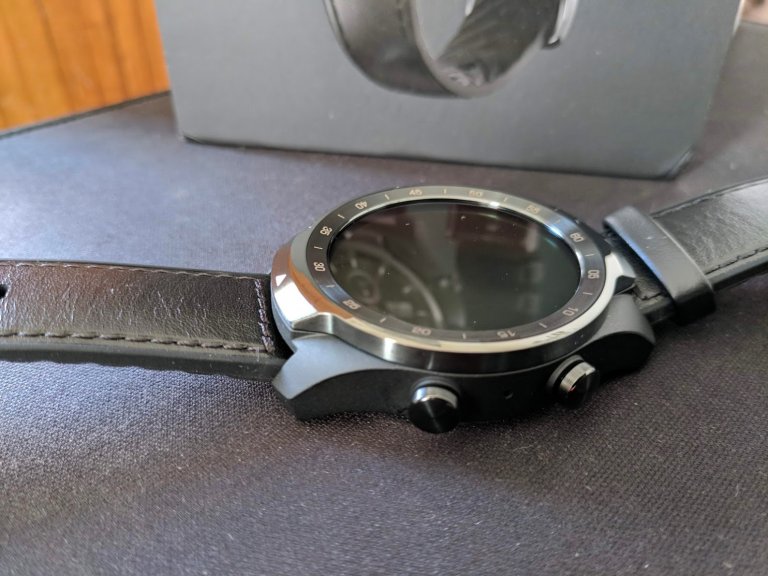
The TicWatch Pro 2020 has a clever way to circumvent battery life issues plaguing high-tech watches while still boasting smart features. It does so by packing Mobvoi’s Dual Display technology, which essentially means that the smartwatch features two screens, one layered on top of the other. The top, low power consuming screen – which looks like those traditional calculator LED displays – is always-on and shows basic information like steps taken, date and time in Essential Mode. When using the TicHealth app, it can even show some workout data. Under this LED screen rests the more power-hungry 1.39” AMOLED display, which activates via a screen tap or button push and toggles to Smart Mode.
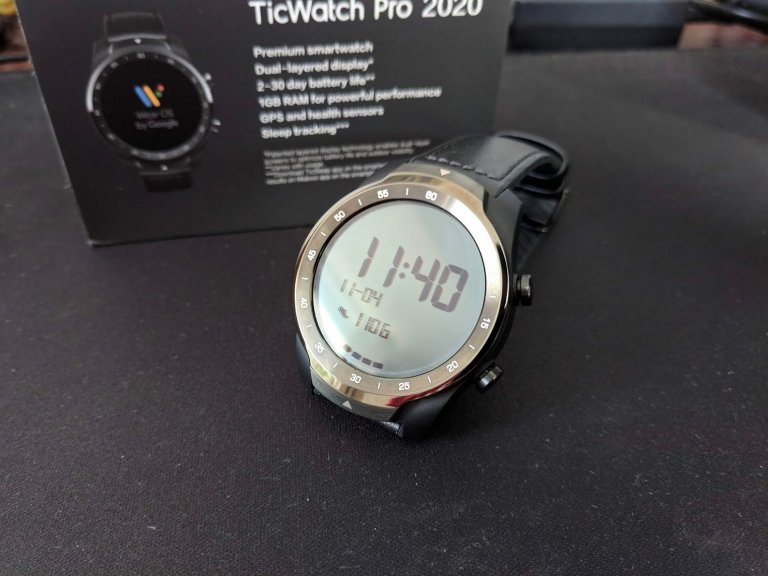
This is one of the most impressive features of this device as it really does help in boosting the battery; easily allowing at least a whole day of use by toggling between the screen modes. This allows the watch to function without compromising on basic features thanks to the always-on, yet low-power LED screen and easy toggle to the feature-rich AMOLED display.
With this mode enabled, the TicWatch Pro 2020 actually looks like a regular watch with a sporty, rugged look. Just like the display, its straps have a duality by being hybrid in nature; the outer layer is made of leather for a classy look, while the inner layer is silicon-based for added comfort, especially for workouts. Nevertheless, an additional strap dedicated for workouts would have been very much appreciated; given that you are already paying top dollar for this $260 package.
Another downside to this smartwatch is its large size. This design might not be the most aesthetically-pleasing for the smaller-wristed among us. Additionally, it lies on the heavy side of the spectrum at around 58 grams; and this needs an initial adjustment period. But users can get used to these aspects over time; and overall, the watch is of a sturdy build quality and has a rather premium look to it.
More than fitness
Smartwatches brought about a whole new era in fitness. They enable users to quantify and visualise their fitness activities with data made readily available via embedded sensors. This helps fitness enthusiasts and beginners alike to gauge their workouts, adjust to their potentials and subsequently improve.
Mobvoi’s TicWatch Pro 2020 is no different and offers decent tracking features if you go through some hoops. It will also allow other expected smartwatch features than just fitness measurements. When paired to your phone, you’ll be able to read social media notifications; check emails; control music; and even answer calls directly from the watch as it features both a microphone and a speaker. The integration of the Google Assistant also opens it up to more voice command controls such as making a call, sending a text or asking for directions. To kill time you can even install some casual touch-based games like Infinity Loop and the tamagotchi-esque PetQuest. Killing time with a watch might sound like an oxymoron but here we are!
If you’re looking for a smartwatch with decent build quality and battery life, the TicWatch Pro 2020 is one to consider. Google’s Wear OS is serviceable at best, especially given the company’s resources. But there are ways to circumvent its shortcomings thanks to the ability to download third-party apps. If you don’t mind digging around for such software that would suit your fitness tracking needs, it will ultimately deliver a more compelling experience; one that could entice The Medical Futurist’s transition from Fitbit.