How To Understand The A.I. Revolution Better In Studies And News?
Artificial intelligence is the hottest topic at the moment in both technology and medicine. Hardly a day goes by without promising research papers and studies being published on how to apply machine and deep learning methods to medical problems. However, as already the mention of A.I. makes companies’ prospects better on any market, hyping and overmarketing what an algorithm can do is an everyday phenomenon. Thus, it is not an easy task to separate the wheat from the chaff. That’s why we decided to offer here a short guide on how to evaluate research papers on A.I.

5 min | · Updated

|
THIS ARTICLE HAS NOT BEEN UPDATED SINCE 2019. THE INFORMATION SHARED IN THE ARTICLE WAS ACCURATE AT THE TIME OF ITS PUBLICATION, BUT IT MAY BE OUT OF DATE NOW. BROWSE OUR LATEST ARTICLES HERE |
Artificial intelligence is the hottest topic at the moment in both technology and medicine. Hardly a day goes by without promising research papers and studies being published on how to apply machine and deep learning methods to medical problems. However, as already the mention of A.I. makes companies’ prospects better in any market, hyping and overmarketing what an algorithm can do is an everyday phenomenon. Thus, it is not an easy task to separate the wheat from the chaff. That’s why we decided to offer here a short guide on how to evaluate research papers on A.I.
How to read an A.I. research paper?
As a first step, you should go to the source. It’s not scientific elitism but it matters where the paper about an artificial intelligence-powered solution was published. It makes a difference if the algorithm gets presented in Nature Medicine or in a third-level journal.
The second most important factor is the data. You should look for where the data stems from, thus you’d better look up the ‘Methods’ section where they describe how, where, what kind of data the authors received. No algorithm can be trained without a good amount of quality data. Moreover, the size of the dataset also matters: the more images, text or any other source material the researchers have, the more precise the algorithms become. However, it is very difficult to get to a large amount of quality data, especially in medicine. Hospitals and other medical facilities, which have been accumulating health data for decades, are more often than not very reluctant to give their sensitive data to algorithmic experiments. Thus, some research groups do tricks on their dataset to make it bigger (e.g. invert images to double the database size). As a reader of an A.I. research paper, you should be aware of that.
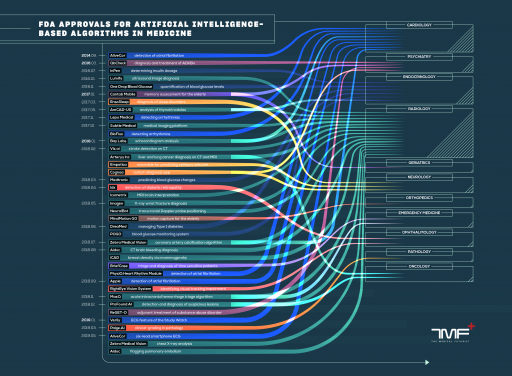
As the third and final step in the process, look for clinical collaborations. If an algorithm performs well on a pre-selected dataset that sounds alright but clinical datasets make it excellent. For example, knowing that DeepMind has partnered with the NHS on several projects for years, e.g. with the Moorfields Eye Hospital, makes a strong case for their algorithm. However, the ultimate proof for the excellent performance of the algorithm is the FDA approval. If the U.S. regulator finds it acceptable according to its high standards, no doubt remains about the usability and efficiency of the smart algorithm.
How to read the news on A.I. development?
When you look at the latest pieces of news on smart algorithms, you should watch out for the following to be able to carefully assess the quality of the given artificial intelligence-related article. The term “artificial intelligence” itself might be misleading as due to the overuse of the expression, its meaning started to get inflated. Its meaning implies software with cognition and sentience, a far far more developed technology than it is standing at the moment, and a far far more likely used concept by marketing gurus to describe each and every software tool dealing with big data analytics.
If someone only mentions A.I. but doesn’t describe the method how they are attempting to reach artificial intelligence you should be skeptical and careful. A company or a research group should mention machine learning or deep learning and be able to explain the method in detail with which they are aiming to create A.I.
As online journalism centers around clicks, likes, and shares, many titles tend to be sensationalist and clickbait in nature. Of course, the word artificial intelligence is much catchier than machine learning and saying that algorithms beat doctors will get a much wider audience than writing about percentages and comparisons in the title. That’s why it is worth looking up the study itself when reading about the latest fantastic achievement of A.I. in an online article, and reading the conclusion of the research. In quality online magazines, the study is usually linked in the article, but you can also search for the author and the medical journal itself on Google Scholar if you are looking for its credibility.
If you are still skeptical, Reddit has a very active community where you can ask around about artificial intelligence, machine learning and deep learning – and any news or research paper on the topic that you are concerned about.

As The Medical Futurist undertakes the role of the “voluntary policeman” or the guardian of the digital health galaxy to filter out companies with overhyped and oversold technologies and propagates the ones whose claims correlate with their actual achievements, we will also aim to bring you information about credible and efficient artificial intelligence solutions in medicine further on in the future. Let us know how you shield yourself against overhype concerning A.I. and if you find something that we should warn others about.
|
At The Medical Futurist, we are building a community for making a bold vision about the future of healthcare reality today. If you’d like to support this mission, we invite you to join The Medical Futurist Patreon Community. A community of empowered patients, future-oriented healthcare professionals, concerned health policymakers, sensible health tech developers, and enthusiastic medical students. If there were ever a time to join us, it is now. Every contribution, however big or small, powers our research and sustains our future. Click here to support The Medical Futurist from as little as $3 – it only takes a minute. Thank you. |