Our Guide To Artificial Intelligence In Healthcare
In the last couple of years, artificial intelligence moved from being a futuristic promise into a reference point for innovation. The technology also started to transform healthcare with great vigor. That’s why we thought it’s high time to talk about what A.I. can really bring to medicine, where does innovation stand at the moment, and what are the greatest challenges in its application to clinical settings. That’s what you can find in our latest e-book, the updated version of A Guide To Artificial Intelligence In Healthcare. Check it out!

5 min | · Updated

|
THIS ARTICLE HAS NOT BEEN UPDATED SINCE 2019. THE INFORMATION SHARED IN THE ARTICLE WAS ACCURATE AT THE TIME OF ITS PUBLICATION, BUT IT MAY BE OUT OF DATE NOW. BROWSE OUR LATEST ARTICLES HERE |
In the last couple of years, artificial intelligence moved from being a futuristic promise into a reference point for innovation. The technology also started to transform healthcare with great vigor. That’s why we thought it’s high time to talk about what A.I. can really bring to medicine, where is innovation standing at the moment, and what are the greatest challenges in its application to clinical settings. That’s what you can find in our latest e-book, the updated version of A Guide To Artificial Intelligence In Healthcare. Check it out!
Deep learning has become part of our lives just as kale and reusable cups
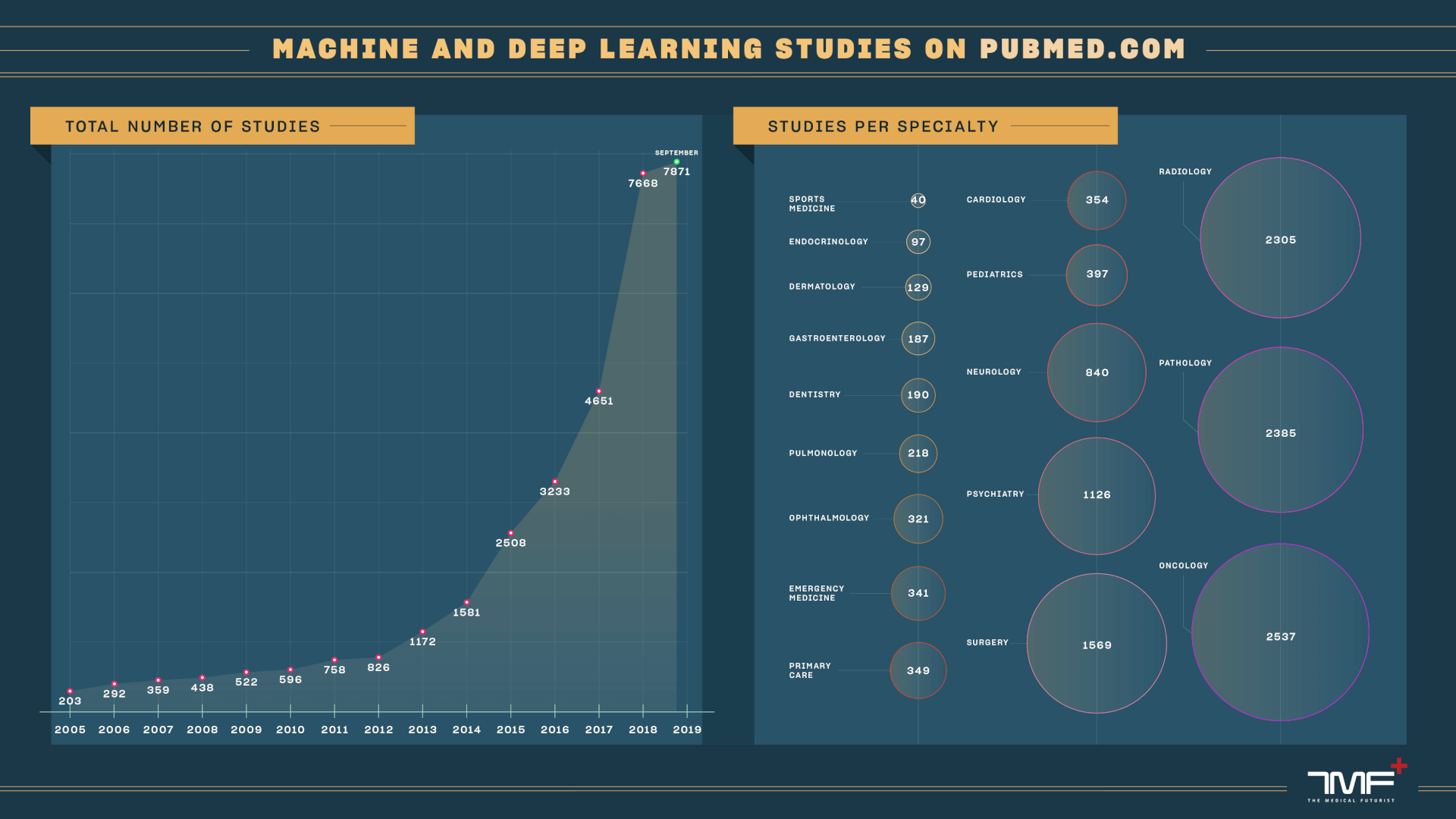
In the last couple of years, the number of A.I.-related studies, research projects, university courses, and companies has grown exponentially, not to speak about the rapid improvement in the precision of the technology. The initiative called A.I. Index in its 2018 Annual Report found that from January 2015 to January 2018, the number of active A.I. startups increased by 113 percent, while all active startups only showed a moderate increase of 28 percent. Research into A.I. is similarly accelerating. Nothing presents that better as the number of studies published in the medical field. While in 2005, there were only 203 research papers on Pubmed.com, one of the most prestigious databases for life sciences, the number rose to 7668 in 2018 and it’s likely to hit a new record in 2019.
It was only a matter of time until the strategic importance of A.I. was recognized by fields other than the tech industry, thus in recent years, we could follow closely how it has spilled over from the economy to politics as well.
Thus, the expressions of deep learning, machine learning, smart algorithms, augmented intelligence, cognitive computing, and of course, artificial intelligence have all become part of our lives just as kale emerged as a necessary ingredient to a healthy diet or reusable mugs as means to reduce disposable coffee cups and the amount of trash. But do you know exactly what these expressions mean? Do you have any idea how they are affecting the medical field? What are the greatest challenges for applying smart algorithms to healthcare settings? What could the future bring?
A.I. explained – for all stakeholders in healthcare
Our updated e-book, A Guide To Artificial Intelligence In Healthcare, will introduce the most important definitions of A.I., highlight the processes, fields, and factors where the technology can have an effect in medicine and could serve as a yardstick for anyone who is interested in the most current snapshot about smart algorithms and healthcare.
If you are a medical student and/or a practicing medical professional, you will get to know the most important definitions of A.I. and all the medical fields where you can expect change in the coming years. Also, we collected the most reliable smart algorithms out there on a complex infographic. If you are a tech developer, you can have a rough idea what challenges to expect with regard to datasets or technological limitations before moving into the healthcare field, and if you are a regulator or a policy-maker, you can familiarize yourself with the most important regulatory issues, ethical concerns, and a vision for the future.
A yardstick for further innovation to foster the art of medicine
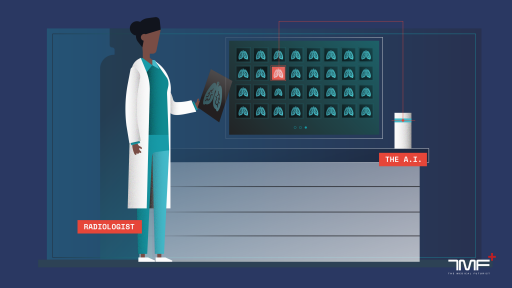
What’s that vision, you ask? In a nutshell, we are sure that A.I. is not going to replace medical professionals; it’s going to be the stethoscope of the 21st century and successful collaboration between humans and technology could bring us the positive change in healthcare that we all so strongly wish for.
Digital health will give us more health data than ever before, and A.I will help us analyze it to find new ways to treat diseases, to cut down on administrative tasks, to streamline medical practices, to optimize both physicians’ and patients’ schedules. However, we should never forget that they are going to be tools in the hands of physicians – and not the other way around. Compassionate care, empathy, creativity, problem-solving and profound human connection will never cease to be the terrain of physicians, moreover, it will be enhanced by artificial intelligence.
If we embrace it, the real art of medicine begins with the era of artificial intelligence.

Check out the updated version of A Guide To Artificial Intelligence In Healthcare.
|
At The Medical Futurist, we are building a community for making a bold vision about the future of healthcare reality today. If you’d like to support this mission, we invite you to join The Medical Futurist Patreon Community. A community of empowered patients, future-oriented healthcare professionals, concerned health policymakers, sensible health tech developers, and enthusiastic medical students. If there were ever a time to join us, it is now. Every contribution, however big or small, powers our research and sustains our future. Click here to support The Medical Futurist from as little as $3 – it only takes a minute. Thank you. |