Peeking Into The Technological Future of Medical Specialties
Chatbots? Artificial intelligence? Telemedicine? How will technology impact healthcare? What happens with the human side of medicine? Which technological innovations will have the most impact on each of the medical specialties? What about the skill-set necessary for doctors of the future? If you are a medical student, a nurse, a doctor or any other caregiver who already contemplated about the coming years, and who is in dire need for reassuring responses, don’t go any further. We just published our latest e-book entitled The Technological Future of Medical Specialties for answering all the questions raised.

4 min | · Updated
|
THIS ARTICLE HAS NOT BEEN UPDATED SINCE 2019. THE INFORMATION SHARED IN THE ARTICLE WAS ACCURATE AT THE TIME OF ITS PUBLICATION, BUT IT MAY BE OUT OF DATE NOW. BROWSE OUR LATEST ARTICLES HERE |
Chatbots? Artificial intelligence? Telemedicine? How will technology impact healthcare? What happens with the human side of medicine? Which technological innovations will have the most impact on each of the medical specialties? What about the skill-set necessary for doctors of the future? If you are a medical student, a nurse, a doctor or any other caregiver who already contemplated about the coming years, and who is in dire need for reassuring responses, don’t go any further. We just published our latest e-book entitled The Technological Future of Medical Specialties for answering all the questions raised.
The matrix of change
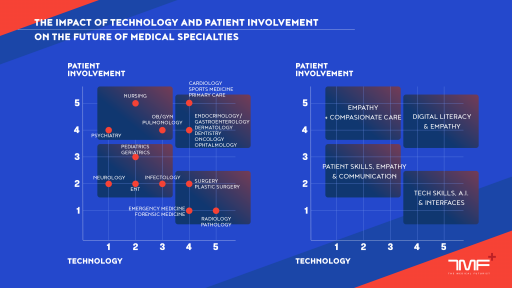
After going through the specialties one-by-one, we realized some patterns. While to some extent, technology has an impact on each medical field, the scale is very wide. Some specialties will most probably become highly “technologised”, for example, surgery, radiology, or pathology, while others will most likely remain analog, rather technology-free fields for decades to come, such as psychiatry or nursing.
As we considered each specialty, we noticed that the overall impact of technology should be assessed in relation to another factor: the extent of patient involvement or, to rephrase it, the overall need for the human factor. In emergency medicine, forensic medicine or surgery, patient involvement is usually very low, while the presence of high-tech solutions is on the rise. On the other hand, in primary care, cardiology or sports medicine, the participation of patients is assumed to be significantly more active, while technology comes to their aid – in order to make patient involvement even more progressive through the use of health sensors, wearables, and other digital gadgets.
As a consequence, we drew up a “heat map” of the various specialties along these two lines: the impact of technology as well as the extent of patient involvement. As we could finally picture the various fields on one map, it was also easier to assign specific skills to them. Skill-sets, which medical professionals will overwhelmingly need in the future in relation to all the technological changes to stay on top of their games. That’s what you can see in the second chart.
The promise of high levels of technology coupled with low levels of patient involvement
For example, take radiology, pathology, surgery, plastic surgery, emergency medicine or forensic medicine. All these fields represent highly technologized specialties with relatively low levels of patient involvement. That’s one of the reasons why the fears around technology replacing physicians in the case of radiologists or pathologists appear on the surface so strongly. As technology penetrates these areas aggressively, while the human factor is originally much lower than in the case of nursing, for example, many people went into panic mode – unnecessarily.
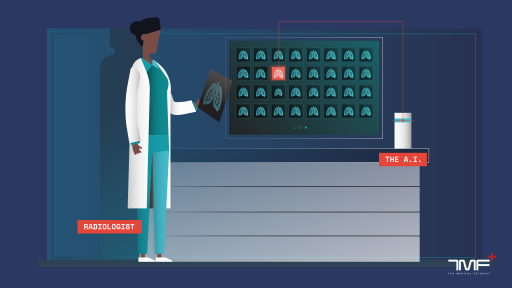
Changes in these specialties won’t mean that technology will replace humans, it will rather require many more specialists who are well-versed in the latest solutions and could successfully cooperate with machines, first of all, artificial intelligence-powered algorithms. Those medical students who would like to choose radiology, pathology or forensic medicine as their career path should prepare for becoming tech gurus and closely following the rapid changes in the coming years. For them, the future rather holds machine learning, smart algorithms, or interactive interfaces than increased patient visits.
Are you curious about further explanations around the question of how the future of medical specialties will unfold and what skills will future doctors and nurses need for performing the best care?
Test your knowledge before you download our latest e-book The Technological Future of Medical Specialties!
|
At The Medical Futurist, we are building a community for making a bold vision about the future of healthcare reality today. If you’d like to support this mission, we invite you to join The Medical Futurist Patreon Community. A community of empowered patients, future-oriented healthcare professionals, concerned health policymakers, sensible health tech developers, and enthusiastic medical students. If there were ever a time to join us, it is now. Every contribution, however big or small, powers our research and sustains our future. Click here to support The Medical Futurist from as little as $3 – it only takes a minute. Thank you. |