Four Futures For AI In Medical Diagnostics
Artificial intelligence is already becoming part of medical diagnostics. Algorithms can analyze medical images, identify patterns in clinical data, support differential diagnosis and increasingly interact […]

6 min |
Key Takeaways
As The Medical Futurist, I regularly use scenario analysis to explore questions where the outcome depends on several forces interacting with each other.
Looking at these four scenarios, one issue appears repeatedly. We need a healthcare workforce that understands AI well enough to use it appropriately.
Getting there will require more than better algorithms. It will require better prepared humans.
Artificial intelligence is already becoming part of medical diagnostics. Algorithms can analyze medical images, identify patterns in clinical data, support differential diagnosis and increasingly interact with physicians through large language models.
Yet discussions about the future of diagnostic AI often focus on one question: what can we realistically expect from the technology?
As The Medical Futurist, I regularly use scenario analysis to explore questions where the outcome depends on several forces interacting with each other. Instead of trying to predict one future, the method helps us create a set of plausible futures and ask what we should do today to prepare for each of them.
I recently applied this method to one of the most pressing issues in healthcare: the use of AI in diagnostics.
I selected evidence-based diagnostic performance and efficiency as the driving force: how convincingly AI systems can demonstrate that they improve diagnostic accuracy, efficiency or both. It’s crucial because healthcare can only start using AI at scale if enough evidence is provided in peer-reviewed studies and clinical trials. The more, the merrier.
The major uncertainty was trust and adoption by medical professionals. Even excellent technology can have little impact if clinicians do not trust it, understand it or integrate it into their work. Or they start trusting it but it takes a lot of time.
Putting these two dimensions together gives us four very different futures.
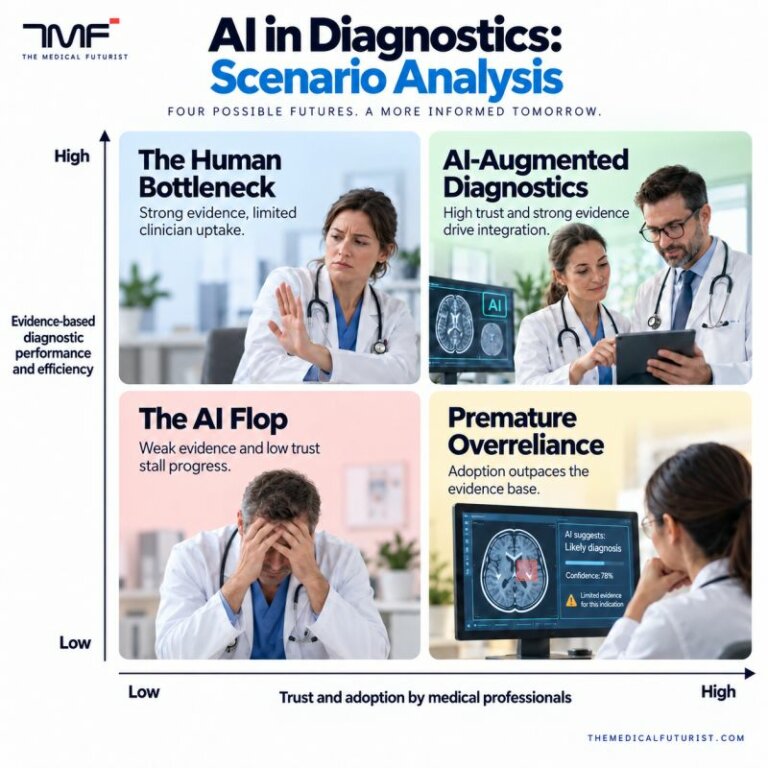
1. Premature Overreliance: high trust, low evidence
This might be one of the most dangerous scenarios.
Clinicians, hospitals and healthcare systems become enthusiastic about diagnostic AI and start relying on it before we have accumulated enough evidence about how well it performs in real clinical environments.
This is not difficult to imagine. Generative AI has already demonstrated how quickly a technology can move from novelty to widespread everyday use. In medicine, that speed creates a different level of risk.
A diagnostic model can perform impressively in a controlled study and still behave differently when introduced into another hospital, patient population or clinical workflow. Performance can change over time. Biases can remain hidden. Clinicians might gradually stop questioning recommendations once they become accustomed to receiving them.
In this future, the problem is not a lack of trust. It is too much trust, too early.
Preparing for this scenario means establishing rigorous validation before widespread implementation, defining clear responsibilities between clinicians and AI systems, continuously monitoring performance after deployment and developing liability frameworks for AI-supported decisions.
Medical education will also have to address automation bias. Physicians need to understand when to question an algorithm, even after that algorithm has been right hundreds of times before.
Enthusiasm can accelerate adoption. Evidence and guardrails have to keep pace with it.
2. AI-Augmented Diagnostics: high trust, high evidence
This is the future many people working in medical AI are hoping for.
Diagnostic AI demonstrates meaningful clinical value, and healthcare professionals trust it enough to integrate it into everyday practice.
AI becomes another routine diagnostic layer. It might highlight abnormalities on medical images, identify patterns across thousands of data points, suggest diagnoses a physician has not considered or help determine which patient requires attention first.
The most important consequence would be augmentation rather than automation. Physicians would remain responsible for the diagnostic process while gaining access to a powerful new set of capabilities.
But even this optimistic scenario creates difficult questions. If AI becomes an everyday part of diagnosis, healthcare systems will need to integrate it into clinical workflows without adding another source of friction. Medical schools will have to teach future physicians how to work with these systems. Professional societies will need to incorporate AI into clinical standards and guidelines.
Healthcare systems will need continuous real-world monitoring to detect changes in performance, unexpected errors or differences between patient populations.
Success therefore creates its own challenge: how do we responsibly scale something that works?
3. The AI Flop: low trust, low evidence
There is also a future in which diagnostic AI simply fails to deliver what many expect from it.
Tools might show impressive technical results without producing meaningful clinical improvements. They might create additional work for physicians, generate too many false alerts or fail to integrate into healthcare systems.
After years of hype and investment, healthcare professionals could become increasingly skeptical.
This would not necessarily mean that AI itself had failed. It could mean that we selected the wrong problems, measured the wrong outcomes or deployed technology without understanding clinical workflows.
There is another important lesson in this scenario. Even mediocre technology can become useful as it improves. But once healthcare professionals lose trust in a category of technology, rebuilding that trust can take much longer.
Healthcare organizations therefore have an interest in avoiding exaggerated claims today. Every unrealistic promise about AI creates expectations against which the technology will eventually be judged.
The best way to prevent an AI winter in healthcare is to be extremely clear about what these systems can and cannot currently do.
4. The Human Bottleneck: low trust, high evidence
I find this perhaps the most interesting scenario (and this might be the scenario that is the closes to today’s reality).
Imagine that study after study shows that diagnostic AI works. It improves accuracy, reduces workload or catches diseases earlier. And physicians still do not use it.
This might sound irrational, but healthcare technology has repeatedly shown us that evidence alone does not guarantee adoption.
Clinicians may not understand how the system reaches its conclusions. They might worry about liability. They may have experienced poorly designed technologies before. Or the AI might simply conflict with the way they have been trained to think about their professional responsibility.
In this scenario, the limiting factor becomes human adoption. That makes explainability important, although I use the term in a broader sense than simply showing how an algorithm mathematically reached a conclusion.
We need to be able to explain what the AI does, what data it relies on, how it was validated, where it performs well, where it can fail and what the physician is expected to do with its output.
Trust has to be earned.
The common challenge is understanding AI
Looking at these four scenarios, one issue appears repeatedly. We need a healthcare workforce that understands AI well enough to use it appropriately.
Too little understanding can lead to distrust and unnecessarily slow adoption of useful technologies. But poor understanding can also lead in the opposite direction, with clinicians placing too much confidence in systems whose limitations they do not recognize.
This is why AI literacy in medicine cannot simply mean teaching physicians how to use a chatbot or write a better prompt.
They need to understand the capabilities and limitations of these technologies well enough to judge when to rely on them, when to question them and when to ignore them.
The ideal future of diagnostic AI sits in the upper-right corner of this scenario matrix: strong evidence accompanied by appropriate professional trust.
Getting there will require more than better algorithms. It will require better prepared humans.