Fighting Fake Drugs With Miniscule Printed Watermarks: An Ingenious Idea
Fake drugs take the lives of hundreds of thousands of people annualy. A new idea can give a powerfull and very accessible tool to patients to avoid risks

7 min | · Updated
It is extremely difficult to tell how many people lose their lives due to counterfeit drugs every year globally. Estimates vary between hundreds of thousands to over a million. No matter which figure is correct, falsified medication and substandard drugs are causing significant losses in human lives.
The share of counterfeit drugs is around 10% globally. It is as high as 30% in some countries, while it stays below 1% in others. I am sure you can guess that the one-digit numbers belong to the richest countries, while the big figures are typical in Sub-Saharan Africa. But before you lean back assured, let me remind you: fake drugs are getting a thing in the Western world too! More on it a little later.
According to the World Health Organisation (WHO), fake malaria drugs alone could be responsible for 270,000 deaths in Africa every single year. The dangers of fake or substandard drugs are obvious: sick people lose time while waiting to recover after taking the fake pills. Instead of reaching out for medical help, they are assured they are on track to get better.
In some cases, fake drugs ‘only’ do nothing. In other cases, they are actually harmful, making the patient’s prospects even worse. And while people trust the tablets they took, malaria is damaging their bodies. Oftentimes to a degree that their lives cannot be saved by the time they get actual medical treatment.
No money? No medication!
And the lack of genuine malaria remedies is only the tip of the fake drugs iceberg. The pandemic highlighted the magnitude of this phenomenon. Fake COVID test kits, fake vaccines, falsified chloroquine, and falsified protection products have been taking their toll in large parts of both Africa and Asia. During a public health crisis such as the current pandemic, the fight against pharmaceutical trafficking becomes even more acute and urgent – WHO stresses.
Why are people taking fake drugs? There are several reasons. The first, of course, is money. Older malaria drugs – Chloroquine, the standard, effective drug for decades – were as cheap as 0.1 US dollars per course. But they stopped working. The new effective drugs— artemisinin combination therapy (ACT)1—today cost US$2.40 per course wholesale and can be marked up to five times that amount in pharmacies in Africa. Easy to see how extremely unavailable it is in countries where many people, living in remote, undeveloped regions often don’t even earn that amount of money in a month.
The other reason is the lack of access to proper medical care. Geographical distance, lack of funds to travel to the point of healthcare, to pay for healthcare and medications are the most important reasons.
Fake drugs are getting a problem in the Western World as well
But if you think fake drugs are only the problems of the third world, you are wrong. With online pharmacies and drug delivery services becoming increasingly popular, substandard or falsified drugs have found their way to Western customers as well.
According to this report, in the U.S. alone, 19 million consumers are buying medications outside of the safe drug supply. Either from online pharmacies outside the legal jurisdiction of their government or other unlicensed sources.
In 2018, out of twelve thousand internet drug sellers, 94.8% were non-compliant and listed as “not recommended”. The majority of these sites (89%) did not require a valid prescription. That is one of the many signs that a pharmacy is not legitimate.
Three pillars of the solution: people, government, pharma
The solution has to come from three directions, all supporting each other. The first and most important is raising awareness. People have to know that fake drugs exist, and how easily they can slip into the supply chain even in the most developed countries. Every tool that allows users to check if a drug is safe is a big step forward.
The second pillar is to ensure the integrity of the drug supply chain, from the production right to the customer. This includes government initiatives. Calling on doctors to draw their attention to the importance of the source they buy from, a good reporting system and other regulatory measures.
The third pillar is to include various safety measures in the supply chain of drugs. The US has come probably the closest to this with its Drug Supply Chain Security Act. It requires data collection at each transfer of the chain of custody: when one company transfers the product to another or one person gives it to another person, and so on. If a product is tracked at each transfer, not only is it possible to more easily prevent counterfeit medicines from entering the supply but the process is also more data-rich overall.
The European regulation is somewhat lagging with its Falsified Medicines Directive. According to the FMD, labels are issued on the packaging line, but scanning only happens in the pharmacy or hospital. The problem with this method is that if a fake product with the same identifier is scanned first, it will make its way to the hospital or to the customer.
New methods emerging: blockchain, watermarks and mobile phones
However good the regulation, if people keep buying drugs from shady online outlets or on street corners. That is why simple solutions, easily implementable by the users, are extremely important.
While it is nice that pharma companies can track the route of a box, we could take one more step further. Tracking each and every pill. If anyone could (and would!) check the actual pill before taking it, it would dramatically decrease the chances of fake drug complications.
How can you check if your medication is genuine? There are several ideas. From blockchain-based identification of each box to this brand-new idea of printing tiny, unique watermarks to individual pills.
Adding traceability directly on a pill could require adding numerous manufacturing and data management steps. But it is possible – so it seems.
Edible, flexible, all protein
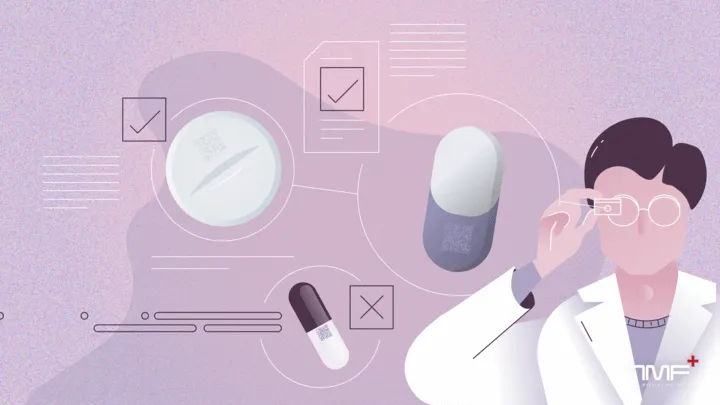
A research team at Purdue University’s Weldon School of Biomedical Engineering came up with an idea to make this possible. The solution is very similar to paper watermarks used on bills. It is especially ingenious as it only requires one tool practically every individual has on this planet: a mobile phone.
“We are affixing a watermark on an individual medicine that is readable by a smartphone camera to extract a hidden digital key,” Young Kim, associate head for research explains. This cyber-physical watermark is printed on specialised fluorescent silk with FDA-approved food dye through an inkjet printer. A common technique bakers use for placing edible photos on cakes.
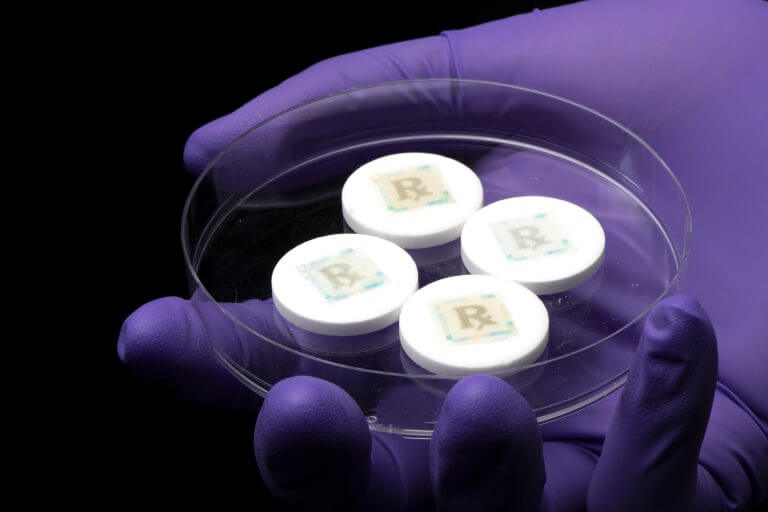
Why silk? It’s all protein, can be edible, and engineers have the ability to change the biopolymer’s shape, structure, and flexibility. This is a solution without using any synthetic or artificial materials, and fluorescent silk makes a counterfeiter very difficult to duplicate the watermark – the team says.
The engineers also addressed how to use the technology with different smartphone models, photo quality, and light. “The reference colours on the watermark’s periphery allow us to know the true colour value of the watermarked image as each smartphone has different spectral sensitivity.” – Kim added.
The watermarks are fixed on pills with sugar glue. The smallest size the team could produce is 5x 5 millimetres. With this solution, every customer could check every pill, and will not only be advised on its genuinity, but also on dosage and general information about the given drug.