Where Is Digital Health Heading In Denmark?
After reading the Danish digital health strategy, one of the most forward-looking examples of a government-supported objective to adjust the medical arena to the 21st century, we looked around what real-life projects aim to transform patients’ and doctors’ lives for the better in the Scandinavian country. Our findings are thrilling: the newly established Danish National Genome Center strives to have at least 60,000 whole-genome sequenced in the next 5 years, while the Copenhagen Healthtech Cluster wants to set up a network of data registers updated so fast that it might enable helping doctors real-time – perhaps even in the OR.

Dr. Bertalan Mesko, PhD
7 February 2019

|
THIS ARTICLE HAS NOT BEEN UPDATED SINCE 2019. THE INFORMATION SHARED IN THE ARTICLE WAS ACCURATE AT THE TIME OF ITS PUBLICATION, BUT IT MAY BE OUT OF DATE NOW. BROWSE OUR LATEST ARTICLES HERE |
After reading the Danish digital health strategy, one of the most forward-looking examples of a government-supported objective to adjust the medical arena to the 21st century, we looked around what real-life projects aim to transform patients’ and doctors’ lives for the better in the Scandinavian country. Our findings are thrilling: the newly established Danish National Genome Center strives to have at least 60,000 whole-genome sequenced in the next 5 years, while the Copenhagen Healthtech Cluster wants to set up a network of data registers updated so fast that it might enable helping doctors real-time – perhaps even in the OR.
With robust data systems towards integration
The third happiest country in the universe has one of the most advanced digital health systems alongside an elaborated and concise national digital health strategy for the next four years. The document emphasizes the importance of the cooperation of each and every healthcare actor through the easiest and fastest way, technology, with a clear purpose: to build an integrated network focusing on patients and looking at the person as a whole, not just at the individual diagnosis.
Why is it so crucial for Denmark to build an integrated network? The Nordic countries as excellent examples of the social welfare state have been providing a social safety net to their citizens based on their data for decades – so they have been front-runners in the collection of information on births, deaths, disease and its control through the centralized state. For example, information on causes of death has been collected since 1875, and cancer incidence has been registered for the whole country since 1943. The Danish National Patient Registry has been keeping records that date 30-40 years back, making it one of the oldest nationwide hospital registries in the world. Henning Langberg, Director of the Copenhagen Healthtech Cluster said that digitalized Danish health data is incredibly rich: crosses various fields, encompasses different periods and enmeshes every social stratum – practically about more than 5.5 million people.
At the dawn of the digital age, one would think that you just open the “data taps” and information will just flow freely and without hitches. However, every city, municipality, Danish region (an administrative unit below the state but above the settlements) and even hospital usually has its own solution, and one of the most difficult things is to apply innovations across regions. Tobias Boggild-Damkvist, who has been suffering from Type 1 Diabetes since his teenage years and struggling with the management of Multiple Sclerosis, told The Medical Futurist that he has been developing medical devices that empower people with diabetes to manage injections – as a person with diabetes has to inject 5-6 times a day, but can’t “use” the same spot twice in a row, the device helps “remember” injection spots. Some of his challenges are to include the specific data into the healthcare records as well as to scale up the solutions across regions or just across different hospitals. “Each and every device is locked in its own universe, so it’s a struggle to get the data from different places – it would be much easier to have them at one place,” he explained.
The digital is spilling over into healthcare
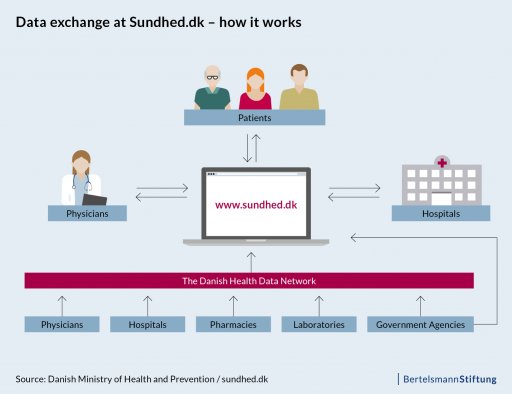
In the Danish healthcare system all residents are entitled to public healthcare benefits, have free and equal access to general and specialized practitioner services, and digitization is at a high level. Everyone gets access to the Sundhed.dk patient portal, which allows any patient to access their own health data, make appointments with the doctors or look up their complete patient history. But that’s only one type of data registry: medical professionals, researchers or institutions get access to a wide range of clinical databases, biobanks, lab- or imaging systems – with high-quality data.
There are numerous efforts to leverage on all these digital bits and pieces, as well as the digital infrastructure. Looking for online solutions based on data could be especially useful for chronic patients to cut back on frequent visits to hospitals for monitoring. For example, in Velje Hospital in Southern Denmark, doctors conducted a study for self-testing. Some patients receiving anticoagulation treatment were asked to do self-testing with an appropriate device once a week and report back on the indicated online channel. They didn’t have to go to the hospital, have the stress of waiting for the physician, do the testing and travel back home. So far 24 patients have completed the one-year weekly self-testing and reporting. It turned out that their results improved by 8 percent compared to the usual monitoring method with hospital measurements. Although as Tobias Boggild-Damkvist remarks, some people want to go to the doctor, and others, especially the older generation, are more reluctant to use technologies, the basic expectation from families and patients is that what you get from consumer electronics, will slowly spill over into healthcare.
Using incredible piles of medical data for good
At the same time, the Copenhagen Healthtech Cluster aims to connect the dots: researchers with appropriate datasets, pharma companies with the Danish regions, for example, to find out more about the side-effects of drugs or hospitals with the state, for example, to be able to update the way individual patients are treated. The horizon of possibilities is as vast as the selection for public registers – and that’s exactly what the publicly funded organization aims to mine. Currently, they are setting up their framework so that private businesses, research institutions, and individual researchers could get access from the state to look into public registers and specialized datasets for specific purposes.
According to Langberg, their overall aim is to establish a close collaboration between companies and the healthcare sector so that they can come up with fresh, out-of-the-box solutions for pressing issues. And there’s no shortage of that. As everywhere else in the developed world, the number of the elderly and of the people with chronic diseases is rapidly growing – which requires fast responses. Connecting the right data with the right researchers might result in fruitful health projects within the next 3-5 years – and later on, possibly new drugs, new treatment methods, and more efficient hospitals.

The Danish National Genome Center, precision medicine and getting smarter day by day
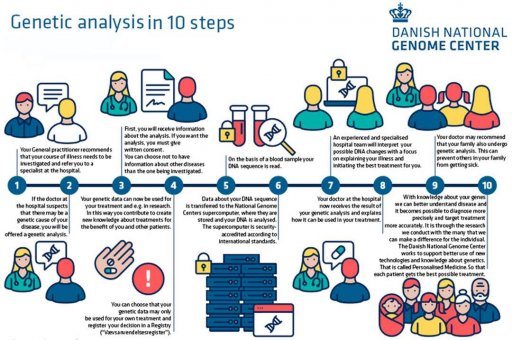
Another area where Denmark invests in heavily is genomics-powered precision medicine – and things are moving fast. The Danish parliament adopted the law to establish the National Genome Center last May, and Peter Longreen, CTO told The Medical Futurist that they expect to build up their dedicated supercomputing infrastructure until this May, then begin large-scale whole-genome sequencing and build up their accompanying genome database around July.
He believes that within the next five years, they will at least do 60,000 whole-genome sequences, but that’s his lowest estimation. “In honesty, I think we will do much much more. I think we’ll do several hundred thousands of these sequences. So, in five years, we’ll have a very rich genome database, some very enriched knowledge databases, and also databases with secondary data,” Longreen explained.
However, it’s not like direct-to-consumer genetic or genomic testing where you order a spit kit and look up your results online within a couple of weeks. Gert Sorensen, CEO of the Danish National Genome Center said that the patient pathway would look like the following: when you go to your family doctor, he refers you to the hospital, and you come to the point where the hospital finds out that there could be a genetic cause for your disease. Then, the doctor would offer you to have a genetic analysis done.
Nevertheless, these vast amounts of genomic data could significantly change the course of healthcare. The ability to do more precise diagnostics, to be able to stratify the population or to prescribe individualized drug cocktails will shift the way towards targeted treatments, personalization – effectively, towards new methods of healing. And Longreen says we don’t even know what else we might find: “this is a domain that’s constantly evolving, so we will also see the design of databases derived from treatments based on genomic information in the clinic. We should anticipate a system where we constantly get smarter and smarter”.
The devil’s name is: data privacy and data security
On the other hand, one of the biggest pain points for both the Danish Healthtech Cluster and the Danish National Genome Center is to secure sensitive patient data in the best possible way.
It seems that Denmark has started to build up a model where the state is entrusted with the guarding of medical big data – instead of private companies. As in Denmark citizens have the highest levels of trust in the government as well as in other people in general, it’s not a surprise that they would rather entrust their sensitive data with the state rather than private companies.
In the U.S., a highly individualistic and entrepreneurial society, where the state has traditionally a much lesser role, the idea might sound odd at first. In Central and Eastern Europe, where the state has not such a good reputation, giving such sensitive data to the state might not even happen (voluntarily), and it would also easily raise some eyebrows in other parts of the world. But with the appropriate checks and balances put in place, the Danish model could work well – especially in light of the recent data breaches of huge tech companies – and the institutions seen so far are doing their best to prove it.
The Danish National Genome Center has been working on a security model where people who are granted access to sensitive patient data would not be allowed to download, copy or remove data from the genome database, where one patient’s genetic analysis is only available in one copy. Beyond that, anyone who wants to carry out a research project has to receive approval from the National Scientific Ethics Committee.
The situation of the Danish Healthtech Cluster is a bit more complicated as they are collaborating with private companies. For the organization, the challenge is not only to build up technical solutions to encrypt data in the most secure way possible but also to make sure patients trust them enough that their data will only be used for purposes that they would like them to be used for, explained Langberg. He added that “we don’t expect people to be willing to give access to their private data to private companies, but I think the way that companies should get access to data is through collaboration with the public health authorities and health system.” That’s what they are working on considering even some options around artificial intelligence to protect patient data as best as possible. So, in a couple of years, patients will have the chance to know that the most advanced technical solutions guard both their genomic and their general patient data.
All-in-all, to respond to the original question, it seems to us that Denmark is heading towards the direction stated in the digital health strategy – at least when looking at efforts in precision medicine and the management of patient data.
It’s in the process of building up an integrated digital health framework focusing on patients and guarding their data against any security or privacy issues. Tobias Boggild-Damkvist said in a somewhat sarcastic tone that instead of the healthcare system “trying to kill you in new and exciting ways,” if you dream 20 years down the road, you hope you will be able to use all your personal data for the good of your children and grandchildren. That seems to be the general direction for Denmark at the moment. It might change in the long run, but all-in-all, we hope for that, too.
|
At The Medical Futurist, we are building a community for making a bold vision about the future of healthcare reality today. If you’d like to support this mission, we invite you to join The Medical Futurist Patreon Community. A community of empowered patients, future-oriented healthcare professionals, concerned health policymakers, sensible health tech developers, and enthusiastic medical students. If there were ever a time to join us, it is now. Every contribution, however big or small, powers our research and sustains our future. Click here to support The Medical Futurist from as little as $3 – it only takes a minute. Thank you. |