COVID-19 In 2022 – An Unexpected Reality
Last April, at the top of lockdowns and the pandemic we forecasted When And How COVID-9 Will End. Within these projections, we looked at how […]

Dr. Bertalan Mesko, PhD
7 October 2021

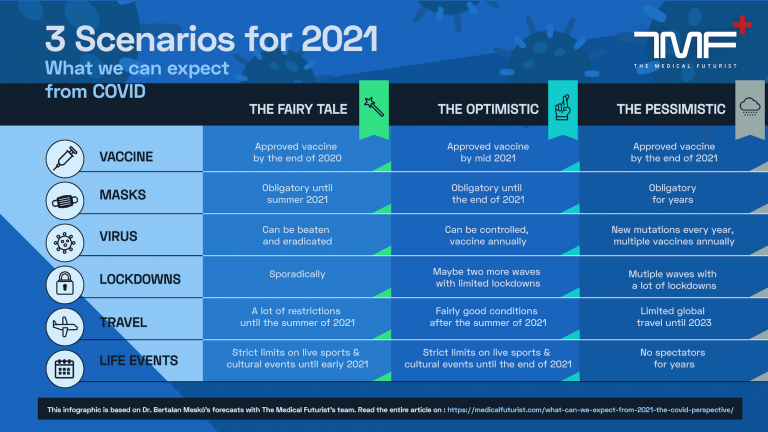
Last April, at the top of lockdowns and the pandemic we forecasted When And How COVID-9 Will End. Within these projections, we looked at how the pandemic can unfold – and when we could finally declare it’s over. Among the 3 scenarios we projected for 2021 last October, the most optimistic seemed the most unlikely (hence its name, the fairy-tale scenario), and everyone hoped for the second. At that time, wearing masks in 2022 did not seem likely – at all.
And still, here we are, heading towards a pessimistic scenario, living a future we should not have – let’s see how that is possible and where we are at.
Waves 3, 4, and beyond
On average, the latest global vaccination rate is more than 34 million doses per day. At this pace, it would take another 6 months to cover 75% of the world’s population. And that’s still not close to the number required for herd immunity. As the variants are becoming the dominant strain of the virus all over the world, the question is obvious – will we be able to stop it before it mutates outside the range of the existing vaccines?
As one Canadian study shows, the virus is becoming smarter. The risk of hospitalisation from the Delta variant is up to 108 percent higher among the unvaccinated according to researchers, who worry about the upcoming holidays and family gatherings. Scientists urge people to take up the jabs and stay safe – and, as kids under 12 have no vaccine yet, save the children around them, too.
Houston, we have an unvaccinated problem
Out of all the infected, those who have severe or fatal sickness are mostly the unvaccinated. However, it also seems clear that while the vaccine blunts the effects of COVID, the Delta variant proved to be extraordinarily transmissible, and capable of circumventing lower levels of immunity. This also testifies to the fact that – at least for the Pfizer vaccine – immunity decreases with time.
Initially, two doses of Pfizer’s vaccine provided more than 95% protection against infection. But in a new report from Israel’s Health Ministry, with time, that number has fallen to just 64%. However, I can’t emphasize enough that the same report shows that even if you are being infected, the vaccine remained 93% effective in preventing hospitalisation and serious illness.
To boost or not to boost?
It is hard to tell which country handled the pandemic well. New Zealand, a country with a still-lasting lockdown and with a total of 27 deaths where it’ll take years(!) for the virus to pass through the population; or Sweden, without a single day of quarantine but with almost 15 thousand deceased, where society questions why the government did not protect the inhabitants sufficiently.
Israel emerged as the frontrunner of COVID vaccinations worldwide. The country was in the vaccination elite until quite recently. However, when Delta hit, health officials had to realise that reaching herd immunity is more complex in the case of COVID-19 than originally thought. They were quick to realise that they need to start administering booster shots – just like Germany or Canada did. Mixing the vaccines is not recommended by the CDC, however, the countries above follow that suit.
What is certain: vaccination is a communication failure
As we head into the fall, I expect a lot of new cases among the unvaccinated, we’ll see masks and social distancing coming back in a big way, with a new race to get the booster shots out there. I believe we’ll see country leaders getting tougher on those who refuse to get vaccinated; but I don’t expect full-blown lockdowns as we had before.
So far over 220 million people have contracted COVID-19. Still, there is a huge number of unvaccinated people who refuse science, “know it best” and would not allow themselves to be vaccinated – but accept a drug for horses as a treatment instead. Insta-influencers and podcasters seem to know more about the science behind the pandemic than epidemiologists, and Antony Fauci needs to publicly respond to celebs’ comments about whether the vaccine could cause reproductive issues. Therefore we can easily say science and medicine have failed in communication.
Yes, we can challenge science. I understand the doubt of people regarding innovation – the history of humanity is full of challenging thoughts when they first arise (remember Giordano Bruno?). But the way our society now challenges science based on naysay rather than facts opens Pandora’s box and gives a dangerous precedent.
Personally, I have received death threats and tons of vicious comments for my videos where I encouraged people to get the jabs. But not everything is a conspiracy. We can’t bully our way to herd immunity. Not everyone has an agenda. Or if so, our agenda at The Medical Futurist is to get to the end of this nightmare, and for all of us to be able to go back to our normal lives.
Will we have COVID in 2022?
This pandemic won’t end overnight. While day by day we are getting to a better place, with time this whole thing is just going to be immensely more complicated. New strains, a booster shot, and combined vaccines – that bring the flu and the COVID jabs into a single dose – are all on the horizon. We need to learn to put our faith in the hands of scientists because they are the ones who can help us responsibly navigate this complex landscape.
In the age of misinformation, we’re facing the most pessimistic scenario.
COVID is going to stay with us for a while. Science has done its part and it’s going to keep doing it, and we can find solace every day as we look around and see how much progress we’ve made since last year. And, hopefully, at the end of this long fight, we’ll be able to learn the right lessons, and when the next crisis comes, we’ll be more ready.