China Is Building The Ultimate Technological Health Paradise. Or Is It?
How could a country keep around 1.4 billion people healthy when the system struggles with corruption, lack of resources and an aging population? China, the emerging giant with a strong central leadership fostering technology and innovation, places its bets on artificial intelligence, telemedicine, cloud-based hospitals, and WeChat. While that could sound like an ultimate technological paradise, the question is, what are they going to do with the vast amount of data or to what interests are they going to leverage their state of the art A.I. systems? Generally, how will we speak about digital health in China: a healthcare dystopia or a system in the service of the greater good?
THIS ARTICLE HAS NOT BEEN UPDATED SINCE 2019. THE INFORMATION SHARED IN THE ARTICLE WAS ACCURATE AT THE TIME OF ITS PUBLICATION, BUT IT MAY BE OUT OF DATE NOW. BROWSE OUR LATEST ARTICLES HERE
How could a country keep around 1.4 billion
people healthy when the system struggles with corruption, lack of resources and
an aging population? China, the emerging giant with a strong central leadership
fostering technology and innovation, places its bets on artificial
intelligence, telemedicine, cloud-based hospitals, and WeChat. While that could sound like
an ultimate technological paradise, the question is, what are they going to do
with the vast amount of data or to what interests are they going to leverage
their state of the art A.I. systems? Generally, how will we speak about digital
health in China: a healthcare dystopia or a system in the service of the greater good?
The Chinese healthcare landscape is ripe…
The most populous
country on Earth has 1.4 billion inhabitants, and it’s almost as huge as the entire European continent. Already
the sheer size of China makes it practically
impossible to summarize its healthcare system, not to speak about the fact that
numbers about almost everything stemming
from the National Bureau of Statistics have to be treated with caution. Thus, while the People’s Daily, the official newspaper of the Central Committee of
the Communist Party says that by the end of 2016, the basic medical insurance has reached over 1.3
billion citizens nationwide, accounting for more than 95 percent of the total
population,
that should not necessarily be taken at face value. Alongside with sentences
that after the country launched the latest healthcare reform in 2016 to create
a unified basic health insurance system
which results in more equal access for
urban and rural residents.
In spite of the
inaccurate statistics, the trends show that the central leadership under Xi
Jinping concentrates a lot more on this area lately, most likely driven by
increased healthcare demand. That could have numerous explanations, but it could
mostly be traced back to the effects of the massive economic growth on China’s
middle class. As economic drives lure more and more Chinese into the cities, who are
spending their money more than ever before, so urbanization and rapidly
increasing consumer wealth if you want, “lifestyle diseases” started to take a heavier toll. What’s more, Beijing’s
legendary one-child policy began to backfire:
while it helped slow down population growth, it heavily shifted the country
towards an aging society – with all its health-related troubles.
Source: www.thebeijinger.com
… for technological disruption
However, these only
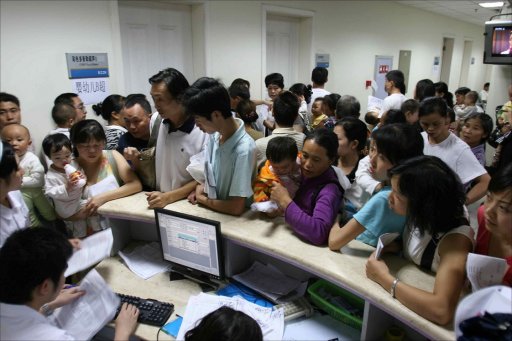
come on top of an already strained healthcare system. China’s primary care
system is mainly underused due to the poor
distribution of resources and lack of quality general practitioners, leaving
hospitals to bear the brunt of treating patients.
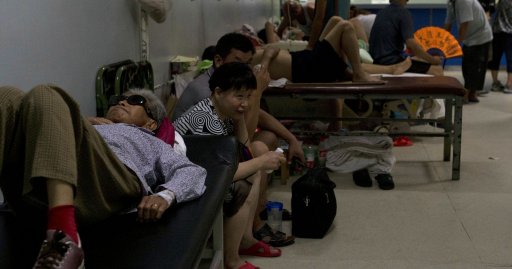
Moreover, huge disparities exist between rural and urban
care facilities. Thus it often happens
that patients from the countryside rather
travel long hours to get into a better hospital in Beijing or Shanghai than let
themselves be treated at home. China also
doesn’t have enough doctors: While the OECD average is 3.19 doctors for every 1,000 people, China only has 2.22
doctors and assisting physicians for every 1,000
people. That practically means that large rural territories with millions of people
are without access to proper care, and people have to wait long hours to be
able to get to the doctor.
Not to speak about corruption at every level of medical services: although universal coverage ensures some level of care, better doctors demand some special fees for treatment. It’s also common for physicians to order excess drugs – as part of a money-making scheme played out with pharma companies. Although that changed lately with the introduction of a two-invoices system for pharma distribution nationwide last year, doctors are living hard times – and not only because they are overworked and underpaid. Over the previous years, patient-on-doctor violence has become startlingly common, mostly when treatments fail. Stabbings and mob-style attacks have risen 23 percent a year on average since 2002, according to the China Hospital Management Association. This situation is a huge mental burden for doctors with an average of an incident every two weeks! No wonder the central government decided to step in.
Source: www.usatoday.com
The promise of technologies in the Middle Kingdom
While massive technological
development has taken place in China starting from the 1990s, the truly
transformative change only came with the realization of the central leadership
about the significance of innovation. As in the
communist country everything has a top-down approach, and nothing can operate
without the oversight of the Party – just think about Google’s ill-fated Dragonfly
project, a censored search engine for the Chinese market -, the
boost in R&D is due to the prominence of the area in the current thirteenth
five-year plan (2016) and other longer-term government programs, such as China’s National
Medium- and Long-Term Program for Science and Technology Development, introduced in 2006. That’s an ambitious
plan to transform the Chinese economy into a major center of innovation by the
year 2020 and to make it the global leader in science and innovation by 2050.
But Beijing does not waste its time: it already challenges the US in the
supercomputer arms race, became
a leader in quantum research and creates its own successful space programs.
The
drive in technology started to conquer every area of life and made it also possible to start the digital health
revolution. First, there’s the appearance of the Internet and the rise of the “Big Three” or Baidu, Alibaba
and Tencent, the BAT. The first
one, Baidu, is basically the Chinese Google, Alibaba sells everything similarly
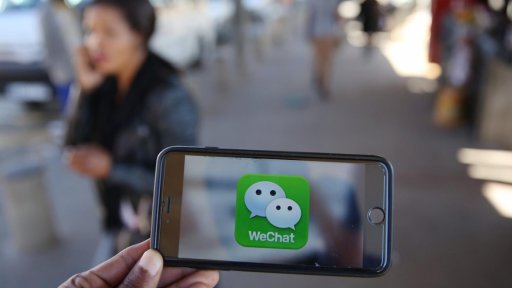
to Amazon, while Tencent introduced the WeChat messaging app in 2011, which has
902 million daily users and about 38
billion messages are sent on the platform every day. Technological solutions
not only enable Chinese citizens easier communication, shopping or banking, but
they spill over to healthcare, too. Three solutions especially stand out as
showing the way forward in the Chinese medical arena. Chatbots, artificial
intelligence, and telemedicine.
Source: www.ft.com
Say Hi
to Doctor WeChat
Although the messaging platform is often compared to Facebook, it offers much more than its Western counterpart – but comes with the baggage that the Chinese government has complete oversight over it. Of course, that also means that the central leadership lets it operate – which you cannot say about all the other, mainly Western messaging platforms: it has censored Facebook Messenger since 2009, blocked the South Korean-owned Line app in 2015, and banned WhatsApp last year.
Thus, WeChat
has an ambition and an open door to
become a one-stop solution for all kinds
of consumer needs in mainland China. Now, it is even poised to take
on an even greater role: an initiative is underway to integrate WeChat with
China’s electronic ID system. WeChat will issue virtual ID cards which individuals
would use instead of physical
state-issued ID cards. Since WeChat requires users to register with their real
names per
government policy, it’s not a stretch to imagine
that one day, WeChat may entirely replace
state IDs – or even medical health records? The Medical Futurist imagines that similarly to Apple, the Chinese WeChat could connect patients’ complete
medical health records to patient’s phones.
Tencent has already been steadily building up a
network of participating hospitals – over 38,000
medical facilities as of 2017 – where users can book doctor’s appointments
through their WeChat Intelligent Healthcare to avoid long lines at medical
facilities. Following their health checkup, patients can also conveniently
access their medical reports through WeChat and pay for their medical bills.
Also, in a push for healthy living, the app’s step count function can be linked to WeSure. Users who reach
over 8,000 steps in a day will receive a hongbao
from WeSure that can be deposited in their WeChat wallets.
From here, it’s only one step further to give full
access to medical health records. And what’s even further down the line? We believe it’s chatbots! As technological
innovation allows it, chatbots could
take the burden off the shoulders of primary care physicians and support the diagnosis of patients with simpler medical
problems. In such a resource-strained country like
China that could mean a viable solution.
Source: www.qz.com
One-Minute
Clinics and cloud hospitals
Chatbots could only aid and not replace physicians, so they cannot completely solve the problems within Chinese primary care. But what if we couple solutions with telemedicine? Experts believe that the integration between telemedicine, online prescription sales, online scheduling of follow-up diagnostic or specialty physician appointments, and electronic medical records could be a game-changer for China’s healthcare system. The central leadership also recognized that and has started pushing for a national telemedicine network. Above all, in April 2018, the state council of the People’s Republic of China has communicated the Internet Plus Healthcare initiative, which allows medical institutions to provide online diagnostics for specific diseases and other services.
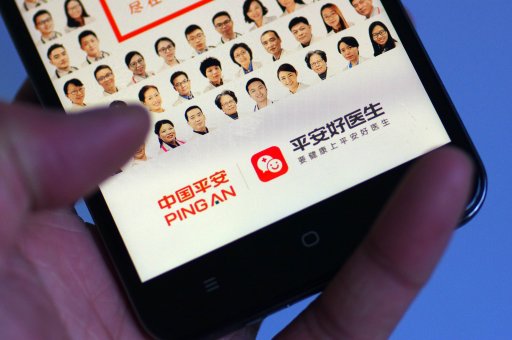
Moreover, one of China’s major insurers, Ping An Insurance (the name literally meaning safe and well) is already pushing for a national telemedicine network. They’re offering a simple app to order non-prescription medicine and personal care products online. Users only need to complete a quick, AI-driven questionnaire for the app to determine their health needs, after which the products will be delivered to their home or office within just an hour. Another example is SUNPA, which has built four Telemedicine centers in China in cooperation with public institutes. The network covers eight provinces and municipalities with a total population of over 200 million.
But the Middle Kingdom is not only building networks, but also cloud-based hospitals. The first one was launched four years ago in Ningbo. The hospital is equipped with cutting-edge cloud technology and connects 100 primary care institutions, 226 specialists and care providers. It also installed four cloud-based “Diagnostic Rooms” for hypertension, diabetes, psychological consultation, and primary care, enabling patients to access these services from the comfort of their home.
And as the latest example already combining artificial intelligence and telemedicine, last year, Ping An’s Good Doctor project, a one-stop healthcare ecosystem platform, piloted unstaffed clinics that employ artificial intelligence called “One-minute Clinics” near Shanghai, which connect patients with a clinician on Ping An Good Doctor’s in-house medical team. In January, the company announced that it had placed its One-minute Clinics across 8 provinces and cities in China and signed service contracts for nearly 1,000 units, providing healthcare services to more than 3 million users.
Source: www.financeasia.com
Building the artificial
intelligence … paradise?
Of course, the ultimate tool in the Chinese government’s pocket is artificial intelligence, the potential game-changer in healthcare (just as in almost every other industry). As we could see, China is poised to become the undisputed global leader in technology – apparently, with A.I. in the lead. Amy Webb, adjunct assistant professor at New York University, pointed out in Davos that only nine companies control the future of A.I. – six American ones (Alphabet, Microsoft, Amazon, IBM, Apple, and Facebook) and the Chinese BAT. The latter three companies also invest in 53 percent of the nation’s 190 major A.I. companies.
The industry started to skyrocket mainly due to three factors: an abundance of data, plenty of financial resources and lax views on privacy. There’s no question about the first and the second in the country of 1.3 billion, but how could the Chinese shrug off privacy so easily? In a country where collectivism traditionally has more value over individualism, most of the people seem to have put up with the fact that the central leadership has oversight on their lives – even in the most intrusive ways – and trust is replaced by technology. Remember the Chinese social credit system? When you walk on the streets of Shanghai or Beijing, you are watched over by thousands of CCTV cameras. If you are jaywalking on the road, you can get a fine to your WeChat app in seconds. On the other hand, cameras and smart algorithms constantly analyzing footage promise a particular type of security and order. Aims that also fall in line with the Chinese government’s goals.
Thus, these three factors make China an A.I.
paradise with more projects than there are grains of sand on the world’s
beaches. Of course, healthcare is a big chunk of it.
Source: www.quartz.com
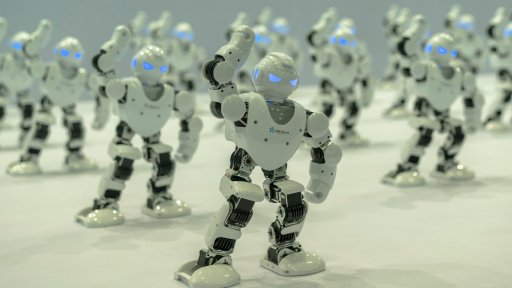
Tencent’s medical A.I. and robots learning how to doctor
There’s no question about the need for A.I. in China to help solve
the shortage of medical staff and improve the accuracy
of average outcomes. Deep learning algorithms trained through the data of billions can analyze medical outputs like CT
and MRI images with a close to 100% accuracy. An A.I. like that might even
solve how to cure diseases like cancer, or Alzheimer’s in the future. This promise
has led to the fact that over
130 companies are working on projects on how to apply A.I. in China’s
healthcare sector.
For example, in November 2017, the Chinese
government announced plans to
build national A.I. innovation platforms with four partnering companies. Tencent is one of them. The company established the A.I.
Medical Innovation System or AIMIS, an A.I.-powered diagnostic medical imaging service – so
far in over 10 hospitals across the country. The method works as the following:
images
of patient tissue are fed into the A.I. software,
which can then determine in under four seconds whether the body looks normal, inflamed or cancerous. AIMIS currently offers
90 percent accuracy for diagnoses of
esophageal cancer, 95 percent for lung
sarcoidosis and 97 percent for diabetic
retinopathy. Such technological aids are a massive
help to overworked doctors in providing patients with correct diagnoses.
Another spectacular example of the capabilities
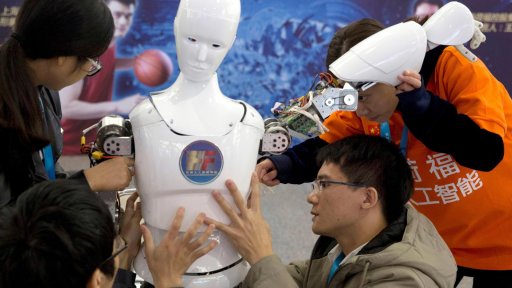
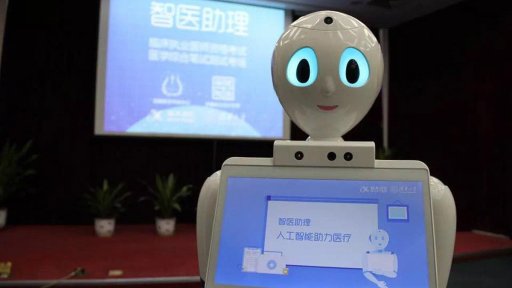
of A.I. was when in 2017, a robot named
Xiaoyi (meaning little doctor) passed the written
stage of China’s national medical licensing examination. During the “learning
period”, it sifted through dozens of
medical textbooks, more than 2 million medical records, and 400,000 articles in
a bid to learn how to ‘doctor’. In the
end, Xiaoyi pulled off a
stunning 456 points – 96 points above a passing
grade. The score is believed to be a testament to the robot’s ability to learn,
reason, and make judgments by itself. Its creators think that it could capture
and analyze patient information and help make an initial diagnosis. Thus, it doesn’t aim to replace doctors – only
to lift the burden off the shoulders of physicians.
Source: www.elperiodico.com
Where
do you go, dear China?
As you can see, China has slowly, but strategically built up their system over the past twenty years, to be an absolute technological superpower of the future. The only question is, how they are going to use it. What are they going to do with all this data, and how are they going to leverage their state-of-the-art A.I. systems? Are they going to keep going down the road that started with the social credit system? Are they going to build a healthcare dystopia, where they can use people’s health against them? Or are they going to turn it into the service of a greater good?
It is incredible how Janus-faced China is: on
the one hand, we could think about the country as a “developer’s paradise” as
the strong governmental boost allows every digital health innovation to be
tested and implemented upon success. There’s even very little resistance as the
healthcare system is an entirely
state-funded, public system and even data privacy concerns are very low. So, in
a technical sense, they could develop solutions about which Western companies
and countries are only dreaming.
However, the other side of the
story is that due to not involving stakeholders of healthcare into the
decision-making processes and building up the ecosystem, they can bring into
effect even the most dreadful, Black Mirror-like dystopias. Systems that abuse
the health of individuals when the interest of the central leadership requires
it, a credit system that not only awards/punishes social performance through
fines but also through access to health services, and infrastructure that
punishes unhealthy behavior or genetic risks.
The odds are high, and the world is watching argus-eyed. What do you choose, dear China? The red or the blue pill?
At The Medical Futurist, we are building a community for making a bold vision about the future of healthcare reality today.
If you’d like to support this mission, we invite you to join The Medical Futurist Patreon Community. A community of empowered patients, future-oriented healthcare professionals, concerned health policymakers, sensible health tech developers, and enthusiastic medical students. If there were ever a time to join us, it is now. Every contribution, however big or small, powers our research and sustains our future.