5 Digital Health Areas To Be Impacted By The FDA Layoffs
In the early days of Facebook, the company’s progress was guided by the “move fast and break things” principle. To a certain extent, this was […]

Pranavsingh Dhunnoo
14 March 2025
Key Takeaways
Recently, the US Food and Drug Administration (FDA) experienced widespread layoffs in key departments overseeing the safety of digital health technologies.
We consider 5 digital health areas that could be the most impacted by such restructuring.
The events also raise an air of uncertainty about the FDA’s leading role in regulating the medical space and encouraging innovation; raising the question of whether other agencies could take up its role.
In the early days of Facebook, the company’s progress was guided by the “move fast and break things” principle. To a certain extent, this was the motto across the tech industry to put products on the market. This principle emphasized the benefit of speed and experimentation, often with mistakes and disruption in relation to regulations and traditional practices, over a slow and cautious pace.
With tech moguls now working closely with the second Trump administration, this concept has been adopted at a governmental level in the US. As a result, things are indeed moving fast, and breaking, with thousands of jobs across key agencies have been eliminated. This includes sensitive sectors such as healthcare where the Food and Drug Administration (FDA), the world’s leading regulatory agency, experienced widespread layoffs and scrambling rehires.
As this happened in a matter of weeks of the new administration taking office, it leads to concerns over the FDA’s future; especially in new and rapidly evolving areas such as digital health and healthcare artificial intelligence (AI) which were markedly affected by the layoffs.
As such disruptions might still be on the table over the coming years of this new administration, it is worth considering the emerging digital health sectors that could be the most impacted. Moreover, will another agency take up the FDA’s role as the world’s leading regulatory body in the medical and healthcare space? We consider these aspects in this article.
What’s behind the FDA layoffs?
In February 2025, as part of a cost-cutting approach initiated by the White House and the Department of Government Efficiency, which is led by billionaire Elon Musk, a thousand employees were fired from the FDA. As with other agencies affected by this “move fast, break things” approach, the FDA terminations targeted those in their probationary period, which is usually the first two years of federal employment.
However, this impacted new and rapidly evolving, but important, areas like digital health and healthcare AI, where the agency was building up its capacity for regulation as these areas quickly advanced in the past few years. For example, the job cuts affected 20 employees from the FDA’s Office of Neurological and Physical Medicine devices. This included individuals reviewing Elon Musk’s Neuralink, which was under pressure for alleged animal deaths during testing of its neurotech device.
“These people are indispensable,” a former FDA employee said. “Many of these roles require so much training and specialization and are so important for keeping people alive.” Indeed, the fired employees included physicians and cybersecurity experts responsible for the approval and safety monitoring of products ranging from X-ray machines to surgical implants.
These layoffs were met with significant pushback from medical device industry lobbyists who fund the FDA with millions of dollars annually to hire extra scientists to review products. In fact, about $3.3 billion or approximately half of the FDA’s budget originates from fees paid by drugmakers, device and tobacco companies. As such, the Musk-led cuts won’t be as significant to their aim at reducing the federal budget.
The lobbyists cautioned that the job cuts would lead to slower product approvals and a scarcity of new treatment options for patients. Following their call for reversal, the FDA did move to reinstate a reported 300 people.
Digital health fields that might get impacted by the FDA lay-offs
Despite the rehires, this leaves a vacuum in key areas of FDA’s regulatory oversight – due to the US President’s executive order to limit the rate of future hiring – and a sense of uncertainty amidst the broader medical community. With the new administration only recently taking office, there remains the possibility of a future reduction in the FDA workforce.
The immediate effects of the reduction of the FDA’s work will mean that the agency will take longer to review applications, which will cascade into reduced efficiency and overall oversight. With fewer hires, the agency’s expertise and expansion in emerging healthcare fields will further diminish. We consider some that are more likely to be impacted below.

1. Digital health devices
The majority of the layoffs impacted the FDA’s Center for Devices and Radiological Health (CDRH), with a reported 200 device staff positions made redundant. As such, this could affect the review and regulation of digital health devices such as brain implants, new surgical staplers and insulin-delivery systems. The turnover rate of assessing their safety and subsequent approval is likely to be reduced and new digital health devices will take longer to be available in the US market.
2. Healthcare AI
FDA employees specializing in healthcare AI were hit particularly hard by the terminations. It is estimated that half of that division was laid off. The approval of such new technologies is among the most challenging and complicated; and a reduced workforce overseeing them will face additional challenges in keeping up with the breakneck speed of AI development. It is crucial to ensure the reliability of such tools when AI software such as MRI scan analysers and cancer detection tools are actively being reviewed.
3. Digital therapeutics
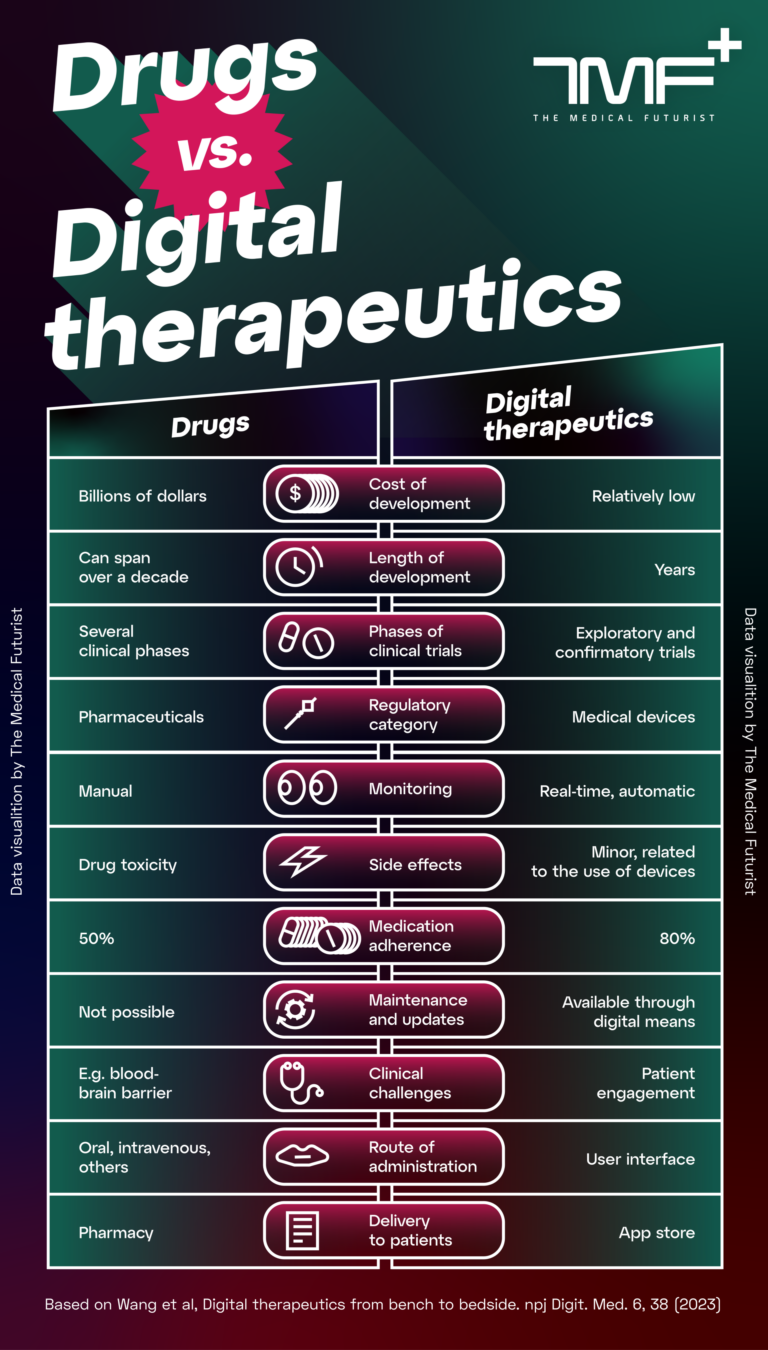
Digital therapeutics (DTx) are an emerging digital health approach which involves the delivery of clinically-backed solutions via software (usually smartphone apps). They can aid in reducing readmission rates and managing chronic conditions more effectively. As a larger number of software are developed and backed by research, the FDA might not have the capacity to regulate this expanding landscape.
4. Software as a Medical Device (SaMD)
Software as a Medical Device (SaMD) is defined by the International Medical Device Regulators Forum (IMDRF) as “software intended to be used for one or more medical purposes that perform these purposes without being part of a hardware medical device”. Examples range from smartphone apps that allow radiological images to be read for diagnostic purposes, to bespoke software that interfaces with medical devices such as a glucose monitor to assess the readings.
With the increasing reliance on companion or even standalone software in the digital health age, the use of SaMD continues to increase. Regulators are expected to assess this increasing volume of software in a timely manner, but restructuring at the FDA might not facilitate this task. This can result in a slower pace of innovation in commercially-available SaMD which might otherwise assist patients and physicians.
5. 3D printing
The FDA’s CDRH also evaluates 3D-printed medical devices to determine safety and effectiveness. 3D printing has been a promising approach in healthcare for decades but their rate of market availability has been stifled by regulatory hurdles. With the CDRH’s reduced capacity, this digital health area is likely to slow down further, preventing widespread access to products such as 3D printed drugs to facilitate medication adherence and 3D printed biomaterials to replace failing organs.
Will another agency take over the FDA’s lead?
The recent layoffs at the FDA do not (hopefully) presage the demise of the agency. Its importance is widely recognized, as reflected by lobbyists who aided towards the rehiring of some employees.
“The disarray caused by the wholesale termination of a wide swath of device centre staff was counterproductive and appears to have caused a variety of unintended and negative results,” said Steve Silverman, a former FDA device official who now runs a consulting firm. “It’s encouraging to see a shift in the opposite direction that recognizes the critical expertise of these staffers.”
However, this state of affairs adds a sense of uncertainty to what has been, so far, considered the world’s leading and most forward-looking regulatory agency in medicine and healthcare. The prevailing notion of potential future layoffs could further make current FDA employees more risk-averse and more cautious about making controversial approval decisions.
As a result, other agencies might take over the FDA’s role in pushing innovations further. The European Union’s European Medicines Agency (EMA), established in 1995, could be an option with its decades of experience and collaboration across member states. However, there remains a fragmentation in individual states regarding access to new therapies.
Such fragmentation might persist, with other agencies such as China’s National Medical Products Administration (NMPA) and the more recent African Medicines Agency (AMA) leading innovation in specific digital health fields, rather than the sector as a whole. This further reflects the uncertainties brought upon by the recent “move fast and break things” principle brought to key agencies like the FDA. As a consequence, it is worth contemplating a future where other agencies take up the mantle of leaders in digital health innovation.
Written by Dr. Bertalan Meskó & Dr. Pranavsingh Dhunnoo